
ADA renovation requirements are the federal rules that decide which parts of a renovation must be made accessible, and which parts stay outside that duty. The analysis uses three separate tests: whether the work is an alteration, whether it affects a primary function area, and whether a path of travel must be improved. A passed building permit is not that analysis. This page explains the tests. It is not a compliance determination for any building.
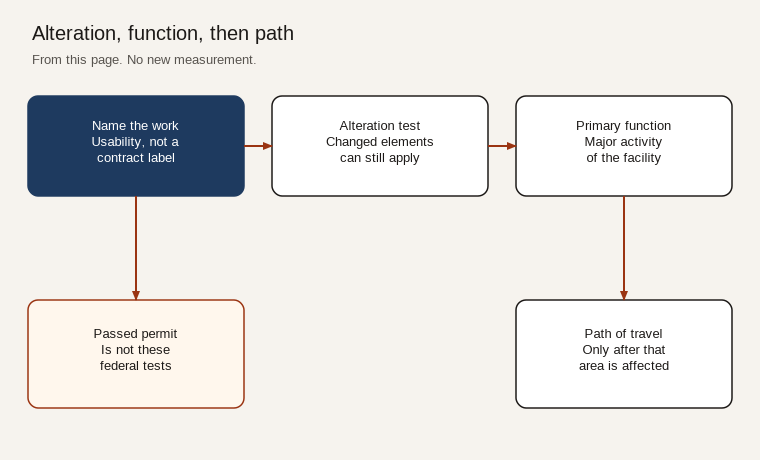
Decide whether the work changes usability, then whether a primary function area is affected, and only then whether a path of travel is implicated, because a passed permit is not that analysis.
Three tests, not one accessibility line
An alteration duty can apply to changed elements even when no path-of-travel duty applies, and a path-of-travel duty can apply while most of the building is untouched. A state or local code can add duties that neither federal test describes.
As of November 2026, the enforceable federal design standards are the 2010 ADA Standards for Accessible Design. They combine Department of Justice regulations with the 2004 ADA Accessibility Guidelines, and the regulation controls where they differ. Public entities, including public school districts, use Title II and 28 CFR 35.151. Places of public accommodation and commercial facilities use Title III and 28 CFR part 36, subpart D. Advisory notes are not themselves enforceable requirements under 28 CFR 35.151(d) and 28 CFR 36.406(b). A qualified professional must assess the actual building.
Test one: whether the work is an alteration
The alteration test asks whether the work changes usability, not whether the contract says “renovation.”
For Title III, 28 CFR 36.402 defines an alteration as a change that affects or could affect usability of the building or facility, or any part of it. Examples include remodeling, renovation, reconstruction, historic restoration, and rearrangement of walls and full-height partitions. Normal maintenance, reroofing, painting or wallpapering, asbestos removal, and mechanical or electrical changes are not alterations unless they affect usability. The Access Board’s alterations guide also treats resurfacing of circulation paths as an alteration, and it treats added thermostats as a usability change because operable parts are covered.
Altered elements must comply to the maximum extent feasible. 28 CFR 36.402(c) uses that phrase when full compliance is virtually impossible. The Access Board guide uses technically infeasible when work would alter an essential load-bearing member, or when other existing constraints prohibit full compliance. What remains feasible is still required, judged against the planned scope. Untouched surfaces stay out. Access may not drop below the new-construction level, and the alteration is not required to exceed it.
For Title III, 28 CFR 36.406 picks the standards edition from the date the last permit application or extension is certified complete, or received if the government does not certify completeness. If no permit is required, the date is the start of physical work. Work on or after March 15, 2012 follows the 2010 Standards. For Title II, 28 CFR 35.151(c) uses the date physical construction or alterations commence, and commencement on or after March 15, 2012 also requires the 2010 Standards. Record which trigger the project is using. Do not copy a private-building elevator exception into a public school without reading the public-entity text. Maryland’s code, below, rejects that exemption for government buildings.
Test two: whether a primary function area is affected
This test asks whether the work affects usability of, or access to, an area containing a major activity the facility is for. Many alterations never reach it.
28 CFR 36.403(b) treats a bank lobby, dining area, meeting rooms, and offices where the entity works as primary-function areas. Mechanical rooms, boiler rooms, supply storage rooms, employee lounges or locker rooms, janitorial closets, entrances, corridors, and restrooms are not. Title II’s 28 CFR 35.151(b)(4) adds that restrooms count only when providing them is a primary purpose, as at a highway rest stop. The Access Board guide also names classrooms, exam rooms, and retail space. Rebuilding a classroom floor can qualify. A corridor, alone, does not.
For the path-of-travel section only, alterations to windows, hardware, controls, electrical outlets, and signage are not deemed to affect usability of or access to a primary function area. That exclusion does not cancel the alteration test. The changed outlet or hardware is still an altered element. The exclusion stops a sign or outlet swap, by itself, from turning on the path-of-travel duty.
Test three: what path of travel is implicated
This test starts only after a primary function area is affected. 28 CFR 36.403(a) and the Title II counterpart require the path of travel to the altered area, plus restrooms, telephones, and drinking fountains serving it, to be accessible to the maximum extent feasible, unless cost and scope are disproportionate. That duty does not replace access inside the altered elements themselves.
A path of travel is a continuous, unobstructed pedestrian way from an exterior approach (sidewalks, streets, and parking) through an entrance to the altered area. It may include walks, curb ramps, clear floor paths, parking access aisles, elevators, and lifts, and, for this section, the restrooms, telephones, and drinking fountains serving the altered area. The Access Board guide carries it to site arrival points. A different wing is not automatic. A serving restroom can be in the package without being the trigger.
28 CFR 36.403(d) says tenant alterations in space only the tenant occupies do not put a path-of-travel duty on the landlord for areas the landlord controls, if those areas are not otherwise altered. 28 CFR 36.201 still covers both parties and lets a lease allocate responsibility between them. Allocation is not a finding that nobody has a duty. Qualified historic facilities still go through the tests. The Access Board guide allows exceptions only where compliance would threaten or destroy historic significance, and Title II then requires an alternative method of access.
The cost limit applies to the path, not the altered room
Disproportionality limits path-of-travel spending. It is not a cap on the altered room, and it is not permission to do nothing.
28 CFR 36.403(f)(1) deems path-of-travel work disproportionate when its cost exceeds 20% of the cost of the alteration to the primary function area. Title II states the same 20% test in 28 CFR 35.151(b)(4). The Access Board guide confines that cap to path-of-travel costs. The denominator is the primary-function alteration, not unrelated roof work or another wing, and not a discount on the classroom or lobby work itself.
Counted path costs include the entrance and route, restrooms, telephones, and moving an inaccessible drinking fountain. If full access would exceed the limit, spend in this order up to the limit: entrance; route to the altered area; at least one restroom for each sex or a single unisex restroom; telephones; drinking fountains; then, when possible, parking, storage, and alarms.
Small alterations on one path may not evade work that could have been one undertaking. If later work on that path follows within three years, total primary-function cost on the path over that period is considered. Title III counts alterations after January 26, 1992. Title II counts alterations on or after March 15, 2011.
A narrow safe harbor covers some older path elements. Title III does not require a retrofit from the 1991 Standards to incremental 2010 changes solely because a primary function area on that path is altered. Title II’s harbor covers elements constructed or altered to the 1991 Standards or the Uniform Federal Accessibility Standards before March 15, 2012. Elements that never met the earlier standard, and the altered room itself, stay outside that harbor.
Other duties are not the renovation tests
28 CFR 36.304 requires a public accommodation to remove barriers where removal is readily achievable, meaning easily accomplishable without much difficulty or expense. Work done only for that duty follows alteration standards for the element changed, but 28 CFR 36.403, including its 20% path test, does not apply. Elements left unaltered since March 15, 2012 that already meet the 1991 Standards have a separate element-by-element harbor that does not cover elements with no 1991 counterpart.
Title II applies path-of-travel rules only to alterations undertaken for purposes other than program accessibility under 28 CFR 35.150. Program access asks whether each service, program, or activity is accessible in its entirety. Citing the path-of-travel cap does not answer that question.
Maryland, Virginia, and the District are not one code
A code approval is not a finding on the three federal tests, and the federal tests do not issue the permit. As of November 2026, these jurisdictions are not on one accessibility code.
Maryland uses COMAR 09.12.53. The Department of Labor states that the 2010 ADA Standards are part of that code, effective January 1, 2012, alongside Fair Housing guidelines and state-specific requirements localities may not weaken. COMAR 09.12.53.07, read on November 22, 2026, is not the federal path-of-travel cost limit described above. For government buildings it still describes a choice between the Uniform Federal Accessibility Standards and the 2010 Standards, and it rejects the 2010 elevator exemption. Federal 28 CFR 35.151(c) requires the 2010 Standards when work commences on or after March 15, 2012. Do not treat the older choice as permission to ignore that date. For other buildings, the section reaches private clubs and religious organizations and adds Maryland requirements. Whether Title III covers a given club or religious entity is a separate question.
The same Maryland section sets second-story rules. New construction must reach the second story of a two-story nonresidential building when that story exceeds 4,000 square feet. In an alteration, existing access is maintained when the story is between 4,000 square feet and 8,000 square feet, and access must be assured above 8,000 square feet. Parking-sign and stall dimensions are in that section; do not take them from this summary. Multifamily housing there follows fair-housing rules, not a classroom path-of-travel analysis.
Virginia uses the Uniform Statewide Building Code: the Virginia Construction Code, the Virginia Existing Building Code, and the Virginia Maintenance Code. The state board adopts it. Local building inspections departments enforce it. The 2021 codes took effect on January 18, 2024. That is not a reprint of 28 CFR 36.403.
The District’s 2017 Construction Codes, effective May 29, 2020, are the 2015 International Code Council family as amended in Title 12 of the District of Columbia Municipal Regulations, including an existing-building code and section 123 transition rules. The code-development page, read on November 22, 2026, estimates a later set for late 2027. Until that edition controls the application, use the edition on the permit. Do not borrow Maryland’s floor-area rule or a Virginia chapter for District work.
An illustrative classroom and tenant suite
This walk-through is illustrative. It is not a Soleil Energy project, not a survey, and not a compliance determination.
A public middle school replaces the floor, teaching wall, and fixed casework in one science classroom. Title II applies. Test one reaches those changed elements. Test two is met because the Access Board guide treats a classroom as a primary function area. Test three is separate: trace parking and the public sidewalk through an entrance to that room, including restrooms, telephones, and drinking fountains that serve it. The disproportionality limit may cap path cost. It does not limit the altered classroom, and it does not decide program access for unaltered rooms.
An office tenant that renovates only its suite does not, under 28 CFR 36.403(d), put a path-of-travel duty on the landlord for unaltered areas the landlord controls. The tenant can still owe an alteration duty in the suite, and 28 CFR 36.201 still covers both parties.
What to close before the price is set
| Question to close | What changes if the answer changes |
|---|---|
| Which federal title applies? | Dates, elevators, and program access differ. |
| Which rooms are primary function areas? | Only those rooms turn on path of travel. |
| Is the work only hardware, controls, outlets, or signage? | Those items skip the path trigger, not the alteration test. |
| What did primary-function work on that path cost over three years? | That record is the disproportionality denominator. |
| Which code edition will this permit use? | Maryland, Virginia, and the District do not share one text. |
Name any structural member, site limit, or plumbing or egress conflict against the scope actually planned. Age of the building is not the test. Keep the access that remains feasible in the work.
Questions owners still ask
Does a roof replacement trigger path of travel?
Not from the definition alone. Reroofing is not an alteration unless it affects usability. If the same project also rebuilds an entrance or an occupied floor, that other work can be an alteration and, if it affects a primary function area, can turn on path of travel. Read the roof contract and the interior contract together.
If only a restroom is renovated, must parking access be upgraded?
Altered restroom elements still must comply to the maximum extent feasible. A restroom-only project does not by itself turn on path of travel, unless providing restrooms is a primary purpose of the area. When a classroom is the trigger, restrooms that serve it are inside the path package anyway.
Can the lease leave the landlord with no duty?
A lease may allocate cost under 28 CFR 36.201(b). It does not take a covered party outside Title III. Section 36.403(d) limits the landlord’s path-of-travel duty only when the tenant alone alters its space and the landlord’s areas are not otherwise altered.
Does a passed inspection settle the federal question?
No. Inspection enforces the adopted building code. The three federal tests are Department of Justice rules. They can overlap the code, use a different cost limit, and remain after final inspection. This page is not that conclusion.
Why can the same classroom differ across a few miles?
Maryland adds second-story floor-area rules. Virginia uses its own existing-building code, enforced locally. The District uses its construction codes, with a later edition still unpublished as of November 2026. None of those texts replaces 28 CFR 35.151 or 28 CFR 36.402 and 36.403, and none should be copied across a border.
Bring the building facts into the scope
Soleil Energy’s construction practice plans renovations for commercial, school, and government clients, including phased work in an occupied building. That is a construction scope, not a legal opinion. Name the rooms that will change, whether people stay in the building, which drawings exist, and which office receives the permit. The published service area names Maryland, Northern Virginia, and Washington, DC. An address outside the counties listed there needs a direct check.
Keep three lines separate: elements being altered, any primary function area they affect, and the path of travel from site arrival if the second test is met. Bring the lease sketch, any historic designation, and alterations on the same route within three years. A qualified professional must assess the actual building before a budget figure is treated as an accessibility conclusion.
Project requirements depend on the site, equipment and applicable rules. Confirm design and installation decisions with the appropriate qualified professional.