
Battery augmentation is the later addition of energy capacity, and sometimes power equipment, to a battery system already in service. It is used when the original installation can no longer deliver a required duration or a contracted quantity of energy. It is not the ordinary replacement of a failed module, and it is not a new standalone plant. Direct-current voltage, cell chemistry, the evaluated listing, and the interconnection agreement decide whether the addition can share the original system.
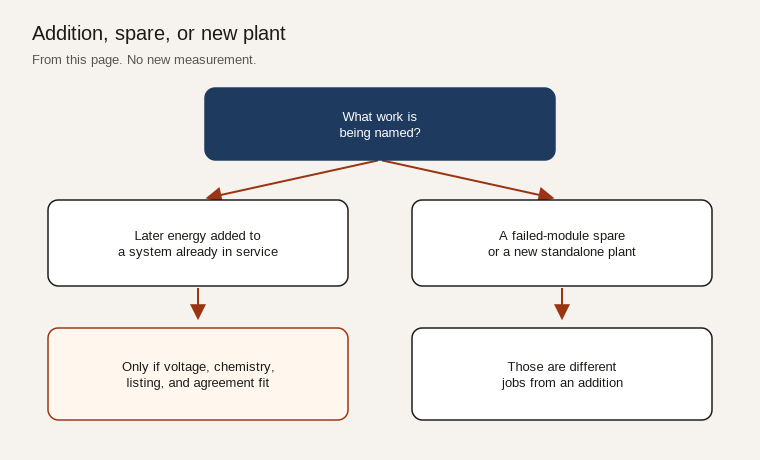
Later energy added to a battery already in service is a different job from a failed-module spare or a new plant, and sharing the original system still depends on voltage, chemistry, the listing, and the agreement.
Energy can shrink while the power rating stays put
Energy capacity is how much electricity a system can hold and later deliver. Power capacity is how fast that electricity can move. The Department of Energy treats the two as separate quantities and notes that storage is never completely efficient, because conversion and retrieval lose some energy. A converter can still deliver rated output after the cells can no longer support that output for the original length of time. Less energy above the controller’s minimum state of charge means the same power stops earlier.
That change is not a figure one project can copy. A presentation at the Energy Storage Systems Safety and Reliability Forum on April 20, 2021, separates cycle life from calendar life. Cycle life follows charge and discharge rate, cycle count, and the voltage range in use. Calendar life follows time, including the state of charge at which cells sit. The same slides name temperature, gradients inside the battery, cell-to-cell uniformity, and the battery management system. That cell and module discussion does not set a year or an energy increment for a stationary plant.
A measured shortfall is also not a reserve the controller holds on purpose. Walker and Desai, in the Federal Energy Management Program’s December 2023 evaluation method, define efficiency as discharged energy divided by charged energy over many cycles. Demonstrated capacity is the most energy accumulated in that window. The capacity ratio is demonstrated energy over rated energy adjusted for the minimum state-of-charge setting. Incomplete cycles, a meter that nets charge and discharge inside one interval, and meter error can move the figure. The method does not name a ratio at which batteries should be added. Its system description asks for cell type, listing lithium iron phosphate and lithium nickel manganese cobalt oxide as separate entries, plus nominal direct-current voltage and maximum charge and discharge current. A later purchase that changes one of those fields is a different unit description.
Four jobs that should not share one scope
A failed-module replacement restores the evaluated design with a compatible spare. Augmentation adds energy later, and sometimes power equipment, because the original blocks no longer meet a duration or energy quantity the site or a contract still requires. Overbuild puts that extra energy in before operation, so the converter, site, fire review, and listing have to fit the larger first plant. A new standalone system is usually its own interconnection request, and a shared fence does not merge the plants. A first battery on solar that never had storage is a different job, covered in Soleil Energy’s guide to adding a battery to existing solar. This page does not choose among overbuild, augmentation, and a mix of the two. A module that only shares a chemistry name, or that stores more than the rack was evaluated to hold, is not a spare.
Where the added energy is connected
A direct-current addition uses the converter already installed, so the voltage window, current limit, cables, combiners, battery management, and fire design have to be in the record. An alternating-current addition brings its own converter. The direct-current buses need not match, but fault current, controls, and the studied model can still change. A conversion stage between a new rack and an older bus adds loss and a controller, and it belongs in the evaluated configuration rather than being improvised in the field. Higher-capacity modules in an existing rack are a spare-part exchange only if the rack, bus, battery management system, cooling, and listing were evaluated for that module.
Voltage, chemistry, and controls have to agree
Cell voltage moves with state of charge, temperature, and internal resistance. Lithium iron phosphate and lithium nickel manganese cobalt oxide are separate entries in that evaluation method, each with its own nominal direct-current voltage. A shared lithium-ion label does not make them one electrical unit, and a later product in the same family can differ in capacity, resistance, or communications.
Strings on one bus share one voltage. Without a design for the difference, current does not split in proportion to nameplate energy, and the lower-resistance path can take more than its share. Many listed systems isolate racks instead of hard-tying unequal strings. This page does not prescribe a parallel connection.
The controller has to be told what the new energy may do. A reserve held for an outage is not available for demand management, and charging is a new load that can set a billed peak of its own. Soleil Energy’s guide to demand charges, solar, and batteries explains why the billed quantity can differ from the highest instantaneous load.
For a Maryland small generator facility, COMAR 20.50.09.06 requires cybersecurity to be designed, installed, maintained, and operated. Operation is required to the extent reasonable and practical, in accordance with accepted industry standards and the utility’s cybersecurity requirements, as that section read on November 22, 2026. NIST Special Publication 800-82, Revision 3, published in September 2023, is federal guidance on securing operational technology, including industrial control systems. It is not the Maryland rule. A planning note on that page, dated September 21, 2026, said a draft of Revision 4 was open for comment through November 30, 2026. A qualified professional assesses the installation. This page states no settings.
A listing describes one configuration
UL 9540, the Standard for Energy Storage Systems and Equipment, evaluates the submitted system for charging and discharging, protection, control, communication, and other aspects. UL Solutions describes references to UL 1973 for stationary batteries and to UL 1741 for inverters, converters, controllers, and interconnection equipment. Off-the-shelf parts can be submitted together. The certification covers that configuration.
On October 21, 2026, UL Solutions described a modular direct-current pathway. The system is evaluated with identified subsystems, including power conversion equipment, for electrical safety, communication, and interoperability. Compatible models are recorded in the Product iQ database so a code official can check them. Later equipment is inside that record only when that model was evaluated. A matching chemistry name is not the record.
UL 9540A is the test method for thermal-runaway fire propagation, not a listing of a larger plant. UL Solutions states that it is used when design or installation conditions exceed limits in NFPA 855, NFPA 1, the International Fire Code, or the International Residential Code, and that it is the only consensus standard explicitly cited in NFPA 855 for large-scale fire testing. The same page describes the 2026 edition, including Annex G.11, as giving that test more weight. The report covers only the arrangement that was tested. As of November 2026, this page does not decide whether Maryland, Virginia, or the District of Columbia enforces that edition or a local amendment. Another container, closer spacing, or more energy in an enclosure can leave the listing and the fire review. A qualified professional and the authority having jurisdiction assess the site.
The agreement limits power, and sometimes the equipment change
Maryland distribution rules and PJM rules are different documents. Neither governs Virginia or the District of Columbia, and a multi-state utility does not carry one state’s chapter across the line. Many commercial batteries stay on a state distribution interconnection and never enter PJM.
On the Maryland distribution system, a small generator facility generates or stores electricity in parallel with the utility. COMAR 20.50.09.02 defines an interconnection request to include increasing the capacity or operating characteristics of a facility already interconnected. Nameplate capacity in that section is the maximum rated output at the point of common coupling. Proposed use means the modes the review uses and the agreement then binds. COMAR 20.50.09.06 requires a request to increase total exports, to change the energy sales strategy named in the chapter, or to change proposed use. A new request is judged under the standards then in effect and, if approved, needs a new agreement. After a request is complete, a material modification other than a minor equipment modification needs a new request unless the utility agrees in writing. That minor-modification term means a change to the proposed facility without a significant safety or reliability effect. The owner does not apply the label alone.
Added energy is not automatically higher export. Output can stay flat while charging or proposed use changes, and that reading belongs to the utility. If the new Maryland request needs an inverter, then after January 1, 2024, the same section requires a smart inverter, defined in the definitions as hardware certified to IEEE 1547-2018 or a later revision, with a utility settings profile. The Maryland Public Service Commission page, read on November 22, 2026, also names UL 1741-SB, or a subsequent revision, and a Maryland statewide, utility-default, or site-specific profile. The profile belongs in the agreement. This page does not provide settings. Spare-inverter and warranty-replacement language in the regulation is about inverters, not added energy. Soleil Energy’s commercial solar interconnection guide describes Maryland commercial utility applications. It is not a PJM manual.
PJM Manual 14H, Revision 07, effective August 19, 2026, separates a new facility, an increase in capability, and a replacement. An increase states the existing and requested maximum facility output and capacity interconnection rights. Storage applications also state charging from the transmission system, the primary frequency response range, the energy stockpile, and hour class where it applies. The manual defines that stockpile as power rating times duration, which is not maximum facility output.
Section 9.7.2 treats an increase in maximum facility output or capacity interconnection rights, above the existing Interconnection Service Agreement, Generation Interconnection Agreement, or active request, as a new generation interconnection request. Section 9.7.3 requires the owner to request a Necessary Study when electrical characteristics change without raising those values. The manual points to PJM Tariff Part IX, Subpart B, Appendix 2, Section 3.4.1. For a multi-fuel request still in a cycle, hour class may change at Decision Point I or II, but an uprate is required if the change makes higher capacity interconnection rights available. That rule does not revise an operating plant.
In the same manual, a new service request below 69 kV is presumed distribution-level and not FERC-jurisdictional, and one at or above 69 kV is presumed transmission-level and FERC-jurisdictional, with cost-recovery exceptions. COMAR 20.50.09.02 defines the electric distribution system as facilities that generally carry electricity at less than 69 kV. A project near that line needs a determination. Section 12 surplus interconnection service is an unneeded portion of service already set in an ISA or a GIA, so the total at the point of interconnection stays the same. It is not permission to add containers with no further process.
What to have in hand before assuming an addition
| Question | Record that answers it |
|---|---|
| What energy is available? | A long charge and discharge record, the minimum state of charge, and the meter boundary |
| Can the converter accept more? | Voltage window, current limit, and documented spare capability |
| Is the listing still the installation? | Listing file, identified subsystems, and approved drawings |
| What may the agreement accept? | Export limit, charging assumptions, and the modification clause |
A monthly bill does not show how long the peak lasts. If usable energy no longer covers that interval, the power rating can look unchanged. Monitoring and maintenance matters when the archive is missing. A gap in the archive is not proof the cells are fine. The outage window and the warranty boundary still belong in the scope.
An illustrative duration gap
An illustrative warehouse battery was arranged around a repeated afternoon peak. Later the converter can still deliver rated power, but energy available before the controller’s minimum state of charge is lower, from time, cycling, and the reserve. The peak is not shorter, so grid import returns for the tail of the interval.
A larger converter does not restore the missing energy, and a spare replaces only a failed module. Added energy extends the interval only if the path, the listing, the fire review, and the agreement allow it. The warehouse is not a Soleil Energy project.
Questions facility and energy managers ask
When might a project add capacity to hold a performance quantity?
When measured deliverable energy, after the required reserve and at the agreement’s measurement point, is nearing the stated quantity, and the design, listing, and interconnection path can accept an addition. There is no standard year or increment. Overbuild, a changed duty, or a changed quantity may be open instead. A qualified professional assesses the actual system.
Does a failed-module swap count as augmentation?
Not when the spare matches the evaluated module and the rest of the boundary stays put. It is another project if energy rating, voltage, the battery management system, export, or proposed use changes. Calling the work maintenance does not rewrite the listing or the agreement.
If export power is capped, can energy still be added?
Only if the utility or, where it applies, PJM says so. Maryland nameplate capacity is an output rating, so flat export can still hide a change in proposed use. In PJM, flat maximum facility output can still require a Necessary Study. The cap is not a waiver.
Can a newer lithium-ion chemistry share the original direct-current bus?
Only when the evaluation says so. Different families use different nominal voltages, and unequal strings do not share current evenly just because they are tied together. A separate converter, or an evaluated conversion stage, keeps those systems apart.
Does a fire-propagation test approve the larger installation?
No. UL 9540A is a test method, and UL 9540 evaluates the submitted system. A report on the original arrangement does not approve more energy, closer spacing, or another enclosure. Which edition of NFPA 855 applies is a local question.
How is this different from a first battery on existing solar?
A first battery joins panels that do not yet store energy. The existing inverter and the solar interconnection decide much of that scope. Augmentation starts from storage already operating and asks whether more energy, and sometimes more power equipment, still fits that system’s limits.
Start from the record, not from a catalog
The question is whether the operating record, the agreement, and the evaluated configuration still describe one system. Soleil Energy’s battery storage work includes homes and businesses, and storage considered where equipment is already installed. Maryland commercial context sits in the commercial battery storage guide. For a later capacity question, bring interval data, the duty the battery should still meet, converter and battery identification, and the interconnection agreement. A qualified professional has to assess the actual system before an addition is treated as work the site can do.
Project requirements depend on the site, equipment and applicable rules. Confirm design and installation decisions with the appropriate qualified professional.