
A commercial roof maintenance plan is the written record of how a commercial roof is inspected, repaired, and opened only to people the owner has authorized. It stores dates, findings, photos, and repair invoices, and it notes the limits in that roof’s written coverage. It does not, by itself, measure how much service the roof has left. A qualified roofing professional has to assess the actual roof.
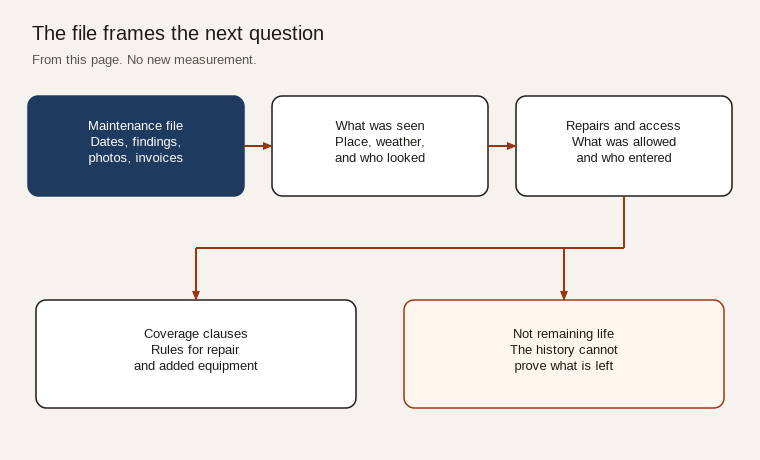
Use the file to record what was seen, which repairs and access were allowed, and what the coverage requires, and stop before treating those pages as proof of remaining life.
The plan is a file, not a forecast
A service contract says who will visit and what that visit includes. The plan is the running file plus the rules for access, repairs, and changes. A visit with no dated record does not feed the plan. A folder that never names who may walk the roof, or which repairs the membrane maker must approve, is only a photo album.
NRCA’s roof repair and maintenance course page calls maintenance often neglected, and the single most important factor after proper installation in the life span and cost of a roof system. That is a reason to keep preventive roof maintenance, not a roof lifecycle count for one building. The page also says the course covers visual inspections, nondestructive moisture surveys, and core sampling. A routine log is not automatically any of those.
FM Global’s Property Loss Prevention Data Sheet 1-28, Wind Design, interim revision April 2026, tells insured locations to keep a roof inspection and maintenance program. Section 2.12.1 says to keep organized written or computer-based records with pictures of problem areas, to limit roof access to authorized personnel, and to limit foot traffic, particularly on membrane roofs. As of November 2026, that section is loss-prevention guidance, not a building code and not a remaining-life report. FM’s revision history says applicable content moved from Data Sheet 1-32, Inspection and Maintenance of Roof Assemblies, which was made obsolete in the April 2025 interim revision.
What an inspection record should capture
A useful entry names the building, the roof section, the date, the weather, and who looked. It should locate the field of the membrane, the perimeter and flashings, drains and overflow paths, rooftop units and curbs, and interior clues such as stains on a ceiling or on the underside of the deck. A photo needs a location. A close-up of an unnamed wrinkle is not a record.
FM’s section 2.12.1 says to inspect roofs, flashing, drains, and rooftop equipment at least semiannually, and before and after severe storms, with a qualified person doing the look. It calls out hot or sun-exposed areas, ponding, exhaust, and high-traffic paths, and it says to correct underside leaks, loose flashing, loose equipment, blocked drains, HVAC discharge on the membrane, and holes, open seams, or billowing. Defects that lower wind resistance are priorities. If deterioration needs confirmation, FM says to engage a registered roof consultant. The log can request that look. It cannot finish it.
Manufacturer schedules are not a calendar this page assigns to every roof. Carlisle’s owner’s manual says to inspect at least every six months, preferably in spring and fall, after weather with excessive rainfall, high winds, or hail warnings, and after rooftop-unit service. Johns Manville’s brochure RS-7395, March 2026, says to inspect at least twice a year or as the written coverage requires, preferably after winter and after summer, and after unusual events such as heavy rain, high wind, or hail. Record the schedule in that building’s coverage and any insurer requirement. One maker’s calendar does not belong on another maker’s roof.
The NRCA pages opened for this article do not state a universal inspection interval. NRCA’s June 2026 note on an updated owner manual stresses scheduled inspection for low-slope structural metal panel assemblies, as a contractor consensus for that assembly type, not as a code interval for every membrane.
Repairs, access, and coverage are separate lines
Finding an open lap or a puncture is not maintenance until the repair is recorded: where it was, what product was used, who did it, whether that person was allowed to repair that system, and whether the manufacturer was told. A later reader should be able to separate a temporary dry-in from a finished repair.
For Carlisle systems, the owner’s manual says a Carlisle Authorized Applicator must perform revision work. It quotes a warranty clause that makes coverage null and void if alterations or repairs are made on or through the roof, or if objects such as solar panels, utilities, or similar items are placed on or attached to it, without written authorization first. Solar is an alteration to document, not a reason to stop inspecting the membrane. A minor emergency patch on a Carlisle roof may use Carlisle lap sealant or a good-grade rubber caulk, not asphaltic roof cement. That material limit is Carlisle’s. The plan should name whatever product was used, because another membrane can reject it.
Johns Manville’s brochure says equipment technicians must not cut penetrations; an approved roofing contractor should make those openings. It also says not to power-wash the roof, move heavy equipment across it, or puncture the membrane, and to flash new equipment with compatible materials. Those are owner controls to write down, not a procedure for someone already on the roof.
Those documents also say who may walk the roof. FM says to limit access to authorized personnel, limit foot traffic on membranes, and reinstall fasteners removed for equipment service. Johns Manville says to lock hatches, keep unqualified people off the roof, and place walkway pads at entries and at equipment panels. Carlisle wants restricted access and a log of who was admitted and why, plus walkways if traffic is regular or if equipment is serviced on a cycle of 30 days or less. The log records permission. It is not a fall-protection plan, and Carlisle disclaims liability for rooftop activity.
Federal OSHA’s walking-working surfaces rule, 29 CFR 1910.28, requires employers to protect employees from fall hazards. A narrow exemption covers inspecting or assessing conditions before work starts or after it is finished, and it does not apply when compliant fall protection is already available. Low-slope roof work has separate provisions that depend on the task. As of November 2026, that federal text does not decide who may be on a given roof or what a state plan requires. The employer has the duty. A qualified person has to assess the actual site. A name in the log does not waive that.
What the file must hold, and what can end coverage
The plan should hold the certificate, any serial number, transfer rules, and the clauses on repairs and added equipment. Carlisle says the owner must keep the warranty document and serial number, inspection logs, rooftop traffic logs, service logs, and invoices. Without those pages, the file cannot show what would put coverage at risk. Carlisle also describes good practice as water leaving the roof, with ponded water evaporating within 48 to 72 hours after rainfall. That timing is Carlisle’s, not a code, and one dry visit does not prove the next storm. The file can show whether the owner’s limits were followed. Only the issuer, reading the issued certificate, can say whether an event is covered.
Why the file does not prove remaining life
Remaining life is a judgment about future performance. The file is only a history of what was seen and repaired. Neat seasonal reports can still hide wet insulation, a corroded deck, or loose fasteners. NRCA’s course page treats a moisture survey and a core as separate from a general look. If those results are absent, do not describe the file as if it contained them.
FM says that following the manufacturer’s inspection and repair schedules will result in longer roof life and lower roof cost. That is a general loss-prevention statement. It is not a roof lifecycle number for one roof, and it is not a figure taken from invoices. ASTM’s roofing standards catalog, as of November 2026, lists D7186-25 for quality-assurance observation of roof construction and repair, and D7954/D7954M-22a for nondestructive electrical moisture surveying. The page shows titles, not the practice text. A maintenance plan is not an ASTM report. A certificate date starts a coverage term only if the certificate says so. Storms, ponding, chemical exhaust, and the wrong repair can age one area faster than that date. A qualified roofing professional has to assess the actual roof.
Solar equipment does not replace the membrane inspection
Rooftop solar is a coordination item. The array needs a structure that can carry it, and the roof still needs its own inspection, including membrane the array will cover. The Department of Energy’s solar photovoltaic design basics, updated July 8, 2022, says photovoltaic arrays must be mounted on a stable, durable structure that can support the array and withstand wind, rain, hail, and corrosion. That sentence is about the mount. It does not check seams, flashings, or drains, and it does not excuse skipping those checks because modules are present.
On a Carlisle roof, panels sit inside the clause that can make coverage null and void without prior written authorization. The plan should show the request, the approval, and any reinspection required. FM’s point is narrower and still relevant: fasteners removed for equipment service go back on, and rooftop equipment is inspected with the roof, not instead of it. A new walking path across bare membrane is a traffic record, not proof the membrane was examined.
Soleil Energy’s guide on replacing a roof before solar calls for a written inspection before a home array. The guide on a roof leak under solar panels separates mounting defects from other roof defects. The equipment is not the inspection.
Read the file before choosing repair or replacement
The rows below sort the next question. They are not a verdict.
| What the file shows | Question it can support | What it still does not prove |
|---|---|---|
| One documented flashing repair, and later visits with no stain there | Whether an allowed contractor used an allowed material | That the rest of the roof, or the insulation, is dry |
| The same drain flagged on several visits | Whether debris, the strainer, or the slope is the pattern | That the roof meets a drainage rule you have not read for this building |
| Open seams or widespread deterioration left unrepaired | Whether the next scope is a local repair or a replacement | Deck condition, concealed moisture, or wind resistance |
| A solar layout over membrane with no recent photos | Whether the maker authorized the added equipment | That the covered membrane and attachments were inspected |
| Names in a traffic log and no walkway note | Who has been on the roof | That those visits met fall-protection duties or traffic limits |
If the file and the roof disagree, believe the roof. A qualified professional has to see it.
An illustrative file, and what it still cannot say
Consider an illustrative low-slope membrane on a distribution building. It is not a Soleil Energy project and not a condition rating. The folder holds seasonal photo reports, invoices for two flashing repairs by the manufacturer’s authorized applicator, and a traffic log. The latest line shows a mechanical contractor at the rooftop units. Walkway pads stop at the curb, and the photos do not show the path that was actually used. A proposal would add a solar array over the south half. The manufacturer has not issued written authorization, and the last close photos of that field are from the prior fall.
The file shows inspections, repairs, and who walked the roof. It flags a traffic gap and, on a Carlisle roof, a coverage problem if panels were added without authorization. It does not show wet insulation, deck capacity, or service left. A qualified person still has to see that roof, including the area an array would hide. Solar planning is a reason to inspect the membrane, not a reason to skip it.
Common questions
Does a full set of logs prove remaining life?
No. The log shows what was recorded. Concealed moisture and repair quality can still be unknown. NRCA treats a moisture survey or a core as separate work, and FM points deterioration that needs confirmation to a registered roof consultant.
Can in-house staff go on the roof to check drains?
Only if the plan authorizes them and their employer has addressed the fall exposure. Johns Manville tells owners to lock hatches and keep unqualified people off the roof. OSHA puts fall protection on the employer, and the narrow assessment exemption does not cover every trip. A house rule is not that determination. A qualified person has to assess the actual roof.
Which repairs put coverage at risk?
The issued certificate controls. On Carlisle’s quoted clause, unauthorized alterations or repairs, including solar panels added without written authorization, make that warranty null and void, and an authorized applicator must do the revision. Johns Manville warns against penetrations cut by equipment technicians, power washing, and punctures. Record who repaired the roof and with what, then ask the issuer.
Does a solar layout mean the membrane was inspected?
No. A layout is not a seam, flashing, or drain inspection. DOE’s page addresses the structure that must carry an array. Carlisle still requires written authorization before panels are attached. Do not let the layout stand in for the membrane.
When does the file point toward replacement rather than another patch?
When the same area keeps failing, when notes show widespread deterioration, or when new equipment would land on a roof the maker has not accepted. Ask a qualified professional for the repair-versus-replacement opinion. FM treats wind-resistance defects as priorities and does not treat a casual note as confirmation of a large deteriorated area.
What should be added the day a leak is found?
Add the date, where water showed inside, the weather, and photos from a safe place. Do not send an untrained person onto a wet roof. Carlisle says to contact Carlisle once the leak is verified through the roofing system, and not to use asphaltic roof cement for a temporary Carlisle patch. Keep that notice with the log.
Bring the file to the roof conversation
Start from the records, not from a guessed remaining life. Bring the coverage certificate, the inspection and repair file, the access rules, and any drawing that would add or move rooftop equipment. Ask which membrane areas still need a qualified look, which repairs the manufacturer must approve, and how solar or other equipment will be coordinated so the membrane inspection still happens.
Soleil Energy’s construction services include commercial roofing and exterior work with other building scopes. That is a way to line the roof file up with the rest of a project. It is not a remote diagnosis, and it does not replace the roofing professional who has to assess the actual roof.
Project requirements depend on the site, equipment and applicable rules. Confirm design and installation decisions with the appropriate qualified professional.