
Electrical commissioning is the documented check that newly installed or retrofitted electrical power equipment, and the system built from it, are ready for the owner to rely on them. It asks whether the installation matches the design and whether the system meets the owner’s project requirements and the basis of design before energization. A factory test, a startup, and later maintenance each answer a different question. A qualified professional must assess the actual site.
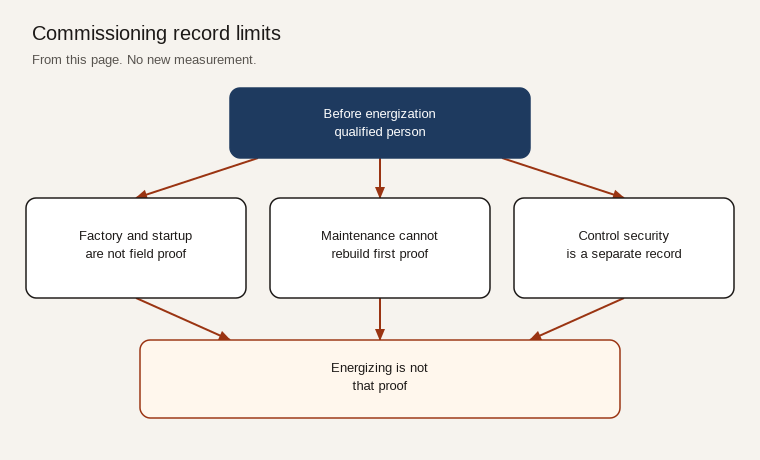
Factory evidence and startup are not the field record, maintenance cannot rebuild the first proof, control security is a separate record, and energization itself is not that proof, so a qualified person assesses the actual site.
What commissioning is asked to prove before energization
Before energization, the record has to show that this installation is suitable to receive voltage. ANSI/NETA ECS-2024 separates two jobs. Acceptance testing provides the baseline later maintenance can trend. Commissioning verifies that the equipment and system meet the owner’s project requirements and the basis of design. The 2024 edition, the third, was approved as an American National Standard on July 2, 2024. As of November 2026, NETA’s revision schedule listed that edition as the released commissioning specification, with the next revision planned later. Use the edition the contract names.
ANSI/NETA ATS-2025 is the field companion for judging suitability for initial energization. NETA states its purpose as showing that tested equipment is operational, within applicable standards and manufacturers’ tolerances, and installed to the design. That purpose is not a finding about a particular site. The 2025 edition added storage and photovoltaic sections. A contents line is not a duty to test them.
The pre-energization record has to let a later reader match each result to a nameplate, see whether evidence is complete or a named person deferred a stated item, and see that results were judged against the specified standard and the manufacturer’s data. This page does not restate those data.
NETA’s standards-development page says the documents specify which tests to perform, not how, and it points to manufacturer data for procedure detail. The same page says the specifications address division of responsibility, qualifications, and minimum report contents. A qualified professional selects the tests and the precautions. This article does not give insulation-test voltages, relay settings, or a switching sequence.
Energization itself is not that proof. Later operating observations do not replace the pre-energization record.
A factory test, a startup, and maintenance ask different questions
| Activity | Question it answers | What a favorable result does not answer |
|---|---|---|
| Factory test | Did the product meet the agreed checks before shipment? | Field wiring, site configuration, or interfaces with the facility |
| Startup | Can the equipment reach an initial operating state? | Whether the integrated system meets owner requirements |
| Electrical commissioning | Does the installed system match the design and owner requirements, with a usable record? | Later suitability without maintenance |
| Maintenance testing | Is in-service equipment fit to continue? | Whether a new installation was proved before first energization |
A routine test, a type test, or a witnessed factory acceptance test can be required procurement evidence, and it still describes the factory configuration. It does not see transport, site conductors, logic loaded after delivery, or operation with the existing bus and sources. Those records do not close the field questions.
ASHRAE’s owner guide, Commissioning: Impact on IEQ, calls start-up part of getting systems ready to operate. It recommends that the commissioning provider witness major equipment, including a generator, and it says start-up should not be considered commissioning. One unit reaching an initial operating state is not proof that the owner’s system was shown.
The guide, citing ASHRAE Standard 202-2024 and Standard 230-2022, defines commissioning as verifying that systems are planned, designed, installed, tested, operated, and maintained to meet the Owner’s Project Requirements or, for an existing building, the Current Facility Requirements. Those standards do not list facility electrical tests. They do name the two documents used here: the owner states requirements, and the basis of design records how the design is supposed to meet them.
ANSI/NETA MTS-2023, approved as an American National Standard on March 6, 2023, is for suitability for continued service. As of November 2026, NETA still listed that edition as the released maintenance specification, with a revision in process. ECS treats acceptance results as the later baseline. Maintenance can describe today’s condition. It cannot rebuild a first-energization record nobody wrote.
NFPA 70B is maintenance, not that pre-energization proof. As of November 2026, NFPA’s 70B development page lists a 2026 edition as current. An NFPA article on the 2023 edition describes the change from a recommended practice to a standard and a purpose of safeguarding persons, property, and processes and of establishing a condition of maintenance. The article is not the standard, and publication is not adoption. Confirm applicability and edition with the authority having jurisdiction. This page gives no interval and no pass-fail value from 70B.
Acceptance testing sits inside commissioning
In ECS, acceptance testing builds the equipment baseline and commissioning checks the system against the owner’s requirements and the basis of design. Every device can have a report while the specified transfer or interlock was never shown.
ANSI approval of a NETA document means that consensus process finished. It does not adopt the document at a facility, and citing the title does not show that a report followed it. Name the edition, because ATS-2025, ECS-2024, and MTS-2023 are different questions, and name who signs: employer, testing organization, manufacturer, engineer of record, commissioning provider, owner, and any utility or host. ASHRAE’s guide uses “commissioning provider” because that role identifies issues and works toward resolution with the engineer of record and the owner. It does not direct the construction team. Code conformance stays with the engineer of record and the authority having jurisdiction. A discrepancy is not, by itself, an accepted design change.
ECS-2024 names low-voltage systems less than 1,000 volts, medium-voltage systems greater than 1,000 volts and less than 100,000 volts, and high-voltage and extra-high-voltage systems greater than 100 kV and less than 1,000 kV. Those bounds, read on NETA’s page in November 2026, are internal to that specification. They are not a code definition. The same edition added photovoltaic, uninterruptible-supply, and transfer-switch sections, which still have to be named in the scope before anyone treats them as included.
Integrated testing has a control-system boundary
Integrated testing asks whether equipment works together as the design described. A device can pass alone and still sit in a wrong sequence, or in a sequence nobody witnessed. “Perform integrated testing” still names no scenario.
For an illustrative transfer scheme, write the questions first. Which source is normal, and which is alternate? Which loads should transfer, and which must not? Which interlock forbids a condition the design rejects? What does the narrative require if the control path is unavailable, who witnesses it, and which revision is current? Those are scope lines, not steps for operating a breaker or entering a setting. Put the boundary in the scope, or each trade will assume another trade proved the interface.
| Boundary | Asked to show | Not settled by that showing alone |
|---|---|---|
| Power apparatus | The device may be considered for energization under the specified standard and manufacturer data | Numerical limits or settings, which belong in those documents and the approved study |
| Scheme and sequence | The defined sequence matches the approved narrative | Modes the demonstration never called for |
| Operational technology | Security and change control were addressed before the owner relies on the controls | Whether the power apparatus met its acceptance criteria |
NIST Special Publication 800-82 Revision 3, September 2023, is security guidance, not an acceptance specification. It treats operational technology as systems that act on the physical environment. The publication page, reviewed in November 2026, gives industrial control systems and building automation as examples. The guide says to address security through architecture, procurement, installation, maintenance, and decommissioning, because assuming security can be added later introduces significant risk. It notes that outages of process controls often must be planned and that software updates need testing before implementation. The page notes a September 21, 2026 draft of Revision 4, with comments due November 30, 2026. This page uses final Revision 3. The draft is not a requirement, and the guide binds a project only if a contract, a regulator, or the owner adopts it. Keep the power record, the integrated-scenario record, and the control-system record separate even when the hardware shares a cabinet.
Safety rules are not acceptance values
This page is not a work practice and not a decision that a site is ready. A qualified professional must assess the actual installation.
29 CFR 1910.269, read on the eCFR in November 2026, covers operation and maintenance of generation, control, transformation, transmission, and distribution lines and equipment. Its application note includes utility installations and equivalent industrial ones, and it places supplementary emergency or standby generation used only to supply a workplace under Subpart S. The section does not apply to construction, except for specified line-clearance and generation cases, or to installations and work practices covered by Subpart S. OSHA’s electric-power eTool says 1910.269 does not normally apply to ordinary lighting or HVAC circuits, points to Appendix A flow charts, and says commercial-type distribution work can carry the same hazards as utility work when 1910.269 applies. The eTool explains. The regulation controls.
The same application text covers test sites used for temporary measurements associated with generation, transmission, and distribution, as opposed to metering, relaying, and routine line work. Paragraph (o), on OSHA’s testing and test facilities text, is limited to interim high-voltage or high-power measurements. The employer sets the protective practices. This article does not, and it does not classify a measurement.
29 CFR 1926.950 covers construction, alteration, conversion, and improvement of transmission and distribution lines and equipment. It does not cover electrical safety-related work practices for unqualified employees. Host and contract employers must exchange safety information and coordinate rules before covered work. A note to the scope says that compliance with 1910.269 does not excuse obligations under other construction subparts.
Where Subpart S applies, 29 CFR 1910.303(b) requires equipment free from recognized hazards likely to cause death or serious physical harm. Considerations include suitability, mechanical strength, wire-bending and connection space, insulation, and heating effects. A note says listing or labeling may show suitability for an identified purpose. It is not a NETA tolerance, and a label does not describe the conductors in the room.
Scope, the outage window, and the handover record
Commissioning changes the job by adding hold points and named evidence. If the schedule omits them, they return as an argument on the morning of energization. Some evidence needs the equipment de-energized. Some observations follow a controlled energization. The window has to allow a stop when an item fails and no deferral is accepted. A short window means proving less and recording the rest, moving work earlier, or moving energization. The owner decides which loads stay served. If the study and the device disagree, the engineer of record decides. The crew does not invent a setting.
Construction complete, a field report, an engineer’s disposition, an inspection, and a utility or host release each close a different question. On a retrofit, the new baseline does not describe existing gear. A qualified engineer decides whether the coordination study still matches. The scope names what is included and which interfaces are demonstrated.
NETA sets minimum test-report contents. The file a later shift needs includes the specification and edition, drawing and study revisions, nameplate identifiers, factory records kept apart from field records, deferrals, open items, items the owner has accepted, and the results maintenance will treat as the baseline. A contractor’s belief that a fix is done is not the owner’s acceptance. File the records by equipment identity, not only by the outage date.
An illustrative window, and the next conversation
An illustrative occupied site adds switchgear and an automatic transfer switch ahead of loads the owner calls essential. The factory packet ships with the gear. A startup technician says the lineup operates. The utility window is short.
Before that window counts as success, the record has to show that device marks match the one-line, that the field report is separate from the factory packet, that a named person accepted any deferral, that the witnessed transfer matched the narrative, including loads that must not transfer, and that a supervisor can find the report from the equipment identity. None of that selects a timer or a test voltage. If the window ends first, the status is incomplete. Energizing under a written deferral can be an operating decision. It is not a completed commissioning record.
For a substation, switchgear, or distribution project, the useful discussion is the testing outage window and the handover records: what must stay available, which study and sequence revisions will be used, and which signatures close which items. Soleil Energy’s power page describes testing and commissioning, coordinated with the utility, as part of how that work is delivered. The service-area page, read in November 2026, names Maryland, Northern Virginia, and Washington, DC, and lists Prince George’s, Montgomery, and Howard counties in Maryland and Arlington County in Virginia. It states that Soleil Energy serves the District of Columbia and does not keep an office there. Confirm the address against that page before assuming the site is in range.
Questions to settle before the specification is issued
Does a factory test authorize energizing installed equipment?
No. It covers the configuration tested before shipment. ATS puts suitability for initial energization on the field record. Keep the factory report separate from the site report.
Why is a startup signature not commissioning?
Startup reaches an initial operating state. ASHRAE’s guide calls that getting systems ready and says it is not commissioning, even when the provider watches. Commissioning is the comparison with the owner’s requirements and the basis of design.
How does maintenance testing differ from first acceptance?
MTS asks whether in-service equipment may continue. ATS asks whether new or altered equipment is suitable to energize. Only the acceptance record is the baseline ECS describes. A later test cannot recreate a comparison nobody wrote down.
Does an inspection or a utility release finish the work?
No. The inspector enforces adopted rules. A utility or host release covers that operator’s conditions. Performance against the owner’s requirements, training, and owner documents can sit outside both. Ask which requirement each signature closes.
What should the contract add?
The specification and edition, owner requirements, basis of design, integrated scenarios, hold points before energization, outage limits, who may accept a deferral, and what is excluded. Separate the test report from owner acceptance, or the bids describe different jobs.
Can this page decide that a site is ready?
No. It has no test method, insulation-test voltage, relay setting, or switching sequence. A qualified professional has to judge the site, the edition the contract adopted, and whether the evidence answers what energization is supposed to wait for.
Project requirements depend on the site, equipment and applicable rules. Confirm design and installation decisions with the appropriate qualified professional.