A solar data acquisition system is the set of instruments, communications, and software that collect, time-stamp, and store measurements from a photovoltaic plant. It gives operators a record of production, site conditions, and device status that can be compared with what the plant was expected to do. The record supports operations and maintenance. It does not, by itself, interrupt fault current or take the place of the protective devices in the power circuit.
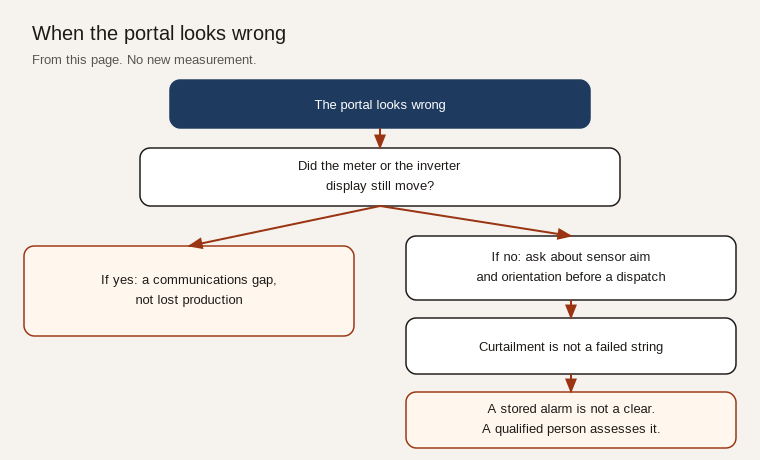
A wrong portal is first a question of whether the meter or the inverter display still moved, then of sensor orientation or curtailment, and a stored protective alarm stays a record for a qualified person rather than a cleared fault.
What the record is asked to prove
Owners use the record to ask whether, given the sunlight and the operating state, the plant delivered the energy it should have. The December 2018 best-practices report from the National Renewable Energy Laboratory, Sandia National Laboratories, the SunSpec Alliance, and an industry working group, hosted by the National Laboratory of the Rockies, treats monitoring as a core operations task: status, revenue metering, alarms, diagnostics, and a comparison with a benchmark.
The report frames the job as an energy balance, from the solar resource through conversion losses to the point of interconnection. A daily total cannot do that. Power-factor changes, clipping, interconnection limits, and curtailment all move the numbers. Ignore them and a normal control action looks like a failure. The Federal Energy Management Program, on a page updated May 8, 2026, describes instrumentation, acquisition, processing, and reporting over a long performance period. The 2018 report also says to decide who owns the data. A login that dies with the vendor contract is an incomplete record.
How a measurement becomes a stored record
Devices that originate the numbers
Inverters often supply the first numbers. The Department of Energy inverter overview, updated March 31, 2025, says an inverter turns array direct current into grid alternating current and may also monitor the system. The Federal Energy Management Program says built-in metering can start the record, with added instruments when the question needs them. Points may be real power, reactive power, and voltage and current at the plant, each inverter, each string, or each module. Plant power shows export. String detail shows which circuit dropped.
Weather is separate. The program lists sunlight, ambient temperature, and module temperature, and notes that satellite data often stand in for roof sensors. The 2018 report says a satellite estimate can beat a dirty or badly aimed pyranometer, while a maintained onsite sensor is the stronger reading of the resource the modules saw. It calls for frequent checks, including a daily check, and says irradiance is often kept at least hourly, with 15-minute or 1-minute records commonly specified. Those intervals are 2018 planning language, not the class limits of the current standard. The Department of Energy performance page, updated May 5, 2026, adds why temperature matters: a hotter cell raises current slightly and lowers voltage by more, so an afternoon drop can be thermal rather than a failed circuit.
Payment often needs a meter other than the inverter register. The 2018 report describes a separate alternating-current meter for invoicing or an independent check. Name the point the contract uses.
The logger and the path off site
Devices rarely share one language. A gateway polls them, stamps the time, and stores the result. The 2018 report treats onsite storage as the way to survive a dead link, including loggers that keep 6 months locally plus an off-site backup. The remote file and the local file match only after someone reconciles them.
Retrieval needs a backhaul. The report names cellular, satellite, or broadband, and says many owners will not put monitoring on the building network. The Federal Energy Management Program remote-metering page, updated January 2, 2026, also lists microwave radio, power-line communication, radio relay, dark fiber, and fiber-optic cable. Without a path, nobody is told that production stopped. That missing notice is not the act of clearing a fault. Federal sites on that page face an agency authority to operate. A private building does not inherit that rule, but it still needs a path its security rules allow.
Measurements that are easy to misread
Plane-of-array irradiance is sunlight on the module face. The 2018 report says each orientation, including a tracked section, needs its own pyranometer, assigned to that portion when a performance ratio is calculated. The wrong plane assigns the wrong resource to real energy.
The report summarizes a performance ratio, from the standard then in use, as electrical yield compared with plane-of-array irradiance and nameplate over the same period. Definitions differ, the basic form is not temperature-corrected, and a short window moves with weather. Dirt on the sensor inflates the ratio because the resource looks smaller than the light on the modules. Clipping is the inverter limit, not that same fault.
Nighttime “up” time says little about daytime delivery. Energy availability, as the report describes it, needs weather and the hours the inverters actually ran. The time series is what separates forced failure, scheduled work, grid events, and causes outside management control. Hand logs rarely match the intervals.
Studies cited in the December 2018 report found combined measurement and modeling error can range from 5% to 10% (Best Practices for Operation and Maintenance of Photovoltaic and Energy Storage Systems). That is the report’s statement about those studies, not a contract tolerance and not a Soleil Energy result. Check the sensor, the meter point, and the model before treating a small gap as a failed string. The report also says monitoring alone is a weak way to find string faults, so a qualified look at the direct-current array is common. That look is power-equipment work, not a historian setting.
A monitoring class is not a protocol
As of November 2026, the IEC webstore lists IEC 61724-1:2021, Photovoltaic system performance, Part 1: Monitoring, as edition 2.0, published July 21, 2021, with a catalog stability date of 2026. The public text says it defines monitoring classes and replaces the 2017 edition. Stated changes include bifacial monitoring, updated irradiance sensors, updated soiling measurement, and elimination of Class C. The stability date is a committee mark, not by itself a withdrawal. The purchased clauses were not read here, so this page does not restate that edition’s sampling or accuracy limits. “Meets the monitoring standard” names neither edition nor class. The 2018 report spoke of classes A, B, and C under an older edition. Carrying that trio forward would ignore the removal of Class C.
Protocols are another layer. The SunSpec Alliance Modbus page, read in November 2026, says SunSpec Modbus sets shared monitoring and control parameters, including voltage regulation, power factor, and export limits, on Modbus. The page says that interface is referenced in IEEE 1547-2018 and is meant to work with IEEE 2030.5 and IEEE 1815. That is the alliance’s account. The purchased IEEE text was not read here.
The IEEE catalog, as of November 2026, still lists IEEE 1547-2018 as the active interconnection and interoperability standard, approved February 15, 2018, and published April 6, 2018, for a 60 Hz source. A named protocol applies only where an authority and the utility require it. Maryland, Virginia, and the District of Columbia are not interchangeable. An owner archive and utility telemetry can share a gateway and still be different duties. The 2018 report recommended SunSpec models on Modbus, Ethernet, and Wi-Fi, with IEC 61850 and Smart Energy Profile 2.0 also in view, across device communication, plant storage, transmission, and application access. A scale error at any level ruins the comparison.
A stored alarm does not clear a fault
Protective devices interrupt or limit current in the power circuit. Inverter grid response is also separate from the historian. The Department of Energy overview says a typical small inverter should ride through small voltage or frequency disturbances and disconnect if a disturbance is larger or longer, and that some units change output with frequency or follow an operator signal. The power equipment does that. A later display does not.
The data system records what instruments reported and may forward alarms the equipment already raised. The 2018 report’s acronym list expands supervisory control and data acquisition into those two jobs. Stored history is only the acquisition half. Control changes setpoints such as curtailment. A curtailment signal is not a ground-fault or arc-fault clear.
A historian neither opens nor closes a breaker. The link can fail while the plant keeps running, and a stale alarm can outlive the event. The 2018 report says to report both lost production and lost communications, because treating every link loss as an outage creates false alarms. Keep electrical status, data freshness, and write access separate. A gateway that can change setpoints is operational technology. A qualified professional has to judge the equipment. This page states no trip threshold and no switching step.
Bad data can look like a bad array
Match the screen to the measurement that could explain it.
| What the screen shows | Ask this before dispatching |
|---|---|
| Portal flat, meter still advancing | Is the gap in the backhaul while production continued? |
| Ratio high, modules look soiled | Is the irradiance sensor dirty? |
| One roof face looks weak | Is one sensor applied to two orientations? |
| Energy down, no alarm | Is the measured point upstream of the problem, or is the alarm path down? |
| Output down during curtailment | Should that interval be excluded from the comparison? |
Two illustrative cases, not Soleil Energy projects, show the split. An illustrative roof has east and west arrays and one sensor aimed west. Morning production on the east, paired with that low west-facing reading, makes the east side look poor if one sensor is assigned to both. The 2018 report’s remedy is a pyranometer per orientation. An illustrative array then loses cellular service for a day. The portal gaps, but the meter advanced and the logger still holds the intervals. Until they are retrieved, the blank day is a communications gap. Flag invalid intervals. Do not average holes in as if they were measurements.
What the specification has to name
The system changes scope even when the module count does not. The change is points, custody, and interfaces.
| Decision | Make this visible |
|---|---|
| Electrical boundary | Inverter registers, a separate meter, string current, or module points, and which one the contract uses |
| Resource | Onsite sensors, a satellite estimate, or both; orientation; who cleans and calibrates |
| Recording | Required interval, time source, and how gaps are marked after power loss |
| Retention | Onsite hold, off-site backup, and who can export raw intervals if the vendor changes |
| Network | Allowed path, who pays, and whether the building network is forbidden |
| Control | Whether the gateway is read-only or can change setpoints |
| Alarms | What notifies a person, and what is only logged |
| Exclusions | Protection settings, utility telemetry, and security duties kept in other documents |
A small inverter portal is not the same scope as a plant logger, weather station, revenue meter, and private backhaul. Ask the utility and the authority having jurisdiction before assuming either one must approve the archive. The 2018 report and the May 8, 2026 federal page both look for documented methods, backup, and an uninterruptible supply for the monitoring gear. A chart is not those tests.
The network is part of maintenance
If the record cannot be reached, it cannot support operations. The 2018 report treats a weak backhaul as a data-quality problem and warns against a host network the owner may refuse. Show a failed path as a failed path.
Where a device can change operation, follow operational-technology practice. A May 6, 2025 fact sheet from the Cybersecurity and Infrastructure Security Agency, with the Federal Bureau of Investigation, the Environmental Protection Agency, and the Department of Energy, says to take that gear off the public internet, replace default passwords, and avoid direct exposure of control-capable devices. Remote access, if required, should use a private connection, a virtual private network, unique passwords, and phishing-resistant multifactor authentication, with the business network split from the plant network. That is guidance, not a design for one site and not a finding that every roof falls under a reliability rule. A one-way copy into a historian is easier to bound than a gateway that can curtail. A qualified security practitioner and a qualified electrical professional must assess the site.
Bring the equipment list and the fault record
Bring inverter and meter models, the sensor map, an export with a good day and a suspect day, the alarm list, and a plain account of the communications path. Note whether the portal, the meter, and the inverter display agree. Soleil Energy’s commercial solar operations and maintenance guide shows sensors, communications, and reporting as separate maintenance lines. If the screen is stale, Soleil’s guide to a solar monitoring system that shows offline separates a broken link from a stopped inverter without opening equipment. If the display itself shows lost production, use Soleil’s guide to a solar system that is not producing.
For a plant in Maryland, Northern Virginia, or Washington, DC, request an assessment from Soleil Energy’s monitoring and operations service. The page describes performance monitoring, support for systems Soleil did not install, and diagnosis that includes communication dropouts. Bring the equipment list and the fault record. Response expectations are set per site, and the page is not a remote diagnosis.
Questions that change the scope
Does a data system change interconnection approval?
Only if the work changes what the utility must see or what the plant may do. An owner archive can be added without a new study. A polled interface, or a gateway that changes export, can be part of interconnection. Confirm the adopted rule and the utility’s current practice. A catalog protocol is not automatically the tested one.
When is the manufacturer portal enough?
It can be enough for a rough check when the inverter already reports the points you will use. It is not enough when payment follows a revenue meter, several orientations share one sensor, or a portal outage cannot be told from a plant outage.
How should missing intervals be treated?
Decide before the year starts. The 2018 report screens missing and implausible values so they do not skew results, then repairs the cause. Dropping a gap, estimating it, and labeling it invalid are different treatments. Say which rule applies to availability and which applies to the performance comparison. A filled interval is not a measurement.
Can one gateway archive data and command inverters?
Many products do both, and SunSpec’s description includes control settings. Say whether writes are enabled, who holds them, and what the plant does if that path dies. Read-only archive and remote setpoints are separate choices. Neither one lets the historian clear a fault. A blank portal still does not prove the array stopped, and a stored alarm does not prove a breaker opened. A qualified professional has to assess the site.
Project requirements depend on the site, equipment and applicable rules. Confirm design and installation decisions with the appropriate qualified professional.