
A substation grounding grid is the buried network of conductors and electrodes that connects a station’s structures and equipment enclosures to earth and carries ground-fault current into the soil. The safety question is whether voltage differences a person can touch during a fault stay acceptable for that site, including between the feet and between a hand and the feet. Resistance to remote earth does not answer that question alone. A qualified professional must assess the actual site.
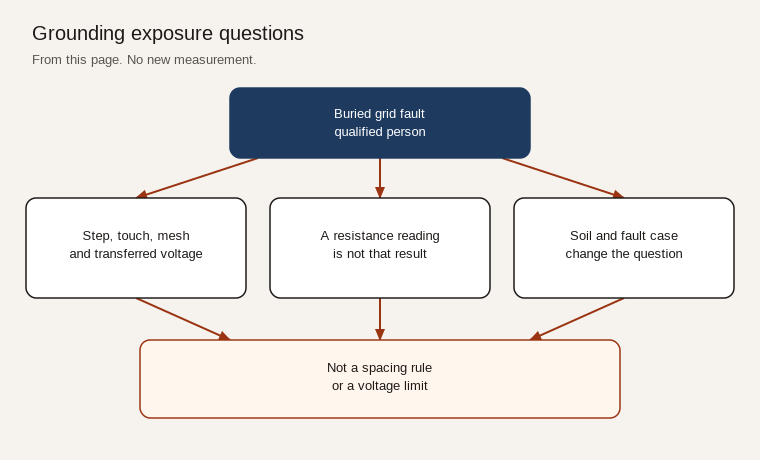
Step, touch, mesh, and transferred voltage stay separate from a resistance reading, soil and the fault case change that question, and none of this is a spacing rule or a voltage limit, so a qualified person assesses the actual site.
What the network is for
During a ground fault, some return current flows in the earth. The grid is the buried network that gives that current a metallic path into the soil and ties structures, equipment enclosures, and the fence to the same electrode. The Bureau of Reclamation’s facilities instruction on personal protective grounding describes this ground mat as the permanent electrode for non-current-carrying metal, including breaker and transformer tanks, structures, and fencing, and as the conductor that carries ground-fault current toward remote sources. That current also creates surface-voltage differences inside the yard and beyond the fence.
A rod is only an electrode. Conductor size, burial depth, and spacing are site results. This page does not give them.
IEEE 80-2013, the IEEE Guide for Safety in AC Substation Grounding, covers outdoor alternating-current substations, conventional or gas-insulated, including distribution, transmission, and generating-plant stations. With caution, the catalog says the methods may apply indoors. Direct-current problems and quantitative lightning analysis are outside it. As of November 2026, IEEE SA lists the 2013 guide as inactive-reserved, inactivated March 21, 2024, published May 15, 2015, with the 2015 corrigendum incorporated. P80, approved September 10, 2025, is an open revision for outdoor air-insulated or gas-insulated stations at 50 Hz or 60 Hz. No published replacement was listed as an active standard. Catalog status is not the edition a utility or a contract requires. A qualified professional identifies the document that governs the site.
Step, touch, mesh, and transferred voltage
Harm comes from current through the body, not from a resistance figure. OSHA’s appendix on hazardous differences in electric potential says a fault to a substation structure can still produce hazardous voltage when impedance to ground is relatively low, and that the hazard depends on current through the person and exposure time. Step potential is the voltage between the feet. Touch potential is the voltage between a grounded object and the feet of a person touching it. A person who only stands nearby can still be exposed.
The Reclamation manual defines step voltage as the surface difference across one meter between the feet, with no other grounded object touched, and touch voltage as the difference between a grounded structure and the surface under a person whose hand is on that structure. Those definitions are not a construction spacing and not a voltage limit. Its station figure separates step, touch, mesh, and transferred touch outside the fence. Mesh potential is an interior case, distinct from a hand on equipment. Transferred touch voltage is carried off the station and can be met between the hands or between hands and feet.
Because the electrode has impedance, a fault raises it above remote earth, and voltage falls with distance. OSHA’s curve is a typical shape for uniform soil. That rise is ground potential rise. Metal outside the yard, electrically connected to the mat, can carry a transferred potential as high as the rise. A pipe, rail, second fence, sheath, or neutral can do that. Tying every nearby metal part to the grid is not automatically safer.
A resistance reading is not the safety result
A request for a resistance target is not, by itself, a safety criterion. This page states none. IEEE 81-2025, published July 15, 2026, and superseding the 2012 edition, covers earth resistivity, power-frequency resistance or impedance to remote earth, surge impedance, touch and step voltages, and integrity of the grounding system. It also reviews factors that distort measurements. One resistance reading does not report the fence line, a missing conductor, or a change in soil.
A structure well connected to earth can still impress dangerous voltage during a fault. The appendix footnote says substation grounding should minimize step and touch potentials. That is an objective, not a number to copy. Resistance describes the whole electrode. A steep difference can still exist across a pace or two at the edge or where a conductor is missing.
Soil and fault assumptions change the question
OSHA’s gradient figure assumes uniform soil. Fill over clay, a dry crust over wet ground, or rock beside loam will not match that sketch. IEEE 81-2025 exists because resistivity has to be measured and because readings can be distorted, so “typical soil” is not a model. The study should state where and when it measured, how many spots, and whether it used one value or layers. Moisture and frozen ground change the same yard. A dry-week test is not a wet-week test unless the report says how the difference was handled.
The current that matters is the share assigned to the grid and the earth for the clearing time, not the transformer nameplate alone. The OSHA appendix notes that a grounded neutral is a direct, very low-impedance path to system ground, and that a substation grid is in that class when the neutral is connected to it. Pole and tower grounds are a higher impedance, so part of a fault may return on the neutral, shield wires, or sheaths. If the study ignores those paths, it should say so.
Name the fault cases. The Reclamation manual, for worksite current, says to consider both three-phase and single-phase-to-ground faults. Also name the source of the current and the clearing time, including backup clearing if used. OSHA ties the hazard to time as well as current. This page gives no formula and no time to assume.
IEEE 1547-2018 covers interconnection performance of distributed energy resources, especially on distribution systems. It is not a grounding guide. A resource that meets it can still feed a fault at the plant substation. The study needs that contribution or an explicit exclusion.
The permanent grid is not temporary protective grounding
The OSHA appendix describes paragraph (n) of 29 CFR 1910.269 as the rule for protective grounding so employees are not exposed to hazardous potential differences on lines and equipment treated as de-energized. In a substation, it says the employer may ground to the station grid, a very low-impedance path that is typically tied to the system neutral when one exists. That is why the permanent grid matters during later work. This page does not describe how to install temporary grounds. A grid that cannot carry fault current, or that a trench has cut, is a poor attachment point. One careful work mat does not show that the rest of the yard was studied.
The appendix separates conductors that carry fault current from connections that only hold metal parts at a common potential. IEEE 837-2024, published April 11, 2025, qualifies permanent connections inside the grid, from leads to the grid, and from leads to equipment and structures. As of November 2026, the open revision’s description excludes connections not intended to carry fault current, and structures outside the station grid. A line marked “ground” is not proof a connection was qualified. Name the edition. A corrigendum project and a revision were listed; neither had replaced the 2024 text on the pages read.
Fences, the surface, and metal that leaves the yard
People touch fences. 29 CFR 1910.269(u)(3) and 29 CFR 1926.966(d), as read on November 22, 2026, both require conductive substation fences to be grounded. When a fence is expanded or a section is removed, the employer must protect employees from hazardous differences in electric potential. Each note points to IEEE Std 80-2000, not the 2013 text. The eCFR text of 1926.966, displayed as current through November 19, 2026, matches the construction wording and showed no change to that section after January 3, 2017. The eCFR is not the annual printed Code of Federal Regulations.
The April 11, 2014 Federal Register preamble shows why the rule is not “keep every section electrically continuous.” OSHA had proposed that continuity when a fence grew or a section came out. Commenters said a temporary fence kept continuous with the station fence can expose people, and that isolation can be protective during an expansion. OSHA agreed that isolation, grounding, or an electrical connection may each be required. The preamble cites IEEE Std 80-2000 and states no fence detail, separation, or voltage limit. This page adds none.
Step and touch are defined at the feet, so stone, pavement, bare soil, and stone packed with fines are different studies. Name the surface. This page gives no thickness and no material value. The Reclamation manual expects the mat to control step and touch potentials inside the fence, and it flags a bay with no equipment and no buried conductors. That is a gap warning, not a numeric limit. Adding equipment there is a reason to reopen the study.
The NEC, the NESC, and IEEE 80 are not one text
IEEE C2-2023, the 2023 National Electrical Safety Code, published August 1, 2022, is an active standard whose catalog covers supply stations, overhead lines, and underground cables, including grounding rules and work rules. The catalog is not the rule text, so this page does not say what any NESC rule requires. OSHA’s substation notes still cite older editions for workspace and clearance, including ANSI/IEEE C2-2012 and C2-2002. Confirm the edition actually adopted.
NFPA 70, the National Electrical Code, is separate. On November 22, 2026, NFPA listed the 2026 edition as current and described it as enforced in all 50 states. Adoption can amend it, and a substation may sit outside that scope. A supply station and a facility station can fall under different documents. “The code” might mean the NEC, the NESC, a utility standard, or IEEE 80. As of November 2026, OSHA names the 2000 guide, IEEE SA lists the 2013 guide as inactive-reserved, and P80 is open. A yearless “IEEE 80” citation names no text, and no touch or step limit is stated here.
What the study record should make visible
Two sheets can both say “ground grid” and still describe different stations.
| Question | What a useful answer includes |
|---|---|
| Which document? | Owner, utility, and the named edition, plus exclusions such as direct-current equipment or lightning. |
| What soil? | Where and when it was measured, one value or a layered description, and how odd readings were treated. |
| What current and time? | Fault cases, the source of the current, metallic return paths, and any future system case. |
| Which exposures? | Step, touch, mesh, the fence, and transferred voltage on named off-site metal, tied to the assumed surface. |
| What was omitted? | Pipes, rails, fences, neutrals, and sheaths left out of the model, stated as exclusions. |
| What must stay true? | Surface, fence treatment while the yard is open, and connections that must remain intact. |
The table sets no passing value. Plots without these inputs are not a site judgment.
An illustrative collector station shows the gap. A developer reuses a grounding drawing from another property. Soil here is unmeasured. A future line would change the fault current. The fence will open toward a public path during construction, a metallic water pipe crosses to a building outside the fence, and the drive aisle will be paved where the old sheet assumed stone. The copied sheet answers none of those exposures. This is not a Soleil Energy project.
Later, a trench, a new gate, or a covered surface can undo an assumption, and a new short-circuit case can leave the grounding study stale. IEEE 81-2025 includes integrity checks and distorted measurements. Ask what will be repeated, and against which as-built. This page does not describe the test.
Soleil Energy’s power work includes substation engineering and short-circuit studies. A grounding-grid scope is a further conversation: bring the one-line, the owner, the utility, and what is known about soil, the fence, and nearby metal. That talk does not establish that a grid is acceptable. For a generating plant, Soleil Energy’s utility-scale solar delivery includes the substation and interconnection, but resource fault current is still an input to the grounding study. Coverage follows the published service area: Maryland, Northern Virginia, and Washington, DC.
Questions the drawing does not close
How do soil and fault assumptions change step-and-touch analysis?
Soil sets how voltage spreads, and OSHA’s uniform-soil curve will not match layers or a dry-to-wet change. Fault assumptions set the grid current and how long it flows. Using the whole fault current is a different study from one that counts neutrals and sheaths. Show both inputs. Do not borrow them from another property.
Is a low resistance to remote earth enough?
No. IEEE 81-2025 lists that resistance beside touch and step voltages and integrity checks. OSHA notes that low impedance can still come with hazardous voltage, and a low reading can hide a steep gradient at the fence or in an empty bay. It shows an electrode could be measured. It does not clear the yard for a fault.
Can IEEE 80 be used as a ready-made limit?
Not from these catalog pages. As of November 2026 the 2013 guide is inactive-reserved, a revision is open, and OSHA’s notes still name the 2000 edition. None of them states a touch or step voltage to copy. The 2014 preamble calls the guide guidance for qualified practice, not a sheet of limits.
How is the station grid different from temporary protective grounding?
The station grid is the permanent electrode. Temporary protective grounding under 29 CFR 1910.269(n), as the OSHA appendix discusses it, is how employees treat lines and equipment as de-energized. The station grid may be the point those temporary connections use. A mat can protect people standing on it and still leave others outside it exposed. Installing temporary grounds is outside this page.
What has to be decided before the fence moves?
Decide which sections stay grounded, which stay isolated while the yard is open, and when a new section may be tied in. The 2014 preamble records that blanket continuity was rejected because it can create touch and step exposure during construction. Conductive fences still have to be grounded. Hardware and timing belong to a qualified professional, not to a field guess after the posts are set.
Does an interconnection agreement replace the grounding study?
No. An agreement can require a study or name a standard. It is not the soil model. IEEE 1547-2018 governs resource interconnection behavior, not the station grid. The National Electrical Code and the National Electrical Safety Code still need an adopted edition and a scope decision. Give the agreement to the engineer as a constraint.
Project requirements depend on the site, equipment and applicable rules. Confirm design and installation decisions with the appropriate qualified professional.