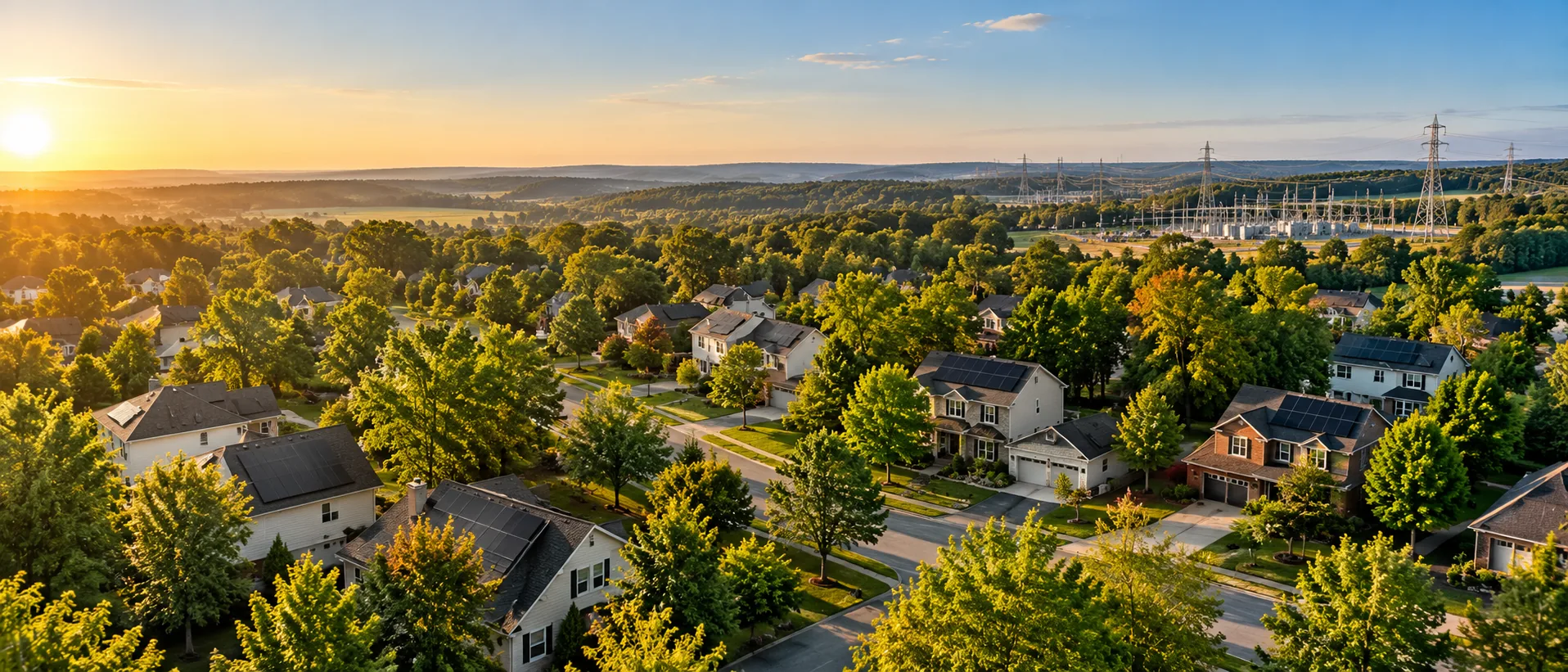

Do solar panels work in a power outage? Usually not. A standard grid-tied system switches itself off when the grid goes down, even in full sun, to protect line workers. Panels can run a home only if the system is designed to run on its own, usually with a battery, and can safely disconnect from the grid.1,2
Why does grid-tied solar shut off during a BGE or Pepco outage?
In a Baltimore Gas and Electric (BGE) or Pepco outage, grid-tied solar shuts off so it can’t send electricity onto power lines that crews are repairing. Engineers call this safety function anti-islanding. The panels stay undamaged. The inverter just stops delivering power until the grid returns.1,3
The National Renewable Energy Laboratory, now the National Laboratory of the Rockies (NLR), put it plainly in a March 2020 report: “grid-connected solar panels are automatically switched off during a grid outage” so that workers repairing downed grid components stay safe.1 A January 2018 Maryland Energy Administration (MEA) consumer guide says the same. A grid-connected system “will not function in the case of an electricity outage” unless the home also has storage and the ability to “island,” meaning to disconnect completely from the grid.3
The shutoff is fast. Sandia National Laboratories says current standards, including IEEE 1547 from the Institute of Electrical and Electronics Engineers, require an inverter to disconnect within 2 seconds of losing the grid.4 BGE’s June 4, 2024 technical guide for connecting generating equipment to its system sets the same two-second limit for island detection.5 So the rule sits in the inverter standards, and BGE’s guide follows it.
The table follows one outage from the inverter’s point of view.
| Moment | What a grid-tied inverter does | Source |
|---|---|---|
| Grid fails | Detects the loss and disconnects within 2 seconds | Sandia; BGE guide4,5 |
| Outage continues | Stays off, even in full sun | NLR1 |
| Grid returns | Stays disconnected for 5 minutes before it tries to reconnect | Sandia4 |
| After that | Production can resume, on settings the utility approved | BGE guide5 |
- Grid failsDetects the loss and disconnects within 2 seconds
- Outage continuesStays off, even in full sun
- Grid returnsStays disconnected for 5 minutes before it tries to reconnect
- After thatProduction can resume, on settings the utility approved
Each clock starts at its own trigger. They are not added together.
Inverter settings aren’t yours to change. BGE’s guide says all inverter settings must be approved by BGE, in the section on Category III inverters.5
What lets a solar home run on battery backup?
Three things: a battery or other store of energy, an inverter that can run without the grid, and equipment that cuts the home off from the grid while backup power is on. Together they let the house run as a small separate system, an island. Without storage, panels make power only while light reaches them.1,2,6
The Department of Energy (DOE) boils it down to two requirements for panels to produce power on their own: a properly configured inverter and a storage system.2 NLR adds a warning about what happens at the bottom of the battery. In an islanded system with a dual-function inverter, if the battery is completely drained at night or on a cloudy day, no energy is available until sunlight returns to recharge it.1
The table compares the common setups. It describes designs and names no product.
| Setup | Sunny afternoon outage | Night or cloudy outage |
|---|---|---|
| Grid-tied solar, no battery | No power from the panels. The system is off.1 | No power from the panels.1 |
| Solar plus a battery not set up to run without the grid | Depends on the design. Storage alone doesn’t give outage power; the inverter and controls must support running without the grid.1,2 | Depends on the design and the stored energy. |
| Solar plus a battery set up to run without the grid | Chosen circuits run from the battery and panels, within the equipment’s limits.1 | Chosen circuits run from the battery until its stored energy is used. Then nothing until sunlight returns.1 |
| Solar with a daytime-only emergency outlet, no battery | NLR describes this option for small critical loads, such as a refrigerator.1 | No power. The panels produce nothing.1 |
| Battery without solar, with its own inverter | Chosen circuits run from stored energy through a transfer switch.6 | Same, until the stored energy is used.6 |
Most backup designs feed only a chosen group of circuits, called critical loads, through a separate subpanel. The Pacific Northwest National Laboratory (PNNL) says these systems need an automatic transfer switch that disconnects the house from the grid while the backup source runs.6 If you’re weighing the whole house against a few circuits, the whole-home battery backup guide covers that choice.
One more detail separates battery types. PNNL says some alternating-current (AC) coupled batteries, which carry their own inverter, need a signal from the grid before they can start charging again after draining fully. Most direct-current (DC) coupled batteries, which work through the solar inverter, can restart from solar power alone, a capability called black start.6 PNNL says black start can be an important feature for a multi-day blackout, which is when a battery is most likely to run flat.6
Why don’t my panels restart the moment power returns?
Panels don’t restart the instant power returns. Sandia’s page says standards call for an inverter to stay disconnected for 5 minutes before it reconnects, so a short delay after the lights come back is normal.4 If the system still shows no production well after that, check your monitoring app and then call your installer.
Five minutes is what the general standard specifies. The settings approved for your own inverter come from the utility and the installer, and BGE’s guide says the utility approves them.5 If the array stays silent, the guide on a solar system that isn’t producing covers what to check next. If your installer is gone or never answers, Soleil Energy’s monitoring and maintenance service says it takes on arrays that other companies installed.7
How many power outages does Maryland have?
About one sustained outage a year for the average Maryland customer, with a wide spread by utility. EIA’s 2025 Maryland total is 0.96 interruptions and 183.9 minutes per customer. Among Maryland utilities on the standard IEEE basis, the interruption rate runs from 0.61 (Easton Utilities) to 1.80 (Choptank Electric Cooperative). Averages smooth over storm outages and your own street.8
The U.S. Energy Information Administration (EIA) collects these figures from each utility. A sustained interruption lasts more than 5 minutes. SAIFI (System Average Interruption Frequency Index) is the number of interruptions the average customer has in a year. SAIDI (System Average Interruption Duration Index) is the total minutes without power for that average customer.9
| Utility, 2025 data | SAIDI, all events (minutes) | SAIFI, all events | SAIDI, no major event days (minutes) | SAIFI, no major event days | Basis |
|---|---|---|---|---|---|
| BGE | 175.1 | 0.87 | 65.4 | 0.64 | IEEE |
| Choptank Electric Cooperative | 216.5 | 1.80 | 120.6 | 1.47 | IEEE |
| Delmarva Power (Maryland) | 114.0 | 0.93 | 66.0 | 0.71 | IEEE |
| Easton Utilities | 30.5 | 0.61 | 20.7 | 0.42 | IEEE |
| Potomac Electric Power Co (Pepco), Maryland customers | 103.7 | 0.74 | 53.8 | 0.58 | IEEE |
| Pepco, District of Columbia customers | 50.3 | 0.32 | 33.9 | 0.31 | IEEE |
| Potomac Edison (Maryland) | 399.1 | 1.30 | 173.8 | 1.05 | IEEE |
| Southern Maryland Electric Cooperative (SMECO) | 173.1 | 1.56 | 117.7 | 1.26 | IEEE |
| A & N Electric Cooperative (Maryland) | 79.2 | 2.26 | 79.2 | 2.26 | Other method |
| Dominion (Virginia Electric & Power Co, Virginia) | 306.7 | 1.78 | 144.4 | 1.32 | Other method |
EIA published these as final 2025 data on October 7, 2026.8 The first eight rows are every Maryland utility in EIA’s 2025 file that reported on the IEEE 1366 basis, plus Pepco’s District of Columbia customers. The last two rows use “another method,” which EIA’s instructions treat separately from the IEEE calculation, so they aren’t directly comparable with the rows above. A & N Electric Cooperative’s Maryland figures cover 325 customers, a small base, so its averages can move a lot. Dominion’s Virginia row is a statewide figure for the utility EIA lists in Arlington County, not an Arlington number.8,9
These are the utilities’ own reports, rounded for display, and methods differ, so treat the table as a rough comparison and not a ranking. On the IEEE basis, every “all events” figure is larger than its “no major event days” figure, because the first includes days a utility classes as major events.8,9
One storm week can undo a good yearly average. Pepco said on Sunday, September 6, 2026, that it had restored power to 99 percent of the customers who lost it in the previous Thursday’s thunderstorms, and it expected the remaining outages to be resolved that evening, according to WTOP News.10
How do I get through a long outage at home?
Plan around the loads that matter most, and assume the panels alone won’t run them in an outage. The Maryland Office of People’s Counsel (OPC) long-term outage page, with tips it attributes to Constellation, lists steps that apply with or without solar:11
- Store one gallon of drinking water per person per day.
- Stock canned and other nonperishable food, and a manual can opener.
- Keep battery- or solar-powered flashlights and plenty of batteries.
- Keep first-aid supplies and medications on hand.
The same page says, “Solar panels, too, can power your refrigerator.” True only for a system built to run during an outage. A standard grid-tied system can’t, as the documents above show.1,3,11
Food gives you a clock. The U.S. Food and Drug Administration (FDA), in guidance current as of March 5, 2024, says a refrigerator keeps food cold for about 4 hours with the door closed. A full freezer holds its temperature for about 48 hours, or about 24 hours if it is half full.12
Medical equipment is a separate question. Ready.gov lists lost use of medical devices among the effects of an outage and says to talk to your medical provider about a power outage plan for powered devices and refrigerated medicines.13 Whether a given solar or battery design could keep medical equipment running is not something a general article can answer. Settle that with your doctor and your equipment supplier before you pick a design.
Some households add a generator instead of a battery, or alongside one. Home battery vs generator lays the two side by side.
What should the proposal say about outages?
Get the outage behavior into the proposal itself. “Provides backup power” is too vague to hold anyone to. A real outage plan names the circuits, the grid-separation equipment, the stored energy at the start of an outage and what happens after dark.1,6
Questions worth having answered in writing:
- Which circuits stay powered, and which appliances can run at the same time?
- Does the system separate itself from the grid automatically, and how does it reconnect?
- How much energy is stored when an outage starts, and what happens after sunset?
- If the battery drains fully, can it restart from solar alone, or does it need a signal from the grid?
- Is this a battery for everyday use, or a design that runs without the grid?
- Who pulls the permits, books the inspections and handles the utility’s approval?
The last question has real paperwork behind it. BGE’s guide defines a distributed energy resource to include energy storage technologies capable of exporting power, and the guide sets out BGE’s technical requirements for such systems.5 If you already have solar and want to add a battery, ask the utility whether a new interconnection agreement is needed. The adding a battery to existing solar guide walks through that case, and the BGE solar interconnection and Pepco interconnection guides cover the utility steps.
Permit offices differ by county. Montgomery County’s Department of Permitting Services runs eSolar for approved installers, and its page says projects may include a new solar system plus an energy storage system such as a battery.14 Howard County’s Department of Inspections, Licenses & Permits lists an electrical permit application on its Let’s Get Started page.15 Neither page is a battery-specific checklist, so confirm the permit route for your address with your installer.
What can’t a general guide tell you?
A general guide can explain how backup works. It can’t size a system, review a home’s wiring or predict an outage at your address, and it can’t speak for your utility’s rules. These are the main limits on what you’ve just read:
- Several technical documents are older. The MEA guide is from January 2018, the NLR report from March 2020 and the PNNL page from September 2021. They explain the principles, but they may not reflect today’s products or code editions.
- The 5-minute reconnection delay is what a general standard specifies. Your inverter’s approved settings come from your utility and installer.
- The EIA averages describe whole utilities for one year, and two rows use a different method.
- County permit rules and each utility’s interconnection process change. Check the current pages for your county and utility.
Which circuits do you need to keep running?
Say a household wants only the refrigerator, a phone charger and one lamp circuit running through an outage. That list fixes which circuits go on a backup subpanel, what separates them from the grid and how much energy must be stored to carry them overnight. Add well pumps or whole-house heating and cooling and every one of those answers changes.
Soleil’s battery storage page says part of its assessment is agreeing which circuits those are, and that it adds storage to existing solar, including systems it didn’t install; your inverter decides how simple that job is.16
Decide which circuits you can’t do without, then check whether the proposal in front of you covers them. Tell us which circuits you want to keep running when the power goes out. Book a free assessment or call (301) 953-4140.
This guide is general information, not legal, tax, or financial advice.
Sources (16)
-
National Renewable Energy Laboratory (now National Laboratory of the Rockies), Will Solar Panels Help When the Power Goes Out? Planning for PV Resilience, published March 2020, https://docs.nlr.gov/docs/fy20osti/75704.pdf, read October 25, 2026. ↩ ↩2 ↩3 ↩4 ↩5 ↩6 ↩7 ↩8 ↩9 ↩10 ↩11 ↩12 ↩13 ↩14 ↩15
-
U.S. Department of Energy, Solar and Resilience Basics, page modified May 18, 2026, https://www.energy.gov/cmei/systems/solar-and-resilience-basics, read October 25, 2026. ↩ ↩2 ↩3 ↩4
-
Maryland Energy Administration and Clean Energy States Alliance, A Maryland Consumer’s Guide to Solar, published January 2018, https://energy.maryland.gov/Reports/A%20Maryland%20Consumers%20Guide%20to%20Solar.pdf, read October 25, 2026. ↩ ↩2 ↩3
-
Sandia National Laboratories, PV Performance Modeling Collaborative, Loss of Grid, undated current page, https://pvpmc.sandia.gov/modeling-guide/dc-to-ac-conversion/loss-of-grid/, read October 25, 2026. ↩ ↩2 ↩3 ↩4
-
Baltimore Gas and Electric, Quick Reference Guide: BGE Technical Interconnection Requirements, Revision 1, dated June 4, 2024, https://www.bge.com/cdn/assets/v3/assets/blt71bfe6e8a1c2d265/blt86b5a443d3247ab7/66630c7f522922000dd37333/Quick_Reference_Guide_to_Technical_Interconnection_Requirements_%28QRG-TIR%29.pdf?branch=prod_alias, read October 25, 2026. ↩ ↩2 ↩3 ↩4 ↩5 ↩6
-
Pacific Northwest National Laboratory, Building America Solution Center, PV Battery Storage for Power Outages, last updated September 29, 2021, https://basc.pnnl.gov/information/pv-battery-storage-power-outages, read October 25, 2026. ↩ ↩2 ↩3 ↩4 ↩5 ↩6 ↩7
-
Soleil Energy Corp, Monitoring & O&M, current page, soleilenergycorp.com/renewable-energy/monitoring-and-om, read October 24, 2026. ↩
-
U.S. Energy Information Administration, Form EIA-861 detailed data files, 2025 final data released October 7, 2026, Reliability and Service Territory tables, https://www.eia.gov/electricity/data/eia861/, downloaded and recomputed October 25, 2026. Values rounded for display; the Maryland state total row is also from this release. The A & N Electric Coop (Maryland) and Virginia Electric & Power Co (Virginia) rows are reported under the file’s “Other Standard” columns, not the IEEE columns. The service territory file lists Virginia Electric & Power Co (Dominion) in Arlington County, Virginia. ↩ ↩2 ↩3 ↩4
-
U.S. Energy Information Administration, Form EIA-861 instructions (file included in the 2025 data release), Schedule 4 definitions of SAIFI and SAIDI and the IEEE 1366 versus other-method reporting parts, https://www.eia.gov/electricity/data/eia861/, read October 24, 2026. ↩ ↩2 ↩3
-
WTOP News, “Let there be light: Pepco says it’s restored power to 99% of customers who were in the dark after Thursday’s storms,” published September 6, 2026, https://wtop.com/local/2026/09/let-there-be-light-pepco-says-its-restored-power-to-99-of-customers-who-were-in-the-dark-after-thursdays-storms/, read October 24, 2026. News report of a Pepco statement. ↩
-
Maryland Office of People’s Counsel, Long-Term Power Outage (tips attributed to Constellation), current page, https://opc.maryland.gov/Consumer-Learning/Storm-Preparedness/Long-Term-Power-Outage, read October 25, 2026. ↩ ↩2
-
U.S. Food and Drug Administration, Food and Water Safety During Power Outages and Floods, content current as of March 5, 2024, https://www.fda.gov/food/buy-store-serve-safe-food/food-and-water-safety-during-power-outages-and-floods, read October 24, 2026. ↩
-
Ready.gov, Power Outages, last updated June 4, 2026, https://www.ready.gov/power-outages, read October 24, 2026. ↩
-
Montgomery County Department of Permitting Services, eSolar Residential Rooftop Solar Panels, current page, https://www.montgomerycountymd.gov/department-permitting-services/all-permits/residential-permits/esolar-residential-rooftop-solar-panels, read October 25, 2026. ↩
-
Howard County Department of Inspections, Licenses & Permits, Let’s Get Started, “Electrical Permits & Licensing” section, current page, howardcountymd.gov Let’s Get Started page, read October 25, 2026. ↩
-
Soleil Energy Corp, Battery Storage, current page, soleilenergycorp.com/renewable-energy/battery-storage, read October 25, 2026. ↩