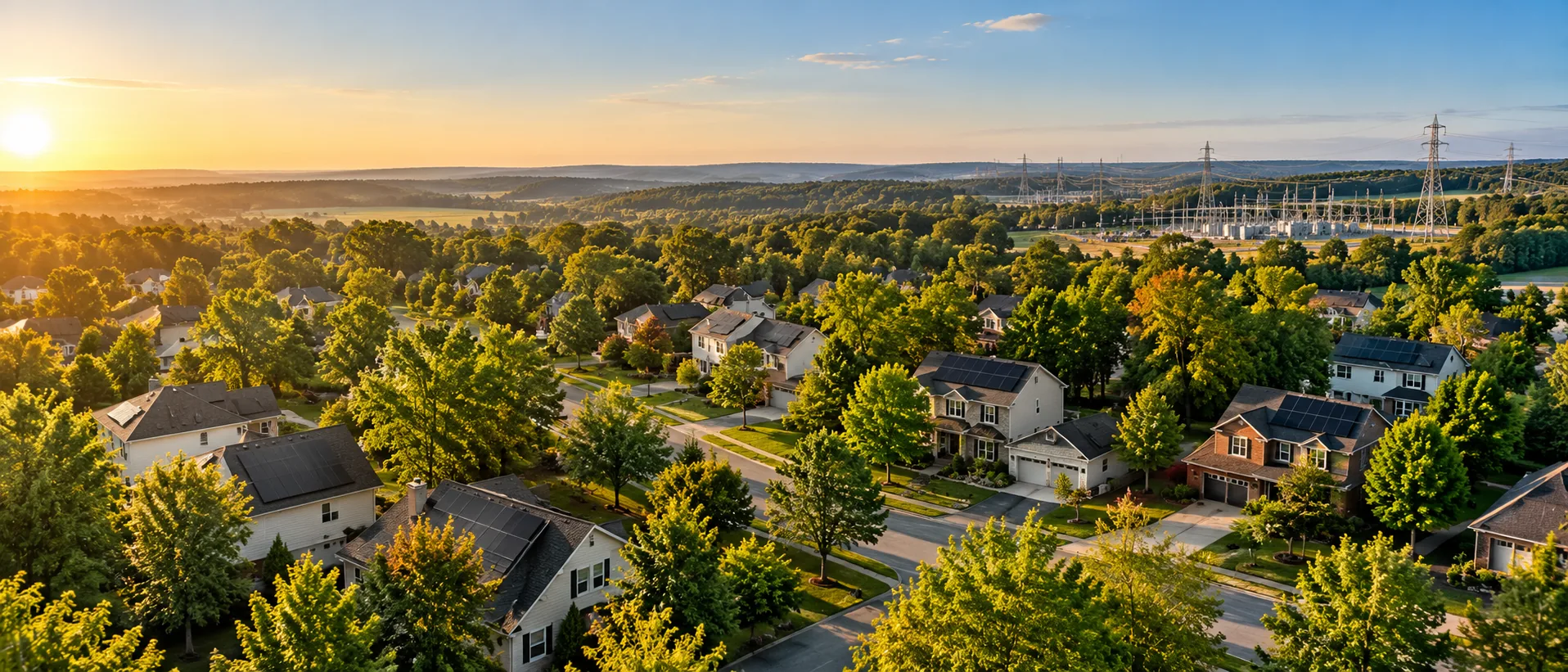

For a Howard County solar permit, your installer files the rooftop application with the Department of Inspections, Licenses & Permits (DILP). Your electric utility, usually Baltimore Gas and Electric (BGE), handles a separate interconnection application. County sign-off and BGE’s Permission to Operate are two different approvals. Columbia village, historic-district and homeowners association review can add a third layer.1,2,3
| Topic | What to know (as of October 25, 2026) | Source |
|---|---|---|
| DILP Solar Express permit | The county announced instant permit issuance for residential rooftop solar in December 2025. DILP decides whether your project qualifies. | County release4 |
| County code editions | 2024 International Residential Code, effective September 7, 2025. 2023 National Electrical Code, effective June 3, 2024. | DILP Adopted Codes5 |
| BGE residential interconnection fees | $108 hosting capacity fee and $17 administrative fee, both one-time, for applications submitted on or after May 1, 2026. The Level 1 application fee is $0.00. | BGE documents6,7 |
| Net-metering cutoff | State law closes new net-metering contracts at the earlier of 3,000 megawatts of customer capacity or July 1, 2027. The Maryland Public Service Commission (PSC) hasn’t posted a final rule on which step counts. | Chapter 353; PSC docket RM568,9 |
| County solar tax credit | Unclear. The county’s solar and incentives pages list a geothermal device credit and no solar credit, but a Finance form mentions “solar energy device.” Ask Finance. | County pages and form2,10,11 |
How does a Howard County solar permit get you to power on?
Howard County takes the permit application through DILP’s online Citizens Access Portal, and the installer normally files it, uploads the documents and books the inspections. BGE runs its own interconnection process alongside. The job moves through five handoffs, and a different party holds the pen at each one.1,2,3
| Step | What the source says | Who acts |
|---|---|---|
| 1. County permit | Contact your county about permit requirements. DILP takes the application online. Ask DILP whether a separate electrical permit applies.12 | Installer with DILP |
| 2. Interconnection application | The contractor typically submits it. The contractor’s email must match the one on your BGE account. Systems of 20 kilowatts alternating current (AC) or less may take up to 20 days to process.3 | Installer |
| 3. Install and inspect | Install after BGE approves, then arrange the county inspection. | Installer and DILP |
| 4. Net meter | BGE needs the Certificate of Completion, proof of the passed inspection and its own approval. An inaccessible indoor meter means an appointment. | BGE |
| 5. Power on | Generate after BGE’s Permission to Operate (PTO) email. | Installer and homeowner |
- County permitInstaller with DILP
- Interconnection applicationInstaller
- Install and inspectInstaller and DILP
- Net meterBGE
- Power onInstaller and homeowner
A passed county inspection isn’t the finish line. BGE’s own sequence ends with the PTO email, and its page says to start generating only after you get it.3
What goes into the county application
DILP publishes a sample handout for the roof-mounted permit. The description of work goes in all capital letters, and its three examples cover adding panels to an existing array, swapping panels during a re-roof, and installing panels on a townhouse. The form also wants panel count, water supply, sewage disposal, existing use and whether the building has a fire sprinkler system.13
The upload list is where projects stall, so it’s worth reading before you sign a contract:
- specifications and cut sheets
- a structural letter
- a roof layout showing where the panels go
- an installation certification
- a condo or homeowners association approval letter, if one applies
- for energy storage, a garage floor plan showing impact protection13
Keep the permit number and the final inspection record. BGE wants proof of the passed inspection before it sets the net meter.13,3
The solar handout doesn’t mention an electrical permit. DILP’s separate Electrical Permit Application, though, has a “Solar Panels” count line and a county electrical licensee signature block. Whether a roof-mounted system needs that permit too is a question for DILP, so get the answer before the installer files.12
How fast the county works
The county publishes some numbers. Its open-data permit file lists 1,375 permits of the type “Solar Express (residential only)” with issue dates from January 1 through November 30, 2025. The same file carries permits of that type back to December 2024, so the label is older than the December 2025 announcement.14 Live Green Howard, the county’s sustainability site, reports an average of 835 solar permits issued and 746 inspections completed per year across 2023 to 2025. The page notes that some permit holders don’t follow through with the project. It also gives 1.1 days for staff review of online applications and says DILP offers inspection appointment times rather than windows.2
Those are county-reported averages, not a promise for your roof. For the permit fee itself, DILP’s Resources & Fee Schedules page lists the current schedules.15
Which building codes do the drawings have to follow?
DILP’s Adopted Codes page is the reference. Howard County lists the 2024 International Residential Code, effective September 7, 2025, and the 2023 National Electrical Code, effective June 3, 2024, each with local amendments. Your installer’s drawings should follow those editions.5
| Code | Edition DILP lists | Effective date |
|---|---|---|
| International Residential Code (IRC) | 2024, with Howard County amendments | September 7, 2025 |
| National Electrical Code (NEC) | 2023, with local amendments | June 3, 2024 |
One more document belongs on the pile. A September 18, 2025 DILP plan-review memo to design professionals sets the snow-load rule for projects submitted after September 6, 2025: the 2024 building and residential codes apply, and the more restrictive of the national standard and the county’s local amendment governs. The memo covers every project type and never names solar. Whether it shapes the structural letter for your roof is a question for DILP’s plan review staff.16
What does BGE need from you and your installer?
You must be the customer on record in BGE’s billing system to apply. Level 1 covers systems up to 20 kilowatts AC, and BGE says almost all residential applications are Level 1.17 After approval, the county inspects the installed system, and BGE then wants the Certificate of Completion and the inspection proof before it installs the net meter.3
Not every Howard County home is on BGE. The county says interconnection runs through the Maryland utilities, primarily BGE in Howard County and also some Potomac Edison.2 Check the delivery utility on your bill. This guide covers BGE only. A Potomac Edison customer should get that utility’s process in writing from the installer.
The interconnection rules are still moving
The Public Service Commission is replacing the state’s interconnection rules in the Code of Maryland Regulations (COMAR) chapter 20.50.09 under docket RM94. Emergency regulations were scheduled to expire on October 10, 2026, and that date has passed.18 The PSC’s proposed permanent version appeared in the Maryland Register on September 18, with comments accepted through October 19.19 The Register issues of October 2 and October 16 carry no adoption notice, and the RM94 docket index shows no final order as of October 25.20,19 So the exact rule text governing an application filed today is unsettled. Ask your installer which version BGE is applying to your submission date, and check the RM94 docket for the outcome. For the utility side in more detail, see our BGE solar interconnection guide.
What does BGE charge to connect?
For residential applications submitted on or after May 1, 2026, BGE lists a $108 hosting capacity fee and a $17 administrative fee, both one time per application, plus a $0.00 Level 1 application fee.6,7 Your installer’s contract should say who pays them.
Amount. Segment width is proportional to the value.
- Hosting capacity fee$108
- Administrative fee$17
- Level 1 application fee$0.00
View the data as a table
| Charge | Amount |
|---|---|
| Hosting capacity fee | $108 |
| Administrative fee | $17 |
| Level 1 application fee | $0.00 |
The fees come from the Maryland Cost Allocation Method (MCAM). BGE says MCAM replaced the earlier “causer pays” model, where the first customer to connect to part of the grid carried the full upgrade cost. Under the secondary-voltage version, MCAM-S, upgrade costs are shared among interconnecting customers. BGE says MCAM-S doesn’t change the residential interconnection steps or the inspection process, and that the fees are due when the application is submitted.6,21
BGE’s documents spell out four points about who gets billed and when:
- Whoever submits the application online becomes the primary project contact and gets the invoices. If your installer files it, find out who that contact will be.6
- Resubmitting or correcting an application doesn’t trigger the fees again.7
- Adding panels to an existing system counts as a new interconnection application, so MCAM applies.7
- If technical review finds an upgrade is needed, BGE says it will tell the customer which parts MCAM-S covers and which costs may fall to the customer.7
BGE also tells homeowners to read the installer’s agreement, including how the installer will handle interconnection and any MCAM-related fees for you.21
What happens to net metering on July 1, 2027?
Maryland law ends new net-metering contracts at the earlier of 3,000 megawatts of customer capacity or July 1, 2027.8 The open question is what a homeowner must have done by then. The PSC’s docket index for RM56 lists entries through October 13, 2026 and no final rule.9
In June 2026 the PSC posted proposed rule text that carries three versions of the qualifying step. Each is marked with who backs it:22
| Version | Qualifying step by July 1, 2027 | Listed with |
|---|---|---|
| 1 | Submit an interconnection application | Maryland Energy Administration, Maryland Department of Transportation, Howard County and others |
| 2 | Receive permission to operate | Potomac Edison, Pepco Holdings (PHI) and BGE |
| 3 | Execute an interconnection agreement | Suggested by PSC staff |
So Howard County’s government and BGE are on record backing different steps. Until the PSC picks one, no single date is safe to plan around. Ask your installer for the date BGE received your application and the project’s current status in BGE’s portal, and keep both. A signed contract with an installer isn’t one of the three steps. Our net-metering deadline guide follows the statewide rule in more detail.
Do Columbia, Ellicott City or a homeowners association add approvals?
Your address decides whether anything gets added on top of the county permit. Columbia Association property needs village architectural approval, historic districts may need a Historic Preservation Commission certificate, and condo or homeowners association (HOA) communities need their own approval letter. The table sorts out the layers.
| If your home is… | Extra approval | Where it comes from |
|---|---|---|
| On Columbia Association assessed property | Village Architectural Committee approval | A covenant advisor for your village23 |
| In the Ellicott City or Lawyers Hill historic district | Possibly a Historic Preservation Commission (HPC) Certificate of Approval; HPC staff can say | HPC application, revised April 202624 |
| In a condo or HOA community | Association approval letter | Uploaded with the county permit13 |
Columbia. A county notice says exterior work on Columbia Association assessed property may also need approval from the Architectural Committee of the village where the work happens. That review is separate from county permits, and a county building permit doesn’t remove the need for it. The notice lists a covenant advisor for each of the ten villages, from Dorsey’s Search to Wilde Lake.23
Historic districts. The HPC’s application form has boxes for the Ellicott City and Lawyers Hill districts. It asks for a typed description of the project, labeled photos, product sheets and plans, and applications are due 22 days before the meeting. The form is general, not written for solar. HPC staff at preservation@howardcountymd.gov can say whether your roof work needs a Certificate of Approval.24
Homeowners associations. Maryland Real Property section 2-119 says a restriction on use may not impose unreasonable limitations on installing a solar collector system on the roof or exterior walls, provided the owner owns or has the right to exclusive use of that surface.25 The statute says a restriction is unreasonable if applying it to a particular proposal increases the installation cost by at least 5 percent over the projected cost of the initial proposal, or reduces the system’s output by at least 10 percent below the initial projection.25 The owner has to give the association documentation, prepared by an independent solar panel design specialist who meets the statute’s qualifications, showing the restriction is unreasonable.25 The section does not apply to a restriction on historic property listed in, or found eligible for, the Maryland Register of Historic Properties, and an association may prohibit or restrict systems in common areas.25 How the section applies to your association’s rules is a question for the association or a Maryland real estate attorney.
Zoning. The county’s solar page says Council Bill 17-2021 allows rooftop solar collectors in all zoning districts.2
Is there a Howard County solar tax credit?
It’s unclear, and the county’s own pages don’t agree. Its solar and incentives pages list a geothermal device credit and no solar credit, but a Finance Department form citing the same code section mentions a “solar energy device” in its opening paragraph. Email Finance before you budget for a county solar credit.2,10,11
Live Green Howard’s solar page names state and federal programs but no county solar credit. Its incentives page lists a residential Geothermal Energy Device Tax Credit, the lesser of 50 percent of eligible costs or $5,000 for a heating or electric generating system, and a commercial High Performance Building Credit.2,10
The county Finance Department’s tax-credits page has the same geothermal heading and no mention of solar, and it shows a June 30, 2026 application deadline that has already passed.26 The form is “Application for Tax Credit for Energy Conservation Devices,” and it cites Howard County Code section 20.128A. Its opening paragraph refers to a residential structure that “utilizes a solar energy device or geothermal energy device.” The certification form attached to it is titled for geothermal heating or electric generation, with fields only for geothermal system details. The form says to apply by June 30 before the first tax year you want the credit.11
So don’t count on a county credit for rooftop solar because one line mentions “solar energy device.” Email taxcredit@howardcountymd.gov and ask whether a rooftop solar-electric system qualifies, how it should be certified and what the next deadline is.11 Have a tax professional check any tax credit before you count on it.
Two other items sit outside the county credit. Maryland Tax-Property section 7-242 says solar energy property, meaning equipment installed to use solar energy to generate electricity for use in a structure or supplied to the grid, is not subject to real property tax, except as provided in section 8-240 of that article. Section 8-240 addresses how solar heating and cooling systems are assessed.27 That is state law, separate from any county credit. The county’s solar page also points income-eligible households to the Maryland Solar Access Program (MSAP), which offers rebates on projects by vetted installers listed on the Maryland Energy Administration’s site. Ask any installer whether it is on the program’s contractor list.2 The same page says the federal tax incentives for residential solar end on December 31, 2025, a date that has now passed. How that affects your system is a question for a tax adviser.2 Our guides on Maryland solar incentives, the Maryland Solar Access Program and the federal solar tax credit cover those in full.
What do Maryland’s 2027 permitting rules mean for Howard County?
Chapter 353, Acts of 2026, requires each county to run solar permitting software by August 1, 2027, to hit an average 5-business-day inspection turnaround for projects permitted that way, and to cap those permit fees at $500.28 The table has the details.
| Requirement | Date | Detail |
|---|---|---|
| Solar permitting software | August 1, 2027 | Each county implements it for residential solar, storage, panel upgrades and derates. |
| Inspection speed | Average of 5 business days | Required for projects permitted by solar permitting software, after a properly completed inspection request. |
| Fee cap | From August 1, 2027 | A county may not set a permitting fee above $500 for permits issued by solar permitting software, for a residential rooftop system under 20 kilowatts AC. A third-party payment-processing charge may be added.28 |
The enrolled text of Chapter 353 prints the fee-cap size threshold twice, once as 20 kilowatts and once as 30 kilowatts AC.28 The Department of Legislative Services’ summary uses 20 kilowatts, the figure in the table.28 A county doesn’t have to comply if it requires no permit for residential solar or if the state determines the software is no longer maintained. The Maryland Energy Administration must delay or suspend the requirement if state or federal funding for counties falls short.28
Howard County announced Solar Express in December 2025.4 The county’s release doesn’t say how the state definition of permitting software applies to it, so don’t assume the 2027 limits already govern your permit. DILP can tell you what your project goes through today.
Which three dates should you write down?
Settle the layers that belong to your address first: utility, village, historic district, association. Then get three dates from your installer in writing: when the county permit was filed, when BGE received the interconnection application, and when BGE emailed the PTO. If the July 1, 2027 rule lands on a step you haven’t reached, those dates matter.
Talk through your Howard County project
Bring your BGE bill, roof details and any DILP correspondence. Soleil Energy serves Howard County, including Columbia and Ellicott City, as listed on its service-area page, and its residential solar service page describes how a project moves from assessment to support. For general questions, see the frequently asked questions (FAQ). Book a free consultation or call (301) 953-4140.
Solar savings and incentive eligibility depend on your roof, your usage, your utility, and your tax situation. Incentive programs change and some have limited funding. We are not tax advisors — we will review your bill with you and tell you what you may qualify for. Confirm any tax credit with a qualified tax professional.
Program rules decide who qualifies. Ask any installer whether it is on the program’s contractor list.
Sources (28)
-
Howard County Department of Inspections, Licenses & Permits, Inspections, Licenses & Permits, “Solar Panel Permits” section and Citizens Access Portal link; current page, read October 25, 2026. ↩ ↩2
-
Live Green Howard County (Howard County Office of Community Sustainability), Solar, “Financing and Incentives”, “Equitable Access”, “Policies and Processes” and “Consumer Protections and Solar Rights” sections and solar metrics paragraph; current page (references spring and fall 2025 updates), read October 25, 2026. ↩ ↩2 ↩3 ↩4 ↩5 ↩6 ↩7 ↩8 ↩9 ↩10
-
BGE, Getting Started with Solar Power, steps 2 to 6; current page, read October 25, 2026. ↩ ↩2 ↩3 ↩4 ↩5 ↩6
-
Howard County Government, Howard County Executive Calvin Ball Unveils the County has Achieved Platinum Status for its Transformational Solar Leadership from SolSmart, press release dated December 16, 2025; read October 25, 2026. ↩ ↩2
-
Howard County DILP, Adopted Codes; current page, edition and effective dates as listed, read October 25, 2026. ↩ ↩2
-
BGE, Maryland Cost Allocation Method: Overview for Residential Customers, PDF dated May 1, 2026 (effective date for MCAM-S); read October 25, 2026. ↩ ↩2 ↩3 ↩4 ↩5 ↩6
-
BGE, MCAM-S Frequently Asked Questions, PDF dated June 12, 2026, questions 4, 10, 11 and 12; read October 25, 2026. ↩ ↩2 ↩3 ↩4 ↩5 ↩6
-
Maryland General Assembly, Chapter 353, Acts of 2026 (House Bill 1532), Public Utilities Article section 7-306(d)(1), chapter text PDF created May 12, 2026; read October 25, 2026. ↩ ↩2
-
Maryland Public Service Commission, Docket RM56 index, entries through October 13, 2026 (entry 476); read October 25, 2026. ↩ ↩2
-
Live Green Howard County, Incentives, “Howard County Tax Credits” section; current page, read October 25, 2026. ↩ ↩2 ↩3
-
Howard County Department of Finance, Application for Tax Credit for Energy Conservation Devices (Howard County Code section 20.128A, CB17-2025), PDF created May 16, 2025; read October 25, 2026. ↩ ↩2 ↩3 ↩4
-
Howard County DILP, Electrical Permit Application (current posted PDF form; undated, filename shows a July 2015 version), fixture-count section with a “Solar Panels” line and a licensee signature block; read October 25, 2026. ↩ ↩2
-
Howard County DILP, Sample Residential Roof-Mounted Solar Panel Permit handout, PDF created November 5, 2025; read October 24, 2026. ↩ ↩2 ↩3 ↩4
-
Howard County Open Data, Building, Electrical, Fire, Grading, Mechanical, Plumbing & Sign Permits, records with permit type “SOLAR EXPRESS (RESIDENTIAL ONLY)”; dataset last refreshed December 4, 2025 (the county updates it annually in December); queried October 24, 2026. ↩
-
Howard County DILP, Resources & Fee Schedules; current page, lists FY2027 schedules, read October 25, 2026. ↩
-
Howard County DILP, Ground Snow Load Requirements for 2024 International Building Code, plan-review memo dated September 18, 2025; read October 25, 2026. ↩
-
BGE, Choosing an Application; current page, read October 25, 2026. ↩
-
Maryland Public Service Commission, Notice of Opportunity to Comment and Rulemaking Session, RM 94, notice dated July 10, 2026; read October 25, 2026. ↩
-
Maryland Division of State Documents, Maryland Register, Volume 53, Issue 19, September 18, 2026, Notice of Proposed Action 26-143-P (COMAR 20.50.09, RM 94), Assembled issue, stating comments are accepted through October 19, 2026 and that the permanent regulations replace emergency regulations expiring October 10, 2026; Issues 20 (October 2) and 21 (October 16), 5320 and 5321, list the proposal in their indexes with no adoption notice; read October 25, 2026. ↩ ↩2
-
Maryland Public Service Commission, Docket RM94 index, “Revisions to COMAR 20.50.09,” entries through October 19, 2026 (entry 47); read October 25, 2026. ↩
-
BGE, Maryland Cost Allocation Method: Scenario-Based Guide for Residential Customers, PDF dated May 1, 2026; read October 25, 2026. ↩ ↩2
-
Maryland Public Service Commission, Proposed Regulations RM 56, COMAR 20.50.10.01 section D(1)(c), three versions; posted June 2026 (PDF created June 25, 2026); read October 25, 2026. ↩
-
Howard County Department of Planning and Zoning, Reminder to those obtaining permits for Columbia Association assessed property, one-page PDF created March 2, 2026; read October 25, 2026. ↩ ↩2
-
Howard County Historic Preservation Commission, General Application for Certificate of Approval and Tax Credit Pre-Approval, revised April 2026; read October 25, 2026. ↩ ↩2
-
Maryland General Assembly, Real Property section 2-119, current statute text, page undated; read October 25, 2026. ↩ ↩2 ↩3 ↩4
-
Howard County Department of Finance, Tax Credits, “Geothermal Device” section, which shows an application deadline of June 30, 2026; current page, read October 25, 2026. ↩
-
Maryland General Assembly, Tax-Property section 7-242, subsections (a)(3) and (b), and section 8-240, current statute text, pages undated; read October 25, 2026. ↩
-
Maryland General Assembly, Chapter 353, Acts of 2026, Local Government Article section 1-1320(c) to (g), chapter text PDF created May 12, 2026; read October 25, 2026. The chapter text prints the rooftop size threshold for the fee cap as “less than 20 kilowatts” in one place and “less than 30 kilowatts” in another. Department of Legislative Services, fiscal and policy note for HB 1532, which describes the cap as applying to systems under 20 kilowatts; read October 25, 2026. ↩ ↩2 ↩3 ↩4 ↩5