
An automatic transfer switch connects a chosen load to one electrical source or another when its controller sees the conditions it was set to watch. The switch does not make electricity. Open transition, closed transition, and a bypass answer different questions: whether the load may go dark for a moment, whether two live sources may be joined, and whether the switch itself can be isolated while the load stays supplied. A qualified professional has to judge the actual service.
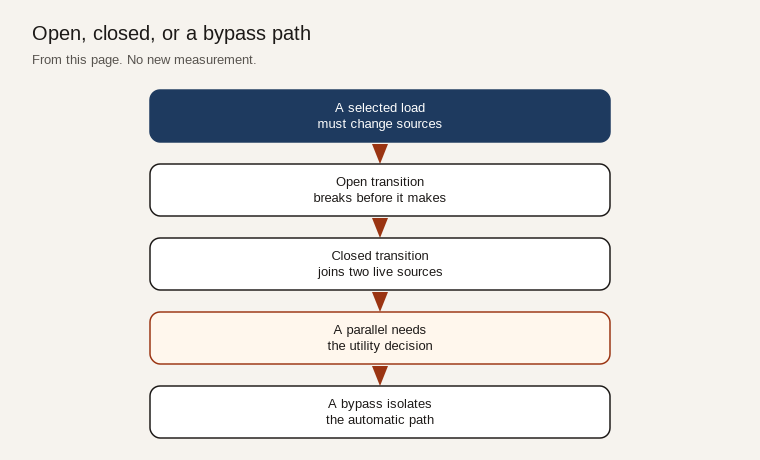
Open transition lets the load go dark between sources, closed transition briefly joins two live sources, and a bypass is a separate path for isolating the automatic mechanism while the load stays supplied.
| Question | Open transition | Closed transition | Bypass |
|---|---|---|---|
| Contact order | Break before make: the load leaves the first source before it reaches the second | Make before break: the new source connects before the old one is released | A second path so the automatic mechanism can be isolated |
| What the load sees | A break it must ride through, with the sources kept apart | A brief overlap only while both sources are available and in phase | Supply can continue while the automatic mechanism is isolated |
| If the source being left has failed | The open move remains once the alternate source is acceptable | There is nothing acceptable to overlap, so the loss is not hidden | The bypass does not start a generator or erase the cutover |
| Whose approval is separate | The listing and the studies still have to support the unit | A parallel can require prior utility approval, which is not the product mark | The submittal has to say whether that path can transfer without a person |
| What the name does not settle | It does not make electricity or size the generator | It does not make an unplanned outage invisible | It is not another transition mode and it does not replace a test |
What the switch is asked to do
The job is to watch the sources, decide from its own logic when the load should move, operate the mechanism, and show the result. On many generator arrangements it also sends a start or stop request. The generator remains a separate machine. The switch does not produce power, size that machine, or classify the building.
Cummins describes three triggers: a person throws a mechanism, a person presses a control that drives it, or a controller acts with nobody at the gear. Only the third is automatic. That overview says the controller may see loss of the normal source, call for a standby generator, connect the load when the alternate source is acceptable, return the load when the normal source is back in its window, and then allow the generator to shut down. That sequence is not a timer chart and not a wiring method.
What sits on the switch is the load it can move. Everything else stays on whatever else feeds it. A service-equipment marking, when the unit has one, is a product fact. It is not permission to land on a particular side of the meter. Dominion Energy’s Virginia requirements, in the section read for this page, say customer emergency generation connects in the transfer switch on customer equipment beyond the meter base, and not on the line side of the meter. That is one utility’s rule.
Open transition, closed transition, and a bypass are different decisions
Open versus closed is the order of the contacts during a transfer. A bypass is whether a second path exists so the automatic mechanism can be isolated. A project can need any combination. None of the three names selects the others.
Open transition disconnects before it reconnects
An open transition is break-before-make. The load leaves the first source before it reaches the second, so for that interval neither source is feeding it. Cummins splits this into a delayed open move and an in-phase open move. The delayed form holds the load off both sources, which is often discussed where motors or transformers should not be reconnected while residual voltage remains. The in-phase form waits until the sources line up, then still breaks before it makes. Cummins notes that the in-phase form depends on a controller and is not a manual operation. This page sets no delay, pickup, or frequency window. The advantage is that the sources stay apart. The limit is the break the load must ride through.
Closed transition briefly joins two live sources
A closed transition is make-before-break. The switch connects the new source before it releases the old one, and only when the sources are in phase. During the overlap they are in parallel. People ask for that when a test, or the return to the normal source, must not drop the load.
Cummins states the limit: closed transition needs the source being left to stay available until the move finishes. If that source has already failed, there is nothing acceptable to overlap, and the switch may then use a delayed open transition. An unplanned outage is not made invisible. The alternate source still has to start and be allowed to parallel.
The parallel is a utility decision. Two local documents show how far apart those rules can be.
Dominion Energy’s Virginia section on customer generation, read on November 22, 2026, says company approval is not needed for portable or standby generators that use manual or automatic break-before-make switching, because that disconnects the customer and avoids backfeed. The same section requires prior written approval for a parallel or a closed transition, even for a few cycles, and recommends that approval during design, before purchase. It lists National Electrical Code titles for Article 700, Emergency Systems; Article 701, Legally Required Standby Systems; Article 702, Optional Standby Systems; and Article 705, Interconnected Electric Power Production Sources, and it points code questions to the local electrical inspector. No revision date was printed on the pages read. This is not a Pepco, BGE, or District of Columbia rule, and it is not the NEC text.
SMECO’s connection-requirements file, also read on November 22, 2026, includes an exhibit effective February 28, 2019. It describes make-before-break switching that parallels the supplies for no greater than 5 minutes and points to IEEE 1547 for that span. An automatic transfer switch proposed only for that duty is reviewed case by case, including a failed switch that could hold a continuous parallel. Additional relaying may not be required if the switch can finish in less than 100 milliseconds, has a retrip against a stuck parallel, and protection is for one-way power flow. Those figures are that exhibit’s conditions, not a pickup or another utility’s limit. Ask SMECO whether a newer document controls.
As of November 2026, none of those utility sentences is the adopted electrical code. The edition, the amendments, and the inspector’s reading still have to be confirmed for the address.
A bypass is a maintenance path, not another transition
A bypass asks whether the load can stay supplied while the automatic mechanism is isolated. UL 1008’s catalog scope, ninth edition published July 13, 2022, reprint through August 25, 2026, applies to bypass and isolation switches used to manually select an available source and to totally isolate an automatic transfer switch. Cummins describes a second circuit that carries power while the other circuit is inspected or tested, so that work need not interrupt the load.
That choice is not open versus closed. A bypass does not start a generator or replace an accepted test. The submittal has to say whether the second path can transfer without a person. This page did not read a code section that requires a bypass for any occupancy. The design professional and the authority having jurisdiction decide.
A product listing is not installation approval
As of November 2026, the UL 1008 scope read here covers automatic, non-automatic, closed-transition, hybrid, fire-pump, bypass, soft-load, and service-equipment types, among others, at a maximum of 1000 volts in non-hazardous locations. Per that scope it does not apply over 1000 volts, to solid-state static transfer equipment, or to certain double-throw switches for optional standby systems. Sensing and time-delay controls are inside the requirements described there. The catalog is not a listing of a particular unit.
UL Solutions lists separate UL 1008 categories for automatic transfer switches in emergency systems, automatic transfer switches in optional standby systems, and nonautomatic transfer switches. A mark is an investigation category. It does not classify the occupancy or prove the installation. Static equipment sits outside the exclusion above.
NFPA’s page for NFPA 110, read on November 22, 2026, lists the 2025 edition and describes performance requirements for emergency and standby power systems supplying selected circuits when the normal source fails. Transfer equipment is part of that system, with the source and the controls. Publication is not adoption. Maryland, Virginia, and the District of Columbia still have to be confirmed locally. Test intervals from that standard were not the text read here.
Which sources, and which loads
Cummins groups applications as utility-to-generator, utility-to-utility, and generator-to-generator. The first usually has to start a machine. The second may choose between two live services. The third assumes more than one on-site source. Each pair is a different failure for the controller to recognize.
Ordinary grid-tied photovoltaics stop delivering when the utility source is gone. Soleil Energy’s guide on solar panels during an outage explains that shutoff. The home battery and generator comparison is household backup, not a facility specification. An inverter that islands a few circuits is not a UL 1008 switch between a service and a generator. Life-safety lighting, a legally required system, and an optional process are not one feeder. Dominion’s article titles are a reminder of that split. This page does not assign a building to an article.
What changes in scope, approval, and the outage window
The single-line has to show both sources, the switch, and what is not on the switch. Available fault current, withstand information, and coordination are study questions. Whether the grounded conductor is switched follows the grounding and ground-fault arrangement. This page will not assign a pole count or a wiring method.
Closed transition adds the utility interface those documents already separate from break-before-make. Pepco, BGE, and a District service can differ from both. Buying first is how a make-before-break unit arrives for a service that will only accept a break. Cutting an existing service into a new switch de-energizes something unless a temporary source was engineered. A bypass can shrink later maintenance outages. It does not remove that cutover. A load-moving test either opens the circuit or parallels sources. A controller-only test does not show that the load moved. This page states no price. Approval still includes the permit, the enforced code edition, and the utility when a parallel is possible.
Records, and the line around the controller
The handover should show the as-built sources, the transition type, any bypass, the utility’s position if a parallel is possible, the code edition on the permit, and whether the test moved load. Settings belong there because they defined an acceptable source that day. This page does not publish them.
NIST’s Guide to Operational Technology Security, Special Publication 800-82, Revision 3, September 2023, describes operational technology as programmable systems that monitor or control devices and processes in the physical environment. A controller that senses voltage and causes a transfer fits that description. The document is guidance, not a certification requirement. A draft of Revision 4 was still open for comment through November 30, 2026, when the page was read. An unrecorded setpoint change changes the physical transfer.
Work rules are a different boundary. OSHA’s section on generation, transmission, and distribution covers operation and maintenance of those installations. A note says Subpart S covers supplementary generating equipment used only for emergency, standby, or similar workplace supply, and the section does not apply to Subpart S installations and work practices. OSHA’s construction section covers construction of transmission and distribution lines and equipment. A premises transfer switch is not, by those words, the same task as building a line. Which standard applies depends on the work. This page is not a switching procedure.
An illustrative contrast, not a design
Illustrative only. A warehouse owner wants office lights and a security panel on a generator and can accept a break on that feeder. Dock equipment stays on the utility. Nothing in the plan parallels the generator. An open-transition switch on the selected panel matches that story only if the studies and the listing support it. A clinic owner wants imaging to stay up during a planned exercise and during the return to utility, and the utility has not said whether a brief parallel is allowed. Closed transition is a question, not a purchase, until that letter exists. Neither owner has decided whether maintenance must happen without dropping the selected loads. That is the bypass question, and it stays open after the transition type is chosen.
If that utility refuses every parallel, closed transition is the wrong purchase. If the only problem is a grid-tied array that stops with the utility, the switch will not keep those panels online.
Frequently asked questions
Does the switch keep the whole building online when the utility fails?
No. Only the connected load can move, and only after the alternate source is acceptable. A generator that does not start, or a breaker left open upstream, still leaves that load down. A grid-tied inverter that shuts off is not that alternate source.
If the normal source has already collapsed, will closed transition hide it?
No. The overlap needs the source being left to stay available. After an unexpected loss, the move that remains is the open form once the alternate source is ready. Loads that cannot tolerate the start interval need a different support method, designed for the site, not a different label on the same switch.
Is a bypass the same decision as open or closed transition?
No. The contact sequence and the maintenance path are specified separately. A unit can be open-transition with a bypass, closed-transition with a bypass, or neither. UL 1008’s scope describes the bypass function as manual selection plus isolation. Read the submittal before assuming the bypass path can transfer on its own.
Does a UL 1008 mark settle the code edition and the utility?
No. As of November 2026, the mark is the product investigation, not the inspector’s adopted edition and not the serving utility’s parallel rule. Dominion’s Virginia text does not govern a SMECO account, and NFPA 110’s published 2025 edition is not itself a local adoption.
What should the handover show that a shop drawing does not?
Which test actually occurred. A shop drawing can show a closed transition that the utility later refused, or a bypass that was deleted. The record should state the as-left transition type, whether load moved, and the code edition on the permit. Settings come from the equipment, not from an example.
What does the switch change about scope and approval?
It puts a controlled meeting point between sources and a selected load, so studies, grounding, the listing category, maintenance access, and any parallel approval have to name that point. It does not approve the generator, classify the occupancy, or set a price.
Bring the source arrangement and the outage window
Soleil Energy’s power infrastructure work includes studies, switchgear and protection, distribution, commissioning, and maintenance for the projects described on that page. Many premises transfer switches sit below that work, and the UL 1008 scope read here stops at 1000 volts, so not every switch is inside that description. The useful conversation is the interface: source arrangement, whether a closed transition needs a utility yes before purchase, what must go dark to cut over or to test, and which records exist afterward. Soleil Energy’s published service area is Maryland, Northern Virginia, and Washington, DC, with named counties and no District office.
Bring the single-line, the load list, the serving utility, and the outage window you have. A qualified professional still has to assess the service. This page is educational. It is not a transfer sequence, a settings sheet, or an approval.
Project requirements depend on the site, equipment and applicable rules. Confirm design and installation decisions with the appropriate qualified professional.