
Construction allowance vs contingency separates a named sum for a known scope item whose price or selection is still open from a reserve for costs that are uncertain in whether they will occur or what they will cost. The owner usually selects the allowance item, and the contract sum moves to the actual cost. Control of a contingency belongs to whoever the contract names, and neither fund covers the other’s job.
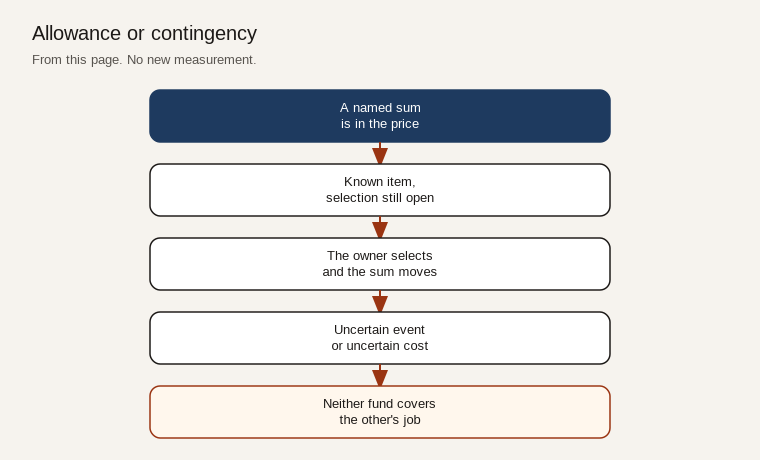
A known item whose selection is still open is an allowance the owner directs, while an uncertain reserve is a contingency only the named party may draw, and neither sum covers the other.
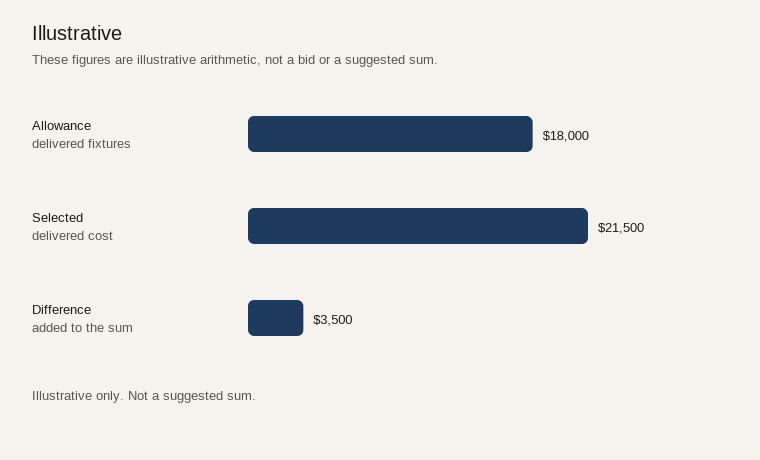
These figures are illustrative arithmetic already written for the fixture example, and they are not a bid or a suggested sum.
Two different questions
An allowance answers a narrow question. The item is in the work, and someone still has to choose the product, the quality, or the exact quantity. Flooring, fixtures, hardware, and a measured quantity of excavation are typical. The work is expected. What is open is the specification or the measured amount.
A contingency answers a wider question. Some costs are not yet pinned to a line, and experience says a portion of that uncertainty will become real cost. Estimating misses, design development that stays inside the agreed scope, and buyout gaps are the usual subjects. An allowance is not a quiet contingency, and a contingency is not a finish nobody has picked.
A schedule-of-values label does not make two bids the same offer. A low base with a thin fixture allowance can cost more after selection than a higher base whose allowance matches the product. A large contingency can be priced risk, or scope pulled out of the trade lines. The definition and the draw rules decide which.
Who directs an allowance
As of November 2026, unmodified AIA Document A201 (2017), section 3.8, in the AIA public explanation and in the 2017 general conditions, sets a clear split. The contractor includes every stated allowance in the contract sum. Items are supplied for the amounts, and by the persons, the owner directs. The contractor need not employ someone to whom it has a reasonable objection. The owner selects the materials and equipment with reasonable promptness.
Unless the documents say otherwise, the allowance covers materials and equipment delivered at the site, and required taxes, less trade discounts. Unloading, handling, labor, installation, overhead, profit, and other expenses contemplated for that allowance sit in the contract sum, not in the allowance. If actual cost is higher or lower, a change order adjusts the contract sum for the delivered-cost difference and for any real change in those contractor costs. Installation that did not change is not repriced.
The owner controls the selection. The contractor controls the purchase and may refuse a supplier on a reasonable objection. Neither holds the allowance as a free balance.
Supplementary conditions often rewrite section 3.8, sometimes putting labor inside the allowance or using a unit-price quantity instead of a cash allowance for a selected product. Read the schedule and any amendment before treating the unmodified split as the deal.
What an allowance does not cover
An allowance does not cover unnamed scope. A plumbing-fixture allowance does not pay for an added restroom, a fixture count the drawings never showed, or a piping redesign. Those are changes, not a reconciliation of the named item.
Under the unmodified AIA split, it also does not cover unloading, handling, installation labor, overhead, or profit. Those belong in the contract sum because the installation can be seen even when the model is unpicked. A heavier product that truly changes labor can be included as a change in the contractor’s costs. If labor does not change, the reconciliation is the material difference only. A fresh markup on every overrun, with no written rate and no change in the work, is not what section 3.8 says.
An allowance does not cover mistakes on fully specified work, defective work, or a subcontractor default. It does not cover a differing site condition, a code change, or a larger program. It is not a bond, and it does not move into contingency unless the contract says so. An underrun credits the contract sum. An overrun charges it.
A late selection is also outside the allowance amount. The owner must select with reasonable promptness. The form states no fixed number of days. Any time or cost effect depends on the schedule, the notice clause, and the facts.
Who may draw a contingency
“Contingency” names different funds. AACE International’s terminology, read in November 2026, defines an estimating allowance as resources for known but undefined requirements (entry dated December 2011). Its contingency entry, dated February 2021, is money added where occurrence or effect is uncertain and experience shows aggregate cost is likely. It is expected to be spent. It usually excludes major scope changes, extraordinary events, management reserve, and escalation. It can include estimating error and design development inside the scope. That is not permission to spend. The contract is.
Federal budgeting uses another pair. In the glossary of the GAO Cost Estimating and Assessment Guide (GAO-20-195G, March 12, 2020), contingency means funds held at or above the program office for uncertain items outside a contractor’s control, and management reserve means contractor-managed funds for uncertain items inside the contract scope. The guide’s product page notes that the practices apply to federal construction. Other users remix the labels, so do not import the pair without reading the clause.
Inside a maximum price, control is whatever the form says. As of November 2026, the August 15, 2025 ConsensusDocs announcement says the updated at-risk agreement defines contingency at section 2.4.4, places it inside the maximum price at section 3.4.2.8, and adds shared savings at section 7.2. The announcement does not reprint the clauses, and shared savings is not a standard split.
The AIA summary of the 2017 cost-of-the-work agreement with a maximum price is narrower. Section 12.1.5.2 says schedule-of-values lines are not separate ceilings; only the overall maximum price is. Section 12.1.5.3 requires documentation to the architect when cost moves off a contingency line. Backup is not permission for the owner to spend that line on the owner’s changes.
A November 15, 2023 ConsensusDocs newsletter commentary states the negotiating pattern, not a statute: an allowance is expected scope still undefined in quantity, quality, or design; a contractor’s contingency is for the contractor and usually cannot fund a change order; an owner’s contingency often sits in financing and funds changes. A remainder is shared, returned, or kept only if written.
DBIA describes design-build as one contract for design and construction. In the progressive variation, qualifications come first and the price develops with the design, so a design contingency should move into trade lines or named allowances as the documents settle.
What a contingency does not cover
A contingency does not cover the next thing the job needs. A negotiated clause may pull escalation, a buyout shortfall, or a subcontractor default back in even when an estimating standard leaves them out. When the estimate and the contract disagree, the contract controls payment.
On usual negotiated wording, a contractor’s contingency does not pay for an owner-directed addition or an allowance selection. An owner’s contingency does not pay for defective work or for risk already in the price. A line on a pay application shows the transfer. It does not decide who may approve it, or whether the contract sum changes.
Contingency does not replace notice. On a federal fixed-price construction contract, FAR 52.236-2, as of the March 13, 2026 edition read in November 2026, requires written notice before conditions are disturbed. It covers subsurface or latent conditions that differ materially from those indicated, and unknown physical conditions of an unusual nature for that kind of work. A qualifying cost or time difference is an equitable adjustment by written modification, not an automatic contingency draw. A missing notice can bar the request, and final payment cuts off a late one. A private form may assign some of that risk to a contingency. The signed text decides.
A bond is not a substitute either. FAR subpart 28.1, read in November 2026, prescribes bid security and performance and payment bonds for federal construction, including above the statutory threshold stated there. A performance bond responds to a failure to perform. A payment bond responds to unpaid labor and material. Neither is a balance for a finish or an estimating miss. Additional security after a price increase tracks the new price. It does not refill a contingency.
The same federal words mean something else
As of November 2026, FAR 31.205-7 in FAC 2026-01, effective March 13, 2026, defines contingency for the cost principles as a possible future event or condition, from known or unknown causes, whose outcome is indeterminable now. Historical contingency cost is generally unallowable. For future estimates, foreseeable effects of known conditions, such as anticipated rejects, go into the estimate. Effects that cannot be measured that precisely, such as pending litigation, stay out of the lines and are disclosed separately, with the basis, so coverage can be negotiated.
FAR 36.207 prefers lump-sum pricing, but it calls for unit prices when a quantity such as excavation cannot be estimated confidently without a substantial contingency, or when quantities may change significantly. Price that quantity in the open. A unit price resembles a quantity allowance, not a risk reserve, and it is not a cash allowance for a selected finish.
FAR 36.205 uses “allowances” as a funding test: an award shall not, with allowances for government-imposed contingencies and overhead, exceed the statutory authorization. That is not a fixture allowance, and it does not authorize spending a contingency. An offer inside a limit only because it is materially unbalanced is rejected. None of these sections sets a commercial percentage for either line.
Match the lines, then rank the bids
| Question | Allowance | Contingency |
|---|---|---|
| Is the item known? | Yes. A product, assembly, or quantity is named. | No single item. The reserve is for stated uncertainty. |
| Who controls use? | The owner selects. The contractor buys, and may refuse a supplier for a reasonable objection. | The clause. Often the contractor for listed risks, and the owner for an owner reserve. |
| What moves the price? | A change order for the difference, unless the documents say otherwise. | A draw inside a maximum price may not raise the ceiling. An owner change usually does. |
| What sits outside it? | Unnamed scope. Under unmodified A201, installation, overhead, and profit sit outside the allowance amount. | The other party’s changes, major scope additions, and anything the clause excludes. |
| Remainder? | Ordinarily a credit or a charge to the contract sum. | Returned, shared, or retained only as written. |
Ask what sits inside each allowance, who may draw contingency, and whether a remainder is returned or kept. Normalize those answers before calling either bid lower.
A public buyer should not quietly replace a bidder’s allowance with the independent government estimate. FAR 36.203 requires that estimate and limits who may see it. If an allowance is unrealistic, raise it in discussions or by amendment under the rules for that buy.
An illustrative reconciliation
These figures are illustrative arithmetic for a private renovation, not a Soleil Energy project, a bid, or a suggested sum. A delivered-fixture allowance of $18,000 covers materials at the site plus tax, less trade discounts. Installation is already in the contract sum and does not change. The owner selects fixtures delivered for $21,500, so the contract sum rises by $3,500 through a change order. Contingency is not reduced: the overrun is an owner selection, not a buyout gap. A lower delivered cost would credit the contract sum. Extra labor would be added only if labor actually changed.
A further illustrative case, with no price, is a conference room the drawings never showed. It is not the fixture allowance, and it is not the contractor’s contingency if the clause excludes owner-directed scope. It is a change, which the owner may fund from an owner reserve.
Write control into the contract
Name each allowance in the contract: the item, what is inside the sum, what stays in the base, who selects, and how the difference is adjusted. Write the contingency the same way: who may use it, which events qualify, which are excluded, what backup is required, and what happens to a remainder. If design is incomplete, say which contingency shrinks as drawings are issued.
Owners comparing a design-build proposal, a renovation, or an exterior package can ask Soleil Energy which sums are allowances, which are contingencies, and which costs sit in neither. The discussion covers delivery method, scope, and budget constraints. It is not a promise that a price will stay put. Soleil Energy’s construction practice covers commercial and institutional work, renovations, residential construction, design-build, and roofing and exterior work. Where the form is amended, or the buy is public, counsel for that procurement should confirm the executed text. This page does not decide a claim.
Frequently asked questions
Who selects an allowance item, and who prices the installation?
Under unmodified A201 section 3.8, the owner selects the materials and equipment with reasonable promptness. The contractor buys the item and may refuse a supplier on a reasonable objection. Unless the documents say otherwise, installation, handling, overhead, and profit stay in the contract sum. A supplement that moves labor into the allowance replaces that split.
Can contingency pay for a change the owner wants?
Only if the clause says so. A contractor’s contingency is ordinarily for risks inside the price, such as buyout shortfalls, not owner-directed additions. Backup for a transfer is not authority to add scope. New scope uses the changes clause, or an owner reserve the owner chooses to release.
Does a leftover allowance belong to the contractor?
Not under the unmodified AIA adjustment. An underrun reduces the contract sum by change order, including any real reduction in related contractor costs. The credit stays a credit unless another clause moves underruns into contingency, shares them, or treats them as buyout savings.
Is a differing site condition paid from contingency?
Not automatically. Where FAR 52.236-2 applies, a qualifying condition is an equitable adjustment after notice given before the conditions are disturbed, and a request after final payment is barred. A private contract can assign some of that risk to a contingency only in words, and doing so does not erase a notice clause.
Why are equal contingency amounts not the same bid?
Only if the eligible events, exclusions, approval rights, and remainder rule match. One line may be a contractor buyout fund. Another may be an owner reserve. A third may be an estimate nobody can spend without a change order. Compare definitions before prices.
Does a bond replace either fund?
No. A performance bond and a payment bond secure performance and payment for labor and material. FAR subpart 28.1 states when federal construction requires that security and how the security tracks a later price increase. The bond does not select a finish, pay an allowance overrun, or replenish a contingency.
Project requirements depend on the site, equipment and applicable rules. Confirm design and installation decisions with the appropriate qualified professional.