
Construction procurement lead time is the time from a decision to buy a stated material or piece of equipment until that item is on site and ready for the work that needs it. The interval is not one factory week-count. It runs on separate clocks for the submittal, the fabrication, and the delivery. A catalog duration describes one of those clocks under the conditions the seller stated. It is not a promise that this order will move on that count.
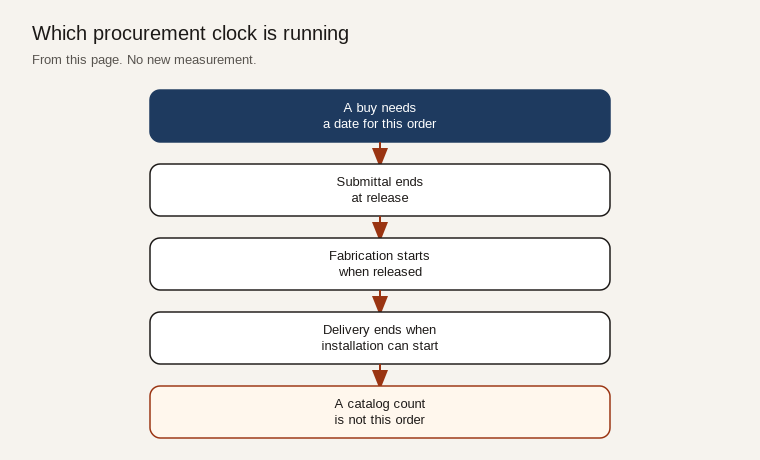
The submittal clock ends at release, the fabrication clock starts at that release, the delivery clock ends when installation can start, and a catalog count is not a date for this order.
A catalog week-count is not a promise for this order
A published week-count describes a product family, a plant, and a starting event. Configuration, plant load, accessories, holidays, and that starting event can all differ from the row someone pasted into the schedule.
Schneider Electric’s Lead Time Guide, published 11/03/26 for November 2026, says its figures are informational only and should not be relied upon for actual orders. Made-to-order times there are based on release to manufacturing, are approximate, and may be wrong when the order is placed. As of November 2026, that column lists 50 weeks for low-voltage draw-out families A, B, C, D, and F, and switchboard families A4 through F from 18 weeks to 34 weeks. Those rows are not a commitment for another rating or a job that has not released fabrication. Schneider Electric’s November 2026 Lead Time Guide is one manufacturer’s file, not a census.
Eaton’s Bid Manager job aid defines lead time as production days from the order date, on seven-day weeks, and gives “56 days = 8 weeks” only as a unit example. Approval-drawing days sit in a different field from shipment-after-release days. Eaton’s lead-time job aid states no duration for a named assembly. Reading the example as a ship date invents a promise.
Grid hardware is a different market. The Department of Energy’s Office of Electricity, on August 10, 2026, said constraints on transformers, breakers, substation components, and power electronics have resulted in lead times of two or more years for critical equipment, citing an industry brief. That article is not a fabrication time for a building switchboard or a roof assembly.
Get four answers in writing before a count becomes a date: which clock it covers, the day it was issued, the configuration it assumes, and whether it starts at the purchase order, at approved drawings, or at release to manufacturing.
Submittal, fabrication, and delivery run on separate clocks
Procurement lead time is the whole chain. Manufacturing and shipping are only two links. The submittal often sits in front of both, because a made-to-order item should not be released until the contract’s authority accepts the documents the factory will build from. One bar hides which link is late.
| Clock | What starts it | What ends it | What one catalog number usually omits |
|---|---|---|---|
| Submittal | A package complete enough to act on | Release to fabricate, after any required resubmittal | Preparation, comments, a second cycle, samples, delegated design |
| Fabrication | Release plus a slot the maker will honor | Ready to leave, including factory tests required first | Queue, parts, holidays, accessories, a change after release |
| Delivery | Shipment, as the order defines that point | Received, inspected, and where installation can start | Transit, access, storage, rigging, unfinished predecessor work |
The contractor usually assembles the package. A design professional, the owner, or a contracting officer acts on it. The maker owns the shop after release, and the site owns the last mile.
The submittal clock ends at release, not at receipt
A submittal checks that the item matches the contract. SpecsIntact’s unified descriptions separate shop drawings, product data, samples, design data, and closeout records, among other categories. That list is a filing language, not a review period, and not a finding that every sheet gates fabrication. Shop drawings show what the factory will build. A finish or roof-membrane sample depends on a viewing condition a data sheet cannot reproduce. Delegated design adds the trade engineer’s seal before the design professional of record can finish. The clock starts on a complete package and ends at release, including any resubmittal. Received, reviewed, and released are different marks.
Where that federal schedule guide is in the contract, a “G” or “S” mark means government approval. Other submittals are for the contractor’s quality-control approval. The text is UFGS 01 32 01.00 10, Project Schedule (August 2023, Change 1 August 2024; references stated as in agreement with the Unified Master Reference List dated October 2025). It is not a private-work rule.
The fabrication clock starts when the maker is released
Fabrication is the work after release: the specific unit, its parts, the build, required factory tests, and packing. The Schneider file starts made-to-order weeks at release to manufacturing. Eaton keeps shipment-after-release days apart from approval-drawing days. Neither file is a promise for an unreleased order.
It does not start at the first call, the bid, or a letter of intent unless the purchase order says so. A slot that expires while the submittal is open starts later, against whatever capacity remains. The unit is done when the slowest required part and any required test are done. If the witness cannot attend, the test date fails. A change after release follows the contract’s change terms, not the old catalog row.
The delivery clock ends when installation can start
Delivery starts at shipment, or where the order says the seller’s duration ends: ready for pickup, with the carrier, or unloaded on site. A count read as “to the room” is short by transit, inspection, and the move. The gate is not the end if the path is blocked, the slab or deck is unfinished, or inspection is required before the set. An early truck can force storage and a second move. Who accepts and protects the item belongs in the order. Early arrival changes cost. It does not let installation start until the item and the place are both ready. A qualified person confirms the actual roof deck, rigging path, or pad. This page sets no lifting plan, storage condition, or electrical rating.
Federal texts name the chain only when the contract includes them
These texts govern a job only if the contract includes them. They do not govern a private agreement in Maryland, Virginia, or the District of Columbia just because the building is there. As of November 2026, confirm the instrument with the owner’s contracting staff.
Paragraph 3.3.4 of the guide specification cited above requires activities for critical submittals and approvals, and for procurement, fabrication, and delivery of long-lead materials and equipment. In that paragraph, long-lead procurement is an anticipated sequence of over 90 calendar days. Non-procurement activities are capped at 20 workdays or 30 calendar days, so a long shop run should stay its own activity. Where the design-build wording is kept, the schedule includes long-lead acquisition before design completion, and construction waits on government acceptance of the related design. Buying early is not permission to install against an unaccepted design.
Part 36, under FAC Number 2026-01 effective March 13, 2026, defines design-bid-build as sequential design and construction under two contracts, and design-build as both in one contract. The schedule clause it prescribes, 52.236-15 (April 1984), requires a practicable schedule of salient features, including acquiring materials, plant, and equipment, within five days after work starts or another period the contracting officer sets. It states no equipment duration. A brand-name-or-equal description must name the essential characteristics. Changing them restarts the submittal until the change is accepted.
Subpart 28.1, in that edition, is a different gate: where a federal construction contract requires performance and payment bonds or another payment protection, that protection is furnished before notice to proceed. It is not a fabrication duration.
The delivery method changes when buying can start
The Design-Build Institute of America defines design-build as one contract for design and construction. In the progressive form it describes, selection is based primarily on qualifications, then design and price advance together. DBIA’s explanation publishes no equipment durations. An earlier conversation can expose a long-lead item while the requirement is still moving, and releasing against that moving requirement buys the wrong item sooner.
Design-bid-build usually waits until there is a construction contract and a design that can be submitted. If the full chain is longer than the time from award to installation, the date holds only if an earlier purchase was authorized. When the owner buys and the builder only installs, name who approves the shop drawings, who stores the shipment, and who bears a design change. Soleil Energy describes design-build on its construction page as one contract for design and construction. That is a method on offer, not a rule for every release.
What the lead time changes in scope, price, fit, and approval
An early release freezes what the shop builds. Name who may release, which sections govern, and who pays if a comment changes the item. A roof system and a switchboard freeze different attributes. A qualified professional judges the building.
The price’s last day and the week-count are different dates. Storage, a retest, and a restock cost money even when no unit price is printed. Compare offers only on the same clock, configuration, and starting event. A faster count on another family is a different product until the essential characteristics are checked.
Size, service arrangement, and utility requirements are why that substitute fails. Soleil Energy’s power page treats procurement of switchgear and transformers, including factory tests, as its own stage. Match that release to the building need date. The firm’s scope is not a voltage-class definition.
A submittal mark is not a permit or a utility acceptance. Soleil Energy’s commercial solar interconnection guide keeps utility review on its own path. As of November 2026, that Maryland-focused guide is not the serving utility’s rule and not a duration for gear inside the building.
An illustrative backward schedule
Every figure in this section is illustrative. The arithmetic teaches the chain. It is not a quote, not a Soleil Energy project, and not a duration to copy onto a bid.
Put the item in position at the beginning of week 40. Working backward: 1 week to inspect and move, so receipt is week 39; 2 weeks in transit, so shipment is week 37; 20 weeks of fabrication, so release is week 17; 2 weeks held for a resubmittal, so the first action ends at week 15; 2 weeks for that action, so the package leaves at week 13; 3 weeks to prepare it, so work starts at week 10. The sum is 3 + 2 + 2 + 20 + 2 + 1 = 30 weeks, and week 10 plus 30 weeks is week 40. If the first action accepts the package, release could move to week 15 only when the shop slot moves too. A slot held for week 17 stays there.
The Schneider file cited above lists 50 weeks, from release to manufacturing, for specific low-voltage draw-out families, and says not to rely on it for an actual order. In this illustrative subtraction only, 50 minus the 20-week fabrication assumption is 30 weeks. With the other assumptions fixed, the release and the preparation start each move 30 weeks earlier. A manufacturing average cannot be pasted onto a bar that already holds submittal and transit. Do not schedule 50 weeks from this example.
What the quote has to state
Leave a seller’s number off the schedule until the quote answers each line. A blank is still an assumption.
- Which clock the number covers, and the event that starts it.
- The day it was issued, and the day through which the count and the price each stay open.
- The configuration and accessories assumed, and what a change does to the count.
- Whether factory tests and packaging are inside the fabrication figure.
- Whether the seller’s duration ends ready to ship, with the carrier, or on site.
- What a returned submittal does to the slot, and who stores the item if the site is late.
A solicitation should ask for the same breakout. One cell hides whether the count starts at release or at the purchase order.
Questions owners and procurement leads still ask
What does this lead time change about project scope?
It names what must be frozen before the shop spends money, who may release fabrication, and who pays if the design moves afterward. Silence does not keep the item flexible. It leaves the mismatch with whoever holds the shipment.
Is a catalog week-count a promise for this order?
No. The November 2026 Schneider file says not to rely on its weeks for actual orders and starts made-to-order time at release to manufacturing. Eaton’s eight-week line only converts seven-day weeks. Use a current statement for this configuration and this starting event, and expect that statement to be checked again when the order is placed.
When does fabrication actually start?
It starts when the maker is released and still holds a slot, not at the first price request. If release means approved drawings, an open comment holds the start. A purchase order sent before approval has to say what a markup does to the slot.
Why keep delivery separate from fabrication?
The shop can finish before the building is ready, and the building can be ready before the truck moves. Transit, inspection, storage, and the move sit outside a release-to-manufacturing average. The order has to say which of those steps it included.
Do federal schedule rules apply on a private project in this region?
Not by default. They apply when the contract includes them. A private agreement follows itself. A state, county, or District public owner follows that government’s rules, not Part 36. As of November 2026, confirm the document before copying the 90-calendar-day test into a private schedule. Soleil Energy’s service-area page names Prince George’s, Montgomery, and Howard counties, Arlington County, and Washington, DC, and states there is no DC office. Location does not pick the contract.
What should be settled before a long-lead release?
Settle the need date at the set point, the three durations and their starts, the configuration, who may release, and the result if the submittal returns or the site is late. A release while one of those is a guess spends money on a date the chain does not support.
Discuss the constraints before the release date
Bring the need-on-site date, the specification sections that gate the item, any quote that states a duration, and the limits on budget, occupancy, and delivery method. Soleil Energy’s construction practice discusses that scope for commercial, institutional, renovation, and design-build work. The discussion can test whether release, shop slot, and site can meet. It cannot turn a monthly file into a date for equipment that has not been released.
Project requirements depend on the site, equipment and applicable rules. Confirm design and installation decisions with the appropriate qualified professional.