
Construction quality assurance vs quality control is the split between giving an owner confidence that contract quality requirements will be met and the builder’s own system for meeting them. Assurance is the owner’s or designer’s check on that system. Control is how the builder manages, inspects, tests, and corrects the work, including subcontractors and suppliers. The two roles can share a jobsite and still answer to different people. An inspection report is not acceptance.
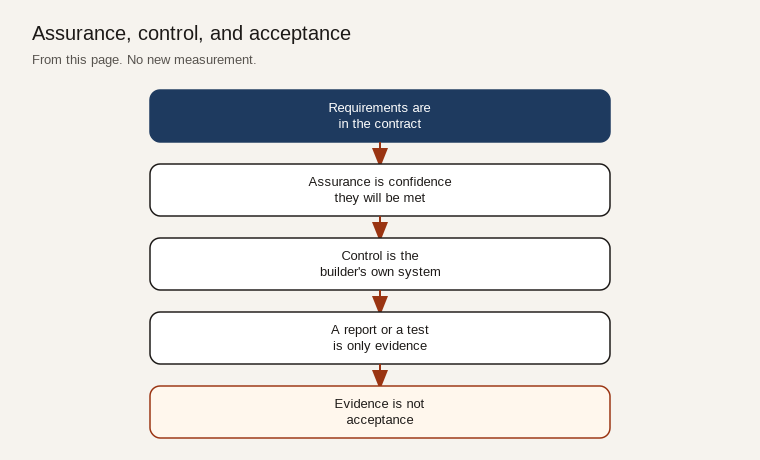
Assurance is confidence that requirements will be met, control is the builder’s own system for meeting them, and an inspection report or test remains evidence rather than acceptance.
Confidence and conformity are different jobs
ISO’s quality-management family page lists ISO 9000:2026 and ISO 9001:2026 among current publications. As of November 2026, the text still published for ISO 9000:2015 on ISO’s Online Browsing Platform defines quality assurance as the part of quality management focused on providing confidence that quality requirements will be fulfilled, and quality control as the part focused on fulfilling those requirements. Use the year the contract names. Do not treat the 2015 sentences as the 2026 text.
Those definitions are not a construction agreement. The Federal Acquisition Regulation lists ISO 9001 as an example of a higher-level quality-management standard when the acquisition needs control of design, operations, testing, and inspection, or closer control of planning and records. As of November 2026, that passage is posted with FAC 2026-01, effective 13 March 2026. A certificate still does not name this roof, this slab, or this switchgear.
| Question | Quality assurance | Quality control |
|---|---|---|
| Purpose | Confidence that requirements will be fulfilled | Fulfilling those requirements on the work |
| Typical holder | Owner, designer, or the owner’s representative | Contractor, including subcontractors and suppliers |
| Typical evidence | Plan reviews, surveillance, audits of the control system | Inspections, tests, deficiency logs, daily control records |
| What it does not do | Replace the builder’s control of the work | Accept the work for the owner |
The owner or designer assures; the builder controls the work
The sharpest official split is Corps construction policy, not a private form and not a Maryland, Virginia, or District of Columbia code. Engineer Regulation 1180-1-6, dated 6 February 2025 and effective 6 March 2025, says quality is a combined responsibility and that the contract sets it. As of November 2026, that regulation governs Corps elements that award and supervise construction. Contractor quality control is the builder’s system for its own work and for suppliers and subcontractors. Quality assurance is how the Government checks that this system works and that the end product meets the specifications and drawings. Assurance includes document reviews, the assurance plan, review of the control plan, and acceptance. A site visit is one surveillance act, not the whole job.
Quality-assurance staff return a noncompliant daily report and, when the report meets the documentation rules, file it with the Government’s assurance report. That file is surveillance, not acceptance. Acceptance inspections, after the contractor finishes its own completion inspections, are a Government responsibility. On private work the owner or designer compares records with the work, while the builder directs crews and corrects nonconforming work. Directing the crew can pull a builder’s duty onto the owner. Treating silence as approval can leave concealed work covered with nobody authorized having accepted it.
A designer’s field report is assurance only as far as the design agreement says. It is not the builder’s control system. Foremen are the people who can stop a crew before the next layer hides a defect. If a quality-control manager is also named, read whether that person may be the superintendent or must report apart from production. The signed section controls.
Federal clauses put control on the contractor
For fixed-price federal construction above the simplified acquisition threshold, and below it when the Government chooses, the contracting officer inserts 52.246-12, Inspection of Construction. The prescription is the authority for that insert. As of November 2026, confirm the threshold in the solicitation you have.
The contractor keeps an inspection system and the records. Government inspection and test before acceptance do not relieve the contractor of quality control, do not constitute or imply acceptance, and do not let an inspector change the specification without the contracting officer’s written authorization.
FAR 46.101 defines government contract quality assurance as the functions, including inspection, used to judge whether quality and quantity obligations were fulfilled. FAR 46.401 says surveillance happens when and where needed. Do not copy a commercial-product habit onto a building without the construction clause.
Corps policy then calls for an edited section 01 45 00, Quality Control. The master is not the contract. The copy read here is the August 2023 section with Change 4 of August 2026. In it, quality control is the plans, procedures, and organization that produce a conforming product, on site and off site. A coordination meeting is where contractor control and Government assurance are explained to each other before work is buried.
Each feature gets three phases of control
A definable feature of work, in the Corps glossary, is a task with its own control requirements, not a copy of the specification table of contents. The regulation’s concrete example separates formwork, reinforcing, placement, mix design, finish, and curing. Both plans should name the features.
The three-phase system is the core method. Preparatory work reviews the requirement and meets before the feature starts, after submittals and materials are on hand. The initial phase checks a representative sample, sets workmanship, and confirms tests. Follow-up continues until the feature is done, including correction before later work covers a defect. A new crew that misses that workmanship is a reason to repeat the initial phase.
An inspection and test plan names the feature, the requirement, who checks or tests, who may witness or release a hold, and the record. A hold point stops the next step until release. A witness point invites someone. Only the plan says what happens if that person does not attend. Shop work belongs on the same plan: which tests are witnessed, which reports ship, and what a site receipt may assume.
Nonconforming work stays under the builder’s control. Under the federal construction clause, the contractor replaces or corrects work the Government finds nonconforming, unless the Government accepts it with a price adjustment. The person who may accept a known defect is the contracting officer, not the inspector who saw it. A private contract needs the same sentence: who may accept a deviation, in writing, and what happens to price and time.
An inspection report is not acceptance
Acceptance is an act by someone with authority. FAR 46.101 defines it as the act of an authorized representative by which the Government assumes ownership of identified supplies or approves services as partial or complete performance. FAR 46.501 says acceptance acknowledges conformity to contract quality and quantity requirements, except as the rest of the contract provides. It is ordinarily shown by an acceptance certificate. Work is ordinarily not accepted before quality-assurance actions are complete.
Under the construction clause, the Government accepts the work, or a portion the contracting officer separates, after completion and inspection, unless the contract says otherwise. That acceptance is final and conclusive except for latent defects, fraud, gross mistakes amounting to fraud, or rights kept under a warranty. Conditional acceptance is still acceptance: nonconforming or incomplete work is taken only if the contractor will correct it by a stated date. A margin note is not that act.
A daily report, a test report, and a punch list are evidence. A pay application may certify what is billed, and payment is often not acceptance. Read that clause before treating an invoice as a waiver. In the federal guide, the contractor punches the work, a pre-final inspection follows, and final acceptance is a later act with the contracting officer. The contractor’s completion certificate is the contractor speaking. Acceptance is the Government deciding.
Testing, special inspection, and commissioning stay separate
A testing agency produces evidence. It is not a third name for assurance or control. ASTM E329-26 is the active specification for agencies in construction inspection, testing, or special inspection. The listing reviewed for this page shows that edition active, last updated 4 August 2026. As of November 2026, cite the edition named in the project manual. “The latest” is not a precise reference while earlier editions remain in print.
E329-26 requires a competency check against the approved documents. It does not replace the agreement that sets the agency’s authority, and it does not address means and methods. Read the accreditation scope. A concrete scope does not cover soils or bolting. The report is data. The builder still controls the work, and the person named in the contract still accepts it.
Special inspection is another role. The federal guide puts it in a separate section and tells control staff to coordinate it, not replace it. Editor notes mention code exceptions for some minor work. Those notes do not exempt a Maryland, Northern Virginia, or District of Columbia project. As of November 2026, the authority having jurisdiction and the statement of special inspections decide. The report is still not acceptance. Commissioning, where the guide includes it, is in addition to quality control, not a substitute. A certificate of readiness can release functional tests. It is not acceptance of the construction contract.
Specifications and design-build should name the split
MasterFormat is the Construction Specifications Institute’s numbering framework. Its 2026 description says Division 01 received maintenance updates that were mainly title clarifications or small reorganizations. As of November 2026, confirm numbers in the edition the project uses. A CSI technical article identifies 01 43 00 Quality Assurance and 01 45 00 Quality Control as different sections, and it places code-required special inspections with the control family. That 2020 article discusses sealing. It is not the current number tables. It is evidence that the Institute has long treated the two words as different sections.
Read Division 01 for project-wide rules, then the trade section. Qualifications and preinstallation meetings often establish confidence. Field checks often sit in the execution article. If two sections disagree on who hires the agency, resolve that before bids. An approved submittal does not accept the installed work.
Design-build, as the Design-Build Institute of America describes it, uses one contract for design and construction. That does not delete the owner’s role or the builder’s control of subcontractors. The federal guide can require a design quality-control plan beside construction control.
Write the decisions down before work is covered
| Decision | What should be visible in the contract |
|---|---|
| Control of the work | The builder’s system for its own forces, subcontractors, suppliers, and off-site work |
| Assurance | Who reviews the control plan, and what happens when records and the work disagree |
| Hold and witness points | What stops, who releases it, and which code tests are a separate hire |
| Nonconformance | Who directs correction, and who may accept a deviation with a price or time change |
| Acceptance | The person, the document, and whether a portion may be accepted before the whole |
| Payment | Whether a paid application is acceptance, or explicitly is not |
A proposal that cannot say which row it owns has not priced control of the work.
An illustrative clinic renovation
This outpatient clinic renovation is illustrative. It is not a Soleil Energy project and not a specification. The private owner uses design-bid-build. Three features matter in the first month: roof membrane replacement, above-ceiling duct replacement in one wing, and firestopping at a rated corridor wall.
The quality-control manager’s preparatory meeting reviews the roofing section, the approved submittal, and the named tests. The owner’s representative confirms that the submittal on site is the approved one and does not direct layout. The minutes accept nothing. Initial and follow-up checks are recorded while the crew is on the roof. A testing agency, hired by the owner and accredited for those membrane tests, reports the test, the location, and the result. The report does not accept the roof. Duct hangers and the rated-wall firestop are separate features. A special inspector, if the code and the statement of special inspections require one, does not replace the contractor’s control. Partial acceptance happens only when the named person signs the named document. A progress payment is not that signature unless the payment clause says so.
Questions before you treat a plan as complete
How do preventive steps differ from inspection and correction?
Preventive steps come first: qualified people, approved submittals, a required mockup, and a preparatory review with the crew. Inspection, tests, and correction start once work exists and can all be control duties. Assurance asks whether the preventive steps happened. A closed punch list does not recreate a meeting that never occurred.
Does any inspection report accept the work?
No. Under the federal construction clause, Government inspections and tests do not constitute or imply acceptance. Laboratory reports, special-inspection reports, and daily certifications are evidence. Treat one of them as acceptance only if the contract says that paper is the act.
Who should hire the testing agency?
Name the hirer and the tests. An agency paid by the contractor can be competent if the accreditation scope matches, but hiring it does not move means and methods, and it does not let the agency accept the project.
Is a company quality manual the project control plan?
No. ISO 9001, when imposed, is a company system. The project plan lists this contract’s features, tests, hold points, and records. The construction clause still requires the contractor’s inspection system. Ask for that plan if you receive only a corporate manual.
What should a private owner specify without a contracting officer?
Name who may accept work and who may accept a deviation with an adjustment. State that a site visit does not change the specification or accept the work. Say whether payment is acceptance. Put those sentences in the agreement with counsel and the design professional.
How does design-build change the split?
Both kinds of control may sit in one firm. The owner still needs to see design checks before a weak detail is built, and field control of subcontractors. Write who accepts the work into the design-build agreement.
Bring the constraints to a scope conversation
Quality roles follow the delivery method, what is already designed, which work will be concealed, and who keeps authority to accept the work. A control plan the price omits will not be staffed.
Soleil Energy’s construction services cover commercial, residential, government, and institutional work, including renovations and design-build, for owners in Maryland, Northern Virginia, and Washington, DC. Bring the outline specification or drawings, the proposed delivery method, and the constraints on occupied use, phasing, and acceptance. The conversation does not replace the contract language that names who may accept the work.
Project requirements depend on the site, equipment and applicable rules. Confirm design and installation decisions with the appropriate qualified professional.