
EV charging make-ready infrastructure is the electrical and civil work that prepares a site so chargers can be added later, and it stops short of the charger itself. It can include raceways, conductors, panels or panel space, pads, trenches, and the utility work needed to deliver power to a future charging location. It does not include the charging equipment, connector, or network service. A qualified professional must confirm what the actual site can support.
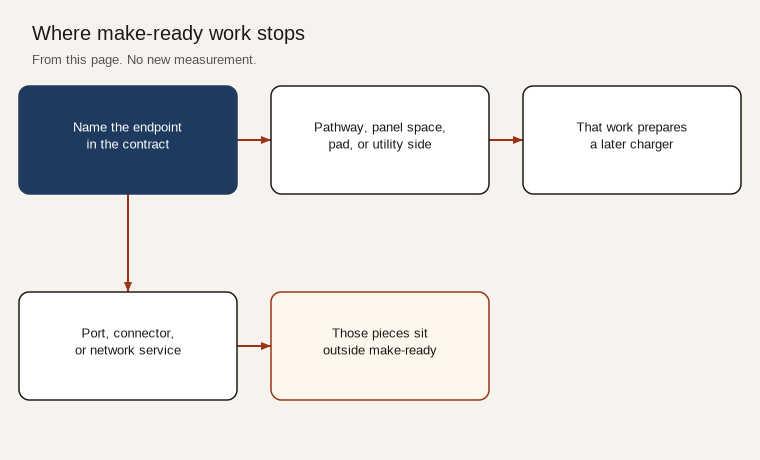
Call the work make-ready when it stops at a named pathway, panel space, pad, or the utility side of the meter, and call it charger scope when the port, connector, or network service is included.
The charger is a different piece of work
A charging port, often called electric vehicle supply equipment, delivers power to one vehicle at a time. The connector is the plug that meets the vehicle inlet. The Alternative Fuels Data Center separates those pieces from the station location, the place where one or more ports sit. Make-ready brings power, a mounting place, and a usable stall to that location. Buying a port does not install the pathway, and burying a pathway does not put a port on the stall.
Name the endpoint in the contract. One scope can stop at a labeled raceway, a junction box, or a reserved panel position. Another supplies and commissions the port. A single price hides who owns the trench and who returns if a later port will not fit.
Connector choice is a hardware question. That overview describes J1772, J3400, the Combined Charging System, and CHAdeMO. Changing the plug does not rewrite an underground route. Changing the power class can. A workplace pathway is not evidence the service can support high-power DC charging.
Ordinary charging is a load. Exporting power from a vehicle is a different subject. The catalog for IEEE 1547-2018, read for scope on November 22, 2026, describes an active standard for interconnecting distributed energy resources and treats the resource as a 60 hertz source. It does not set raceway rules. Whether a bidirectional port is such a resource is a question for the serving utility.
Utility-side and customer-side work are not the same job
The meter is the usual split between utility work and customer work, and it decides who designs, who owns, and which application is filed.
Southern California Edison’s Charge Ready explanation, read November 22, 2026, splits banks of charging equipment at the meter. Utility-side make-ready runs from the distribution system to a new panel, which the utility designs and maintains. Customer-side make-ready runs from that panel to the charging equipment. Those are Southern California Edison program terms, not a tariff for Pepco, Baltimore Gas and Electric, Dominion Energy, the Southern Maryland Electric Cooperative, or a municipal utility in Maryland, Northern Virginia, or Washington, DC.
California Public Utilities Code section 740.19 draws a related line for electrical corporations. The text reproduced on california.public.law, read November 22, 2026, defines “electrical distribution infrastructure” for that section as poles, vaults, service drops, transformers, mounting pads, trenching, conduit, wire, cable, meters, other necessary equipment, and the associated engineering and civil work. It directs a tariff for utility-side work when a customer other than a single-family residence installs separately metered charging infrastructure. It does not assign stall raceways or the port to the utility, and it does not govern a Mid-Atlantic utility.
The California Public Utilities Commission page on distribution infrastructure, read November 22, 2026, says the EV Infrastructure Rules stand in for the ordinary service-extension rule on separately metered or submetered charging, with ratepayers covering those extensions. It describes an interim average energization time of 125 business days from December 2022, excluding distribution-upgrade projects, projects above two megawatts, and substation upgrades. That average is not a site date, and it is not a Maryland, Virginia, or District schedule.
Ask the serving utility, in writing, where its work ends and whether a new meter or service is required. A building permit is separate from the utility study. A finished trench does not show that capacity or an approved service exists.
Name the endpoint before pricing the work
A useful endpoint is physical: a capped raceway, a junction box, landed conductors, or a reserved position in distribution equipment. “EV ready” as a slogan is not an endpoint, because codes and funding rules use similar words for different installed work.
| Question | Usually make-ready | Usually the charger scope |
|---|---|---|
| Trench, raceway, and pull points | Yes, when installed for later use | No |
| Conductors and a terminated circuit | Only if this scope finishes the circuit | The port still has to be connected |
| Panel space or a new panel | Often, when a future circuit is in the job | No |
| Utility transformer, service, and meter | Sometimes, and often utility-owned | No |
| Pad, curb, and equipment protection | Often, because they are hard to move | The port sits on them |
| Port, connector, and network service | No | Yes |
The table is a planning distinction, not a code minimum. The adopted code, the utility, and the contract decide which row applies.
New York shows how local a rule can be. The Alternative Fuels Data Center summary of State Finance Law section 19-a, read November 22, 2026, says that from December 28, 2023, certain new publicly funded non-residential parking must designate make-ready spaces: at least 10 percent in a facility of 50 to 200 spaces, and at least 20 percent above that, at a minimum of 40 amperes and 208 volts. Further requirements and exemptions may apply, and the compiled statute was not open during this research, so confirm the official text. It is not a target for a private lot in Maryland, Northern Virginia, or Washington, DC.
Elsewhere, codes may mean only a raceway and reserved capacity, a finished branch circuit, or a port already installed. The adopted edition, including amendments, is the tier that counts. Another state’s number is not a spare-capacity share, a conduit fill, or a panel size for a different address.
Install the pathway while the ground is open
On many lots the costly work is opening and restoring pavement around cars that already park there. The Alternative Fuels Data Center’s procurement checklist says to weigh near-term and long-term port counts, distance to the incoming service, and future expansion, and to coordinate both with the utility before construction.
Trenching is excavation. The Common Ground Alliance describes 811 as the national number, designated by the Federal Communications Commission, that reaches the local one-call center so utilities can mark approximate line locations. Notice rules are local. A drawing is not a substitute for that locate.
If the raceway will sit unused, record the route, the termination, any pull line, and the charging class it was meant to support, plus what was not checked, especially service capacity. An unmarked pipe may be a drain or an abandoned sleeve. A spare raceway does not prove a larger conductor or another charging class will fit later. Curbs, bollards, lighting, and striping belong in the same package. The checklist treats signage and safety as site work, and deferring them often means breaking concrete twice.
Choose the charging class before the route is buried
Level changes the infrastructure even when the stall looks the same. AFDC describes Level 1 on a 120-volt plug, Level 2 on 208-volt service in many commercial settings or 240-volt service in many homes, and DC fast charging as a three-phase supply delivering direct current. It places Level 2 in a published kilowatt range and DC fast equipment much higher. Charge time also depends on the vehicle and the battery. Those descriptions classify equipment. They do not assign a circuit.
AFDC says most residential Level 2 units, in its account, need a dedicated branch circuit under National Electrical Code Article 625. That is a home pattern, not a design for a lot or a depot. The adopted edition controls, and this page does not select a breaker, a conductor, or a raceway size. The same overview notes three-phase AC charging for some medium- and heavy-duty vehicles and a megawatt-class DC system still under development. Employee-car preparation is not truck-yard preparation unless that class and a utility study were in the design.
Controls can keep several ports from drawing full rating at once. Whether that serves more stalls depends on dwell time and on whether the utility and the permit office accept a managed limit. Soleil Energy’s workplace charging guide covers that question and does not replace a site calculation. A networked station, AFDC’s procurement page says, needs wired, wireless, or cellular service. The network contract is not make-ready.
Stall layout is part of the infrastructure
Drivers leave the vehicle and carry the connector to an inlet that is not in one place on every model. The U.S. Access Board’s technical assistance, updated July 17, 2023, and read November 22, 2026, separates charging spaces from parking for that reason. It says the Americans with Disabilities Act covers state and local governments and places of public accommodation and commercial facilities, and that the Architectural Barriers Act can cover certain federally funded work, including some National Electric Vehicle Infrastructure projects. Regulated entities must still provide access where those standards do not name charging. Whether a private site is covered is for the owner and counsel.
The document uses “must” for applicable standards and “should” for advice it says is not binding. Mobility recommendations include a vehicle space at least 11 feet wide and 20 feet long, an access aisle at least 5 feet wide, and clear floor space at the port. Bollards, curbs, and cable slack can block the route. Those figures are recommendations, not a stall quota and not a waiver of a stricter local rule. The termination and pad are what a later port inherits. An employee depot, a public lot, and a curb space are different problems. The plan should name which one it is for.
Decide these items before anyone digs
| Decision | What the answer changes |
|---|---|
| Which vehicles park, and for how long | Whether the class is a low-power circuit, a managed group of ports, or a high-power dispenser |
| Which stalls get a port now | Where hardware is required, and where only a raceway, pad, and label are required |
| Who owns each side of the meter | Which application goes to the utility, and which work the customer contracts |
| Which code or funding rule applies | Whether “prepared” means an empty raceway, a finished circuit, or an installed port |
| How a later crew finds the pathway | What the drawing, labels, and pull points must show |
| Who must be able to use a future port | Where the termination, aisle, curb, and protection can sit |
A house often needs one circuit from the panel to the parking place, a permit, and an inspection. Soleil Energy’s home Level 2 guide describes that scope, including a separate utility step when the service changes. A lot or depot is distribution and site work, not a larger version of that circuit.
An illustrative office lot
This example is illustrative, not a Soleil Energy project and not a design. While repaving a visitor lot, the owner runs raceways from the electrical room to one row, leaves a pull line, labels the caps, pours pads, and files a route drawing. No ports are bought, and the drawing says service capacity was not studied.
Later, ports are wanted on some of those stalls. The record shows the route. It does not show that the raceway is intact, that the code still allows the use, that the service can carry the ports, or that the curbs leave an accessible route. A shift to DC fast charging for a few fleet vehicles can make the buried pathway the wrong infrastructure. The later work still needs its own load study, utility conversation, permit, and hardware specification.
What preparation does not decide
A finished customer-side raceway does not approve utility work. A transformer or an upstream upgrade can still set the schedule, which is why AFDC tells planners to raise service needs and rate effects early. Port ownership is a separate contract: AFDC distinguishes a site host from a third-party owner. Revenue and maintenance can share a trench and still be a different scope.
Incentives move on their own calendar. As of November 2026, a California statute or a New York funding rule is not evidence of what a Maryland, Virginia, or District utility will pay. DOE’s trends page, whose newest snapshot there is the second quarter of 2024, describes technology and port counts as still changing, so a rule for one class can exclude another. Confirm the current text with the administrator. This page does not restate amounts or deadlines. Preparation is also not an inspection of a future port.
Questions that change the scope
Does make-ready include the charger?
No. It ends at the endpoint the contract names. The port, connector, and any network service are separate. If one price covers both, split pathway lines from hardware lines and say who owns each.
Does a buried raceway mean the stall is ready?
Not under every rule. Some codes are satisfied by raceway and reserved capacity. Others expect conductors, a terminated circuit, or a stated capacity, and the adopted label controls. An unlabeled empty pipe is neither a finished circuit nor permission to energize a port.
Who builds the utility side of the meter?
The serving utility decides. The California statute and the Edison description put utility-side distribution with the utility and can leave the run toward the port with the site. Maryland, Northern Virginia, and Washington, DC hosts need that answer from their own utility. A building permit does not grant it.
Can preparation avoid a service upgrade?
It can reveal the question. It cannot close it. Raceway to a row of stalls does not show that the service can feed a later port. Only a site-specific study, and the utility’s review, can say whether an upgrade is required. Load management may change the result, and it may not.
How is a house different from a lot or a depot?
A house often adds one circuit. A lot or depot adds trenches, distribution equipment, and utility construction that is costly to reopen. The two guides cover those problems. Neither replaces the load calculation for the building in front of you.
What belongs in the handover if ports come later?
Ask for a drawing that matches the field labels, the charging class the pathway was built for, and a list of unchecked items. Service capacity, utility approval, and the future port stay on that list unless a qualified professional checked them. Photos of an unmarked pipe are not a record.
Discuss capacity before the hardware is chosen
Owners who know how vehicles park, which stalls might get ports later, and what the service records show can scope the work without guessing at hardware. Soleil Energy can discuss charger count, electrical capacity, and load management in its published service area of Maryland, Northern Virginia, and Washington, DC. Confirm an address outside the counties named on the service-area page before assuming a crew is available. Start with Soleil Energy’s EV charging service, and bring the parking plan. A qualified professional still has to assess the site.
Project requirements depend on the site, equipment and applicable rules. Confirm design and installation decisions with the appropriate qualified professional.