
An EV fleet charging depot is a private site where an operator charges many fleet vehicles between trips, using the time those vehicles are parked. The site follows a duty cycle: vehicles leave on a schedule and must be ready for the next one. That job is different from a public charging station, which serves unknown drivers, and from a single workplace plug, which serves one employee car.
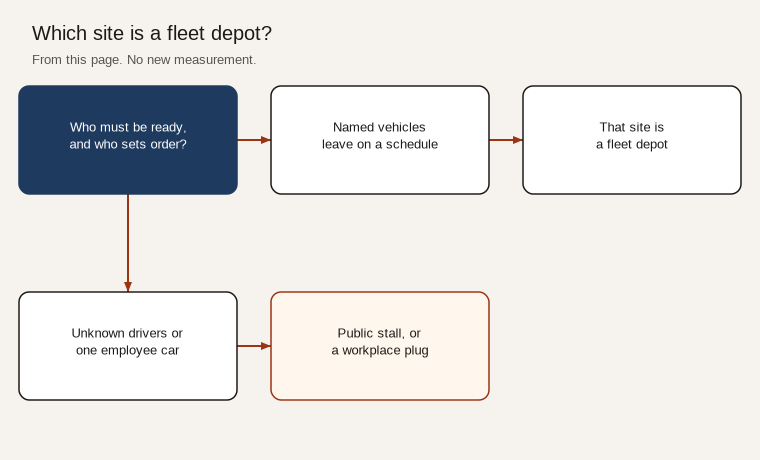
Treat the site as a fleet depot when one operator must ready named vehicles for a scheduled departure, and treat unknown public drivers or a single employee car as different sites.
A depot is defined by the duty cycle
A yard, a bus barn, or a row of reserved stalls is a depot when one operator controls the return, the parked time, and the departure with enough energy. The Alternative Fuels Data Center describes facility charging for overnight and idle time, and it treats return-to-base routes as a common fit for medium- and heavy-duty work. A 2021 National Renewable Energy Laboratory study uses the same idea for short-haul trucks: predictable routes and a return to base let vehicles recharge off shift at the depot.
A later laboratory report on OSTI adds the electrical point. These vehicles often need more energy than a passenger car, run on repeating schedules, and park together, so demand can bunch in space and time. Duty cycles still vary: a school-bus yard, a parcel route, and a refuse route are not one load shape. The dataset is national analysis for depot-based trucks and buses, not a sizing sheet for one yard.
Count ports, not handles. Light-duty vans fit the same definition when the operator, not each driver, owns readiness. The charging-stations page defines a port as the part that powers one vehicle at a time, even if the post carries two connector types.
Dwell time is the charging window you actually have
Dwell is parked time available for charging, not the shift length and not the hours the gate is open. Connecting, disconnecting, and staging are outside that window. A second departure is a second dwell.
Energy, in kilowatt-hours, is what the route removed. Power, in kilowatts, is how fast it comes back. The Department of Energy’s school-bus module puts it this way: a 10-kilowatt charger supplies about 10 kilowatt-hours in about one hour. In that module’s example, a bus at about 1.5 kilowatt-hours per mile over about 100 miles needs about 150 kilowatt-hours back, and a 19.2-kilowatt AC Level 2 charger would take about 7.8 hours to deliver it. Those figures are the module’s example, not a local bus. Fleet guidance lists weather, terrain, cabin loads, and auxiliary equipment as reasons nameplate range is not the planning number.
That page separates equipment by dwell without assigning a layout. Level 2 can meet medium- and heavy-duty needs when daily use is moderate or the window is long; overnight school buses are the example. Direct-current fast charging is described for short dwell between shifts and for sharing one charger. Level 1 can suit some plug-in hybrids and is a poor match for a large battery due at dawn.
Those bands are ranges, not a depot specification. The stations page ties Level 1 to about five miles of range per hour at an assumed 1.9 kilowatts, and Level 2, often 208 or 240 volts, to outputs from 2.9 to 19.2 kilowatts. Its “about 25 miles per hour” line assumes a mid-range output. DC fast equipment is described up to 500 kilowatts, but delivered power still depends on the vehicle and state of charge. SAE J3068 is described for three-phase AC from 6 to 130 kilowatts, and a megawatt-class truck system is described as still in development. Match energy, connector, and dwell. Rate also falls near a full battery, and some vehicles reject the nameplate, so a brochure time is not a cold-morning time.
The electrical service sees coincident load
The service cares how many port ratings are real at once, together with the rest of the building. Controls can hold that group under a ceiling the nameplate sum would exceed.
Federal smart-charge notes illustrate the control, not a yard size. Five Level 2 chargers at 7 kilowatts each would draw 35 kilowatts together. If only 30 kilowatts is available, the note sets each to 6 kilowatts. The same note says a controller can prefer a lower state of charge or a shorter dwell. Those are options inside a stated objective, not settings to copy.
A Department of Energy account of a laboratory workplace garage is the same lesson and is not a depot. That garage grew to 108 Level 2 units at 6.7 kilowatts each, about 720 kilowatts if all ran together, and operators held the group near 460 kilowatts so existing transformers were not exceeded. Commuters could accept a slower session. A route vehicle that misses its departure cannot.
The utility has to see the proposed load, including later growth and the bill effect. In fleet guidance, a demand charge is a fee on the greatest measured power draw, on top of energy, and it is account-specific. Soleil Energy’s guide to demand charges, solar, and batteries explains how certain Pepco, Baltimore Gas and Electric, and Dominion Energy Virginia schedules separate a short-interval kilowatt charge from kilowatt-hour energy. It is not a depot tariff. This account’s schedule, interval, season, and any look-back decide the cost of a new peak. Maryland, Virginia, and the District of Columbia are not one rate.
The 2021 summary is easy to over-read. Its modeled schedules recharged at rates the authors call common for light-duty equipment, stated as 100 kilowatts per vehicle, and most of 36 substations in that study accepted high levels of that charging without upgrades. The record read here states no upgrade dollars or durations, and those substations are not identified as Pepco, BGE, Dominion, or SMECO equipment. It is a reason to ask the local utility, not a cost for this yard.
Process loads can collide with plug-in time, so interval data and a simultaneous schedule matter more than a monthly energy total. Extra conduit, if the owner chooses it now, can be simpler than opening the site later. That is a choice, not a spare rating named here. Whether the transformer, switchboard, or feeder is adequate is a site question for a qualified electrician or engineer, with the utility and the permit office. This page does not select a breaker, a conductor, or a protection setting.
Sequencing is an operating decision
Sequencing is which vehicles get power, and at what rate, inside the service limit. It is not a stall map. Vehicles that leave first may be the ones that would charge in an expensive hour. Readiness, a lower operating cost, and a capacity ceiling are different objectives in the federal material. A time-of-use setting alone can leave a short-dwell truck short. Immediate full power can set the monthly demand on the first night.
Sharing one charger spends dwell on disconnecting, moving, and reconnecting. Fleet guidance notes that fast charging can serve several vehicles in a day, while Level 2 is often discussed as one unit per vehicle across a long night. Neither line is a required ratio of ports to spaces. Operations still owns which routes cannot slip and who may override a pause. Connected is not the same as charging if software may wait.
The Open Charge Alliance publishes the Open Charge Point Protocol in the 1.6, 2.0.1, and 2.1 lines. Procurement guidance describes version 1.6 or higher as a way to change network operators without replacing the charger. A non-networked charger can still energize a vehicle, but it will not stagger sessions or report energy by vehicle. Putting a cloud controller on the site network is an authorization question for information-technology staff, with fleet, facilities, and the utility. That is coordination, not a security certification.
Three sites that are easy to confuse
| Question | Fleet depot | Public station | One workplace plug |
|---|---|---|---|
| Who must be ready? | Named vehicles on a schedule | Whoever arrives | One employee car |
| Who sets order? | The fleet | The driver, often via a network | The employee, within site rules |
| What fails? | A route vehicle is short | The stall or connector does not fit | That car is short of range |
| Power plan | Fleet load plus the building | Uncertain public use | One circuit |
Public charging can extend range or bridge construction, but connector, payment, queue, and driver time differ from a vehicle at its base. Quarterly trend reports count ports in a national locator. Those counts are not one yard’s coincident load. Workplace charging is closer: cars often sit through a workday. Soleil Energy’s workplace planning guide covers that dwell and spare building capacity. A depot adds a departure that cannot slip, so the same hardware can be plenty for employees and late for a route.
What the feasibility discussion needs
Start from the duty cycle, not a catalog charger. The records that change the answer are energy to replace after each return, hours left after staging, which vehicles must finish together, which routes can wait, and who moves a shared vehicle. Add the service rating, other large loads, interval data, the tariff, connector type, and the power each vehicle will accept. Write a later phase as a scenario. Say whether software may pause a session, who may override it, and whether users are employees only, clients, or the public. Access rules, and sometimes rules for selling electricity, follow that last fact.
Procurement guidance separates host ownership, which keeps control and maintenance, from a third party whose contract can include response time. A dead charger can idle a vehicle. Spare equipment and public charging are contingencies, not something assured on a given morning.
An illustrative energy check
Illustrative example, not a fleet size and not a Soleil project. One vehicle must receive 48 kilowatt-hours in eight continuous hours, with no pause and no taper.
48 kilowatt-hours ÷ 8 hours = 6 kilowatts average.
The same energy in four hours:
48 kilowatt-hours ÷ 4 hours = 12 kilowatts average.
Losses, taper, cold weather, and a shared ceiling are left out. This is not a charger model or a service size.
If the site can deliver only 6 kilowatts, and two vehicles each need 48 kilowatt-hours before the same departure, one can finish and the other cannot unless the window, the supply, or the readiness rule changes. Sequencing chooses who is ready. It does not create the missing energy, and it does not turn a short dwell into a long one.
Generation, access, code, and the federal credit
Solar and a stationary battery are a different scope. Panels follow the sun, so they do not automatically cover a pre-dawn pullout. A battery can shift utility draw, and the bill moves only if that discharge covers the billed interval. Soleil Energy’s battery storage work covers homes and businesses, including backup of selected circuits when the system is built for it. Backup and charging support compete for the same energy. This page does not say a depot needs a battery.
Parallel operation is its own study. IEEE 1547-2018 is the active standard whose catalog scope is interconnection of distributed resources at typical distribution voltages, including inverters. Amendment 1547a-2020 is also listed. The catalog is not the clause text. Chargers that only draw power are not, on that description, the interconnected resource. Whether discharge falls under the standard is for the utility and a qualified engineer. Federal notes mention vehicle-to-grid and ISO 15118 only where the equipment supports them.
The Access Board’s charging assistance, updated July 17, 2023, says covered entities must provide accessible charging where the Americans with Disabilities Act or the Architectural Barriers Act applies. Examples include federal fleet sites and commercial fleet sites offered to clients. An employee-only company fleet can, in some cases, fall under a work-area exception; the document still recommends access if an employee needs it as an accommodation. Personal cars are treated differently. This page does not decide which case a yard is, and its dimension notes are not a truck layout.
The work has to meet the adopted code and be done by a licensed electrical contractor. Permits can include building, fire, and electrical inspections. The charging-stations page points to Article 625. A depot is not that page’s residential circuit example, and this page does not determine compliance.
Internal Revenue Service instructions for Form 8911, revised December 2025 and read on November 22, 2026, say the section 30C credit cannot be claimed for refueling property placed in service after June 30, 2026. While it applied, an eligible census tract and other tests also applied. The procurement page still links a locator for that credit. For equipment not yet in service, follow the IRS instructions and a qualified tax professional. State and utility programs are separate and are not listed here.
Questions that change the scope
How is a fleet depot different from workplace charging?
Workplace plans assume cars can usually wait out a workday. A depot assumes a route departure. The same Level 2 port can cover a commute and miss a short night. The workplace guide does not replace that schedule.
Does every depot need DC fast charging?
No. The Alternative Fuels Data Center ties fast charging to short dwell and to sharing one charger, and Level 2 to a long window. A yard can use both. A nameplate the vehicle will not accept does not shorten the session.
Can load management avoid a service change?
It can hold chargers under a ceiling by slowing or delaying sessions. It cannot finish the energy if the allowed power needs more hours than the dwell. Whether the utility or permit office accepts that ceiling is their determination, not another utility’s study.
What should the fleet bring?
Bring departure waves, energy to recover, free hours after staging, connectors, the service rating, other large loads, interval data, and the tariff name. A parking count without those facts sizes the wrong thing.
Can equipment placed in service after June 30, 2026, use the federal charger credit?
The Form 8911 instructions say it cannot, for refueling property placed in service after that date. Earlier dates still had census-tract and other tests. Do not plan a later date as if the credit were open.
Who decides charging order?
Operations decides which vehicles must be ready. The electrical design decides what can run at once. State both in the control setup, including who may override a pause. Stall geometry does not set the order, and immediate full power is a default, not a requirement.
Bring the duty cycle before the charger count
The first question is which vehicles must leave, with how much energy, after how many real charging hours, and what else the service already carries.
Soleil Energy’s EV charging work includes home, workplace, and fleet installations, with distribution and load management behind a bank of chargers. For a depot in its Maryland, Northern Virginia, and Washington, DC service area, a useful conversation starts from the departure schedule, how many vehicles must charge together, and the electrical information on hand. That conversation does not decide that a utility upgrade is required, and it does not replace the utility’s study or a permit review.
Project requirements depend on the site, equipment and applicable rules. Confirm design and installation decisions with the appropriate qualified professional.