
A factory acceptance vs site acceptance test comparison separates two demonstrations. The factory test examines equipment at the maker’s works, before shipment, against the approved design and the agreed plan. The site test examines that equipment after installation, where site cables, grounds, controls, and operating limits can be seen. Neither result is permission to energize, and neither answers the questions that only the other place can pose.
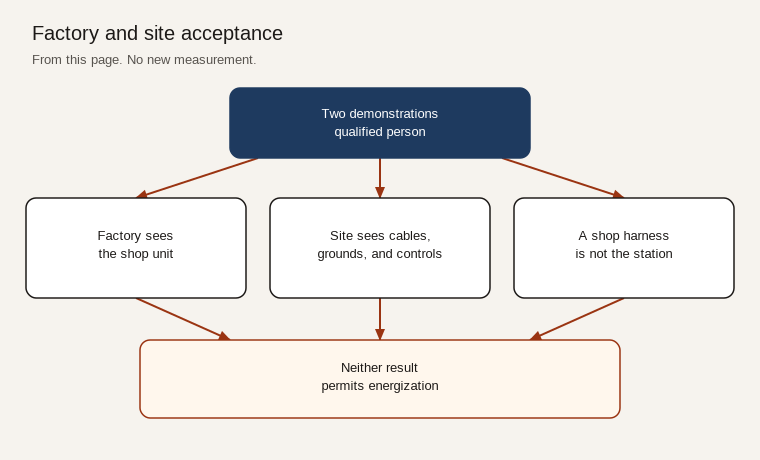
A factory witness and a site witness answer different questions, a shop harness is not the station, and neither result permits energization, so a qualified person assesses the actual site.
Two locations, two different questions
Factory acceptance and site acceptance both ask whether equipment matches the purchase. They are not two names for one event. The factory event uses the maker’s tools, temporary power, and whatever simulation the plan allows. The site event happens after delivery, tied to cables, grounds, and controls that were not in the shop.
A clean shop result can still be followed by a damaged or miswired installation, and a site test cannot recreate every factory condition. Shipping, field wiring, and equipment already beside the new gear sit outside a factory witness. If the contract never says where the work occurs, what is simulated, who attends, and which result allows the next step, the gap appears when travel is booked or an outage clock starts.
| Question | Factory witness | Installed site |
|---|---|---|
| Does this serial number match the build drawings? | Usually the right place | Confirms identity after delivery, not the build |
| Is there a production-test report for this unit? | Yes, if the plan required those tests | Does not replace a missing factory report |
| Did transport or field work change the installation? | Cannot see it | This is why the site activity exists |
| Does the controller reach the owner’s network? | Only if that path is actually present | Yes, within the agreed communications check |
| May the equipment be energized? | No | Not from the site test alone |
The table is a scope aid, not a procedure. A qualified professional must judge the actual equipment. This page sets no pass limits, insulation levels, or relay settings.
What a factory test can witness
A factory witness compares the unit with the approved documents while the builders are available. Nameplates, layout, auxiliary wiring, and mechanical interlocks on that assembly can be checked against the manufacturing revision, and a correction can still be made before shipping release. That access is not evidence about the owner’s site.
The visit can also show functions that do not need the site: a controller on simulated inputs, lights and alarms on temporary control power, and drawings marked to the shop condition. None of that proves field terminations, station ground, the utility source, or the network the device will join. If the plan says an interface was tested, name the interface. A bench harness is not the station.
A witness point means a named party sees the step. A review point may proceed on records. A hold point stops the next step until the evidence is accepted or a deviation is logged. Those controls govern shipment. They do not authorize energization.
Routine tests are not the witness plan
For liquid-immersed distribution, power, and regulating transformers, the catalog entry for IEEE C57.12.90-2026, read on November 22, 2026, describes methods for tests specified in IEEE C57.12.00. The abstract names resistance, ratio, polarity and phase relation, losses, dielectric tests, temperature and short-circuit tests, audible sound, and calculated data, and it excludes several specialty transformers. The page lists the document as an active standard and an approved draft, with board approval on September 25, 2026, superseding the 2021 edition. Confirm that status before citing the year. The abstract is a topic list, not a procedure and not a set of limits.
Eaton’s transformer fundamentals page separates routine tests, performed on production units, from design tests on a new design or prototype, and it points the routine work to IEEE C57.12.00 with methods in IEEE C57.12.90. That is a manufacturer’s summary. The factory acceptance test is the contract event: the buyer sees the routine tests, document review, and functional checks the contract listed. A prototype test does not describe the serial number being shipped.
IEEE C57.12.00-2026, read the same day, states requirements for that family when the highest winding voltage is 601 V or higher. Board approval on the page is November 4, 2026. As of November 2026, “latest IEEE” is ambiguous. Name the edition. Opening a project on the 2021 texts does not change the edition because a catalog page moved.
Switchgear is a different library. IEEE C37.74-2025, published May 6, 2026 and ANSI-approved June 26, 2026, covers design and production tests for specified pad-mounted and related switchgear on alternating-current systems up to and including 38 kV. That is an equipment class, not a test voltage and not the document for every lineup.
What only the installed site can show
The site is the first place the new equipment, the field cables, the local grounding, and the gear already in service exist together. A factory report cannot show transit damage, a bushing struck during setting, a cable landed on the wrong point, or phasing that does not match the crew’s work. Those facts are the reason a site activity remains after a complete factory file.
IEEE C57.152-2025 guides diagnostic field testing of fluid-filled power transformers, regulators, and reactors. The abstract for the edition approved November 4, 2025 and published June 2, 2026 says several results should be read together and that the manufacturer’s criteria may take precedence. Those discussions are the authors’ judgment of practice. The guide is not a script and not a source of pass numbers. A qualified person uses the named edition, the factory record for that serial number, and the manufacturer’s criteria.
Fit and labels matter too. Does the equipment match the pad, cable window, and working space, and do the labels match the one-line operators will use? Those checks identify the installation. They do not replace specified tests, and this page assigns no torque or insulation values.
Controls and the outage window
A controller that passed on a bench still has to live on the owner’s system. Only the site shows whether it communicates on the installed network, whether accounts match the owner’s rules, and whether a point from neighboring equipment arrives where the design named it. NIST Special Publication 800-82, Revision 3, published in September 2023, is guidance for operational technology that interacts with the physical world, including industrial control and SCADA. It is not a factory-acceptance standard and not, by itself, a contractual test. The Computer Security Resource Center record, read November 22, 2026, says an initial public draft of Revision 4 is open for comment through November 30, 2026. Revision 3 was still the final publication that day.
The guide says security should be handled through architecture, procurement, and installation, not left for later, and it treats a link between OT and corporate networks as added risk. A shop harness is usually neither network. The same publication notes that OT changes need careful testing and that outages are often planned ahead. A factory date does not create the owner’s switching window. Checks that did not fit should stay marked as not performed.
Do not collapse the neighboring activities
Design tests speak to a design. Routine tests speak to units built to it. A purchaser’s witness speaks to the contract. A prototype report does not identify the shipped serial number, and a routine report does not mean the buyer saw interfaces that exist only at site.
IEC 62381:2024, published July 30, 2024, covers process-industry automation. The catalog says it defines requirements for the factory acceptance test, an optional factory integration test, the site acceptance test, and the site integration test, so the parties can agree the work. An ISA preview adopting it as ANSI/ISA-62381-2026, limited to the foreword and introduction retrieved on November 22, 2026, stops before the checklists. Confirm the US edition before naming it. Do not paste that automation standard onto every transformer. It does remind a buyer that two suppliers may need one combined demonstration before shipment and another after installation.
Field acceptance is another library. ANSI/NETA ATS-2025, on the association page read November 22, 2026, is described as field tests and inspections for judging suitability for initial energization. The ANSI blog summary says the edition also adds sections on battery energy storage and solar photovoltaic systems. The tables were not read here, so no test level should be inferred, and the page does not make the document a legal duty for every owner. Name the 2025 edition if that is the document you mean.
Commissioning is wider. The Whole Building Design Guide, quoting ASHRAE Standard 202-2018, calls it a quality-focused process for verifying that systems are planned, designed, installed, tested, operated, and maintained to meet the owner’s project requirements. Factory and site witnesses can sit inside that process. They do not replace the issues log or training records the plan may also require.
Energization is separate. It applies system voltage under the authority of whoever controls the source, often the utility or the station operator. A finished site test is evidence for that step, not the authorization. This page is not a switching plan.
Safety rules do not set the limits
29 CFR 1910.269, read November 22, 2026, covers operation and maintenance of generation, control, transformation, transmission, and distribution equipment, including some test sites for temporary measurements. It does not apply to construction except stated cases under 29 CFR 1926.950(a)(3), and it does not apply where Subpart S covers the installation. 29 CFR 1926.950 covers construction of transmission and distribution lines and equipment, and it sends generation-installation work back to 1910.269. Before that construction work, the host employer must share safety-related characteristics such as nominal voltage, grounds, and environmental conditions.
A factory and a line-construction site can sit under different duties, as can a building switchboard and a utility-style installation. Employers determine coverage. Nothing here is an approach distance. A qualified professional must assess the actual work.
Lock the boundary in the contract
Before travel or a promised outage, write which serial numbers are in the factory event and which interfaces are only simulated; whether suppliers must combine equipment before shipment; which steps are witness, review, or hold points; which edition states the criteria; who may accept a deviation; what is repeated if wiring, firmware, or settings change; what shipping release means while items stay open; which site checks need a de-energized window; and which records travel with the equipment.
Payment and technical evidence can share the word acceptance and still be different gates. Shipment may be allowed on factory documents while energization still waits on site evidence. A later wiring or firmware change means the witnessed unit is no longer the unit being shipped. A qualified person has to say what is repeated.
An illustrative lineup
Consider an illustrative owner adding a liquid-immersed transformer, a switchgear lineup, and a controller that must report on a network the station already uses. This is not a Soleil Energy project or a test sheet.
In the shop, the witness can match nameplates to the order, compare the assembly with the drawings, operate that lineup’s interlocks, and run the controller on simulated inputs. The transformer report should name this serial number. The visit cannot show the pad, the field cables, the station ground, the crew’s phasing, or the station network.
On site, ask whether those serial numbers arrived without unresolved damage, whether connections and grounding match the one-line, whether interlocks with equipment already there behave as the combined design requires, and whether the controller is on the owner’s network. Ask which checks fit the outage. The phrase “test and commission” does not choose among the transformer test code, the switchgear standard, IEC 62381 if adopted, ANSI/NETA ATS-2025, and the safety rules for the work.
Records a later reader can follow
Later operators were not in the shop. Ask for the procedure and the edition or specification section; serial numbers, drawing revisions, and the configuration present; what was simulated; deviations and who accepted them; enough instrument identification to know what was used; site results under the same identifiers, including items not done; and the energization path when someone else holds that authority. Keep the two results distinct. If the equipment changes, say what was repeated.
Common questions
If the factory already accepted the equipment, why test at site?
Factory acceptance can be the commercial gate for shipment and still say nothing about transit, field cables, or the owner’s network. A formal site test exists only when the contract, the specification, the utility, or the authority having jurisdiction requires it. Those sources differ by place. A shop result does not erase a site requirement that remains in the specification.
Is site acceptance the same as NETA testing?
No. Site acceptance is whatever the contract requires after installation. ANSI/NETA ATS-2025, on the publisher’s description, is a set of suggested field tests for initial energization and final acceptance. Use that edition, part of it, or another procedure, and name the choice. A public summary is not the purchased text.
Do OSHA 1910.269 or the construction rules set the test limits?
No. Those sections address safety of covered work, including training and information shared before transmission and distribution construction. They do not define a factory witness or an equipment limit. Employers decide which section applies.
Can one standard cover the transformer, the gear, and the controller?
No. IEC 62381:2024 addresses process-industry automation. IEEE C57.12.90 and IEEE C57.12.00 address liquid-immersed transformers within their scope. IEEE C37.74-2025 addresses design and production tests for one class of pad-mounted switchgear, not every lineup. Say which document governs which equipment.
What if the configuration changes after the factory witness?
The factory record then describes a configuration that is not the one being shipped. The contract should say whether the demonstration is repeated or logged as a limited change. A qualified professional defines what the repeat includes.
Bring the window and the file
Soleil Energy’s power services page describes substation, switchgear, transformer, and distribution work, including factory-acceptance witnessing during procurement and later testing and commissioning with the utility. That describes the service. It does not mean every job uses the same tests. The utility-scale solar page separately describes plant commissioning. The two scopes meet only when a project includes both.
Soleil Energy’s service-area page states work in Maryland, Northern Virginia, and Washington, DC, with no DC office. Who may authorize energization still differs by utility. Confirm the address on that page.
Bring the one-line, the equipment list, the sections that name the tests, and the dates the system can be taken out of service. Ask which interfaces are only simulated in the shop, which results exist only after installation, and which document authorizes energization. Those three answers show whether the two tests are doing different jobs.
Project requirements depend on the site, equipment and applicable rules. Confirm design and installation decisions with the appropriate qualified professional.