
Level 1 vs Level 2 charging is a comparison of two alternating-current methods for replenishing an electric vehicle. Level 1 uses a 120-volt supply, often through the cordset shipped with the vehicle. Level 2 uses a higher-voltage supply, commonly 208 or 240 volts, through installed supply equipment. The difference changes how much energy a parking session can add. It does not select a circuit, a connector, or a service size for a particular site.
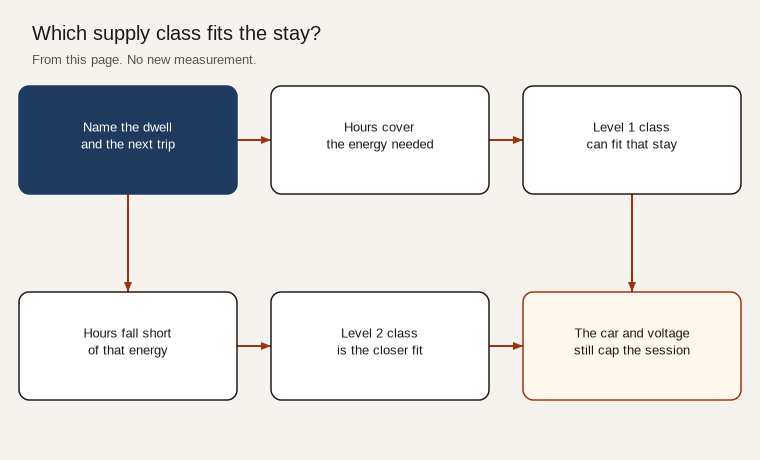
Choose Level 1 when parked hours cover the next trip at the lower supply class, and Level 2 when the stay is shorter or the need is larger, while the vehicle and the real voltage still cap the session.
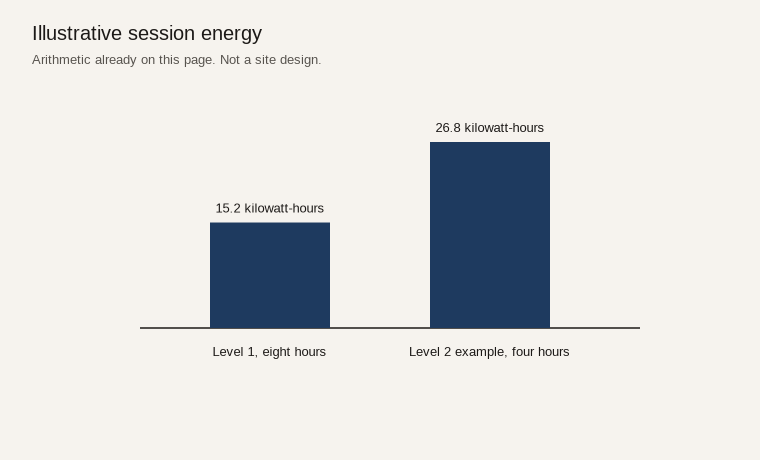
The illustrative totals of 15.2 kilowatt-hours and 26.8 kilowatt-hours repeat the arithmetic already on this page and are not a site design.
What the two levels name
Both names describe alternating current delivered to the vehicle. The wall or pedestal unit is electric vehicle supply equipment, or EVSE. The car’s onboard charger converts that current to direct current for the battery. DOE’s federal fleet training states that AC Level 1 and AC Level 2, as defined by SAE J1772, share that path. Direct-current fast charging bypasses the onboard charger’s power limit.
The Alternative Fuels Data Center stations guide is the public description used here. AC Level 1 charges through a 120-volt plug, commonly a portable cordset with a household plug on one end and an SAE J1772 connector on the other. AC Level 2 charges through 240-volt service, typical of residences, or 208-volt service, typical of commercial buildings. Charging time depends on state of charge, battery capacity, battery type, the vehicle’s internal charger, and the equipment. The pedestal rating is only one of those inputs.
Direct-current fast charging is not a third alternating-current step. The stations guide also calls it Level 3 in ordinary usage, while DOE’s training separates DC Level 1 and DC Level 2 on a combined inlet. Treat “Level 3” as a nickname unless a specification names the standard. The AFDC consumer guide says most plug-in hybrids cannot charge that way.
Medium- and heavy-duty vehicles can use a different alternating-current path. The stations guide notes SAE J3068, aimed at roughly 6 to 130 kilowatts on three-phase supplies such as 208/120 or 480/277 volts. That choice is outside Level 1 versus Level 2.
Why 208 volts is not 240 volts
Power in watts equals voltage times current. DOE’s June 2022 training states that relationship. It describes AC Level 1 as 120 volts at a maximum of 16 amperes, reported as 1.9 kilowatts, and a 32-ampere Level 2 unit as 7.7 kilowatts at 240 volts or 6.7 kilowatts at 208 volts. Those are class descriptions, not a circuit assignment.
The stations guide gives Level 2 a band, not one product. A footnote says output can range from 2.9 to 19.2 kilowatts. The body says equipment can operate at 40 to 80 amperes, while most residential units operate at up to 30 amperes and deliver 7.2 kilowatts. Thirty amperes produces 7.2 kilowatts at 240 volts and less at 208 volts. Eighty amperes produces 19.2 kilowatts at 240 volts and less at 208 volts. Those phrases are not two labels for one box.
The AFDC distribution page says homes use 120/240 volts, while commercial and industrial customers typically use 208/120 volts or 480/277 volts. Moving a charger from a house to a commercial panel can lower the voltage at the same current. The session slows even though the nameplate still says Level 2.
| Question | Level 1 | Level 2 |
|---|---|---|
| Supply | 120 volts | 240 volts in many homes; 208 volts in many commercial buildings |
| Power the sources state | Up to 1.9 kilowatts | About 2.9 to 19.2 kilowatts; many home units near 7.2 kilowatts |
| Miles per hour, AFDC | About 5, or a band of 2 to 5 | About 25, or a band of 10 to 30 |
| Usual hardware | Portable cordset | Installed equipment |
Those mile rates are illustrations for unnamed vehicles. One AFDC page ties a single figure to an assumed power. Another gives a band. Use the band, then check the vehicle limit and the measured voltage.
The car sets a ceiling the station cannot raise
The session follows the lower of what the EVSE offers and what the onboard charger accepts. The stations guide lists that internal capacity among the factors that set time. A battery near full accepts less power than an empty one, so nameplate power times parking hours overstates the end of a session. The AFDC infrastructure checklist says workplaces and multifamily sites should consider Level 1 and Level 2, while public hosts should consider Level 2 and direct-current fast charging. That is a siting heuristic, not a code rule.
Dwell time is the selection test
Match parked hours to the energy the next trip needs. The stations guide says eight hours at 120 volts can replenish about 40 miles for a mid-size electric vehicle. The consumer guide says Level 1 can charge a smaller plug-in hybrid, or a partly depleted all-electric vehicle, overnight, and that Level 2 can generally charge a fully depleted all-electric vehicle overnight. Those are typical-use descriptions, not a result for a named model.
A shorter pause flips the test. Four hours in the consumer guide’s Level 1 band of 2 to 5 miles per hour is about 8 to 20 miles. Four hours in its Level 2 band of 10 to 30 miles per hour is about 40 to 120 miles, and only if the car and station are in that band. A van with a set departure range can fail on Level 1 and still be fine overnight on a cordset.
One shift-long employee car can take a lower rate than a stall that must turn over in an hour. The stations guide says most charging happens at home. As of 2023, less than 1 percent of public ports in its data were Level 1 and nearly 80 percent were Level 2. That public mix does not decide a private garage.
An illustrative session, not a design
The arithmetic in this section is illustrative. It uses published power descriptions and assumed hours. It ignores tapering, cold weather, shared controls, and losses.
DOE reports Level 1 at up to 1.9 kilowatts. Holding that power for the eight-hour window in the stations guide gives:
1.9 kilowatts × 8 hours = 15.2 kilowatt-hours.
DOE’s federal example of 6.7 kilowatts, held for an illustrative four-hour stay if the car accepts it the whole time, gives:
6.7 kilowatts × 4 hours = 26.8 kilowatt-hours.
If a vehicle needed 20 kilowatt-hours, constant 1.9 kilowatts would take about 10.5 hours, longer than a four-hour pause. Constant 6.7 kilowatts would take about 3 hours. Six vehicles at 6.7 kilowatts together would be about 40 kilowatts before other building load. None of that is a service size. Thirty-two amperes is 6,656 watts at 208 volts and 7,680 watts at 240 volts, which DOE rounds to 6.7 and 7.7 kilowatts. A 208-volt feeder is not a defective 240-volt charger.
What changes in the project
Level 1 often starts as a cordset on an existing outlet. The outlet, the other loads, the wiring, and the location still need a qualified electrician. This page does not assign a receptacle, a breaker, or a conductor.
Level 2 usually adds a branch circuit and a listed unit. DOE’s 2022 training describes National Electrical Code Section 625 as putting each EVSE on its own circuit and sizing the breaker at least 125 percent of maximum current. That transcript ties a 16-ampere Level 1 example to a 20-ampere breaker and a 32-ampere Level 2 example to a 40-ampere breaker. The stations guide says most residential units at up to 30 amperes and 7.2 kilowatts require a dedicated 40-ampere circuit under Article 625. Those are published examples, not an instruction to install that hardware. The adopted edition, amendments, nameplate, and listing instructions control the circuit.
Several ports move the question to the service. The distribution page warns that coincident charging can strain nearby equipment even when regional generation is adequate, and it points to managed charging. The development checklist says to engage the utility early. A control system can keep ports from all running at full setting. Whether the adopted code lets the calculation use that controlled maximum is a question for the designer and the authority having jurisdiction.
Shared sites also add networking, access, and billing. The development page separates stations that report use and take payment from stations that only charge, and it points to Open Charge Point Protocol version 1.6 or higher so the appliance is not locked to one operator. One port still charges one vehicle at a time even with two connectors. Some states set sign rules; the development page cites Maryland electric-vehicle parking signage, and it does not treat the Americans with Disabilities Act as one layout for every private cord. A commercial demand charge is separate from energy stored in the car. Workplace scope is planned in the workplace charging guide. Home panel and permit steps are on the Level 2 home installation guide.
The connector is a different decision
Level 1 and Level 2 are power classes. The connector is the inlet. The stations guide says both levels use the same SAE J1772 connector and that commercially available U.S. electric vehicles can charge on both. It also describes SAE J3400, the standardized North American Charging Standard design. In that page’s wording, J3400 inlets were then limited to Tesla vehicles, with a J1772 adapter, while several manufacturers had announced adoption as early as 2025. Confirm the inlet on the vehicle. Do not treat that sentence as a 2026 census.
An adapter does not change the level. Direct-current inlets are a further split: the combined charging system adds two pins to a J1772-style port, and CHAdeMO is separate. Buying Level 2 does not buy highway fast charging. The consumer guide says equipment should be certified by a nationally recognized testing laboratory. The development page says ENERGY STAR Level 1 and Level 2 chargers use 40 percent less standby energy than similar products. Standby is not charging power.
Maryland, Virginia, and DC do not share one code book
As of November 2026, a newer edition of the National Electrical Code is not automatically the rule on a given parcel.
Maryland’s Department of Labor matrix, dated March 18, 2026, splits adoption. Modular and state-owned buildings are listed with the 2020 National Electrical Code. The State Fire Prevention Code line lists the 2017 edition. Other buildings are locally adopted. Confirm the edition with the local authority. The matrix is the Maryland adopted-code matrix.
Virginia enforces a statewide code locally. 13VAC5-63-300, amended effective January 18, 2024, requires covered electrical systems to follow that code and NFPA 70. The paragraphs read here amend some NFPA 70 provisions and do not print the edition year. Ask the building official which edition the permit uses. Do not import a Maryland county edition.
In the District, the Department of Buildings construction-codes page identifies the 2017 DC Construction Codes, effective May 29, 2020, as including the 2014 National Electrical Code, amended by Title 12 of the District of Columbia Municipal Regulations. Title 12 is the official text. Transitory rules can leave some applications on an earlier book.
Federal refueling-property tax treatment stops on one date in every state. 26 U.S.C. § 30C, current through Public Law 119-142 (November 10, 2026), does not apply to property placed in service after June 30, 2026. While it applied, the statute used 30 percent of cost, or 6 percent for depreciable property unless wage-and-apprenticeship rules multiplied that credit by five. Caps were 100,000 dollars and 1,000 dollars, and the property had to be in an eligible census tract. Bidirectional equipment is not disqualified only because it can discharge. A tax professional has to judge any earlier installation. The tract and the placed-in-service date still vary by address.
Maryland’s household rebate is level-specific. As of the Maryland Energy Administration FY27 residential EVSE page, checked November 22, 2026, it covers residential Level 2 equipment only: 50 percent of eligible costs up to 700 dollars, after the unit is installed, operating, and paid. The deadline is 3:00 p.m. Eastern Time on May 31, 2027, and the portal may close sooner. The page anticipated up to 1.5 million dollars; its November 9, 2026 update already showed a large share requested or reserved. Commercial equipment is pointed to a separate community program. A Level 1 cordset is outside the Level 2 limit. This article did not verify an equivalent open rebate on an official Virginia or District page. Confirm the utility rider on the bill. Do not apply the Maryland household rebate in Northern Virginia or in the District.
IEEE 1547-2018 does not define these levels. Its catalog scope is interconnection of distributed energy resources, including inverters, at distribution voltage. A charger that only draws power is outside that title. Equipment that can export may be treated as generation under the utility’s interconnection rules.
Questions that change the choice
Is Level 1 too slow for every home?
No. About 40 miles in eight hours is the stations guide’s mid-size illustration, and the consumer guide treats overnight Level 1 as workable for a smaller plug-in hybrid or a partly depleted battery. It is the wrong tool when parked hours fall short of the next trip, or when the outlet cannot be used safely.
Why can a workplace unit add fewer miles than a home unit at the same current?
Commercial supply is often 208 volts, not 240. DOE’s 32-ampere pair is 6.7 kilowatts at 208 volts and 7.7 kilowatts at 240 volts. Compare energy per hour at the real voltage and at the vehicle limit.
Must several Level 2 ports be added at full nameplate?
Not automatically, and not automatically discounted. Coincidence plus the rest of the building is the service question. A control system may cap the group only if the enforced code edition allows that maximum in the calculation. DOE’s 2022 training still described a dedicated circuit per EVSE.
Does a J3400 inlet retire Level 1 and Level 2?
No. J3400 is a connector, including for alternating current. The stations guide still describes Level 1 and Level 2, and still describes J1772 equipment for both. The inlet decides the plug. Voltage, current, and the onboard charger decide the session.
Which incentive still depends on the level?
As of November 2026, section 30C does not apply to property placed in service after June 30, 2026. Maryland’s FY27 residential rebate, on the page read, pays only for home Level 2 equipment and can close before May 31, 2027. Virginia and District offers have to be confirmed locally. An incentive changes cost. It does not select the level the site can use.
Discuss capacity before fixing a charger count
Bring the parking hours, the vehicles’ accepted charge rates, the service voltage, and any panel or interval records. Soleil Energy can discuss charger count, the electrical capacity already on the property, and whether load management belongs in the plan for homes, workplaces, and fleets in its Maryland, Northern Virginia, and District of Columbia work, as described on the EV charging service page. The useful level is the one that can finish the session the vehicle actually has, on the voltage the building actually provides, under the code edition the authority having jurisdiction enforces.
Project requirements depend on the site, equipment and applicable rules. Confirm design and installation decisions with the appropriate qualified professional.