
Lockout tagout is an employer’s program for preventing machines and equipment from starting unexpectedly, or from releasing stored energy, during servicing and maintenance. The lock or the tag is only the hardware. Control sits in the written program, used by a person the employer authorizes. This page explains that boundary for owners and contractors. It is not the program, and it is not a method for equipment.
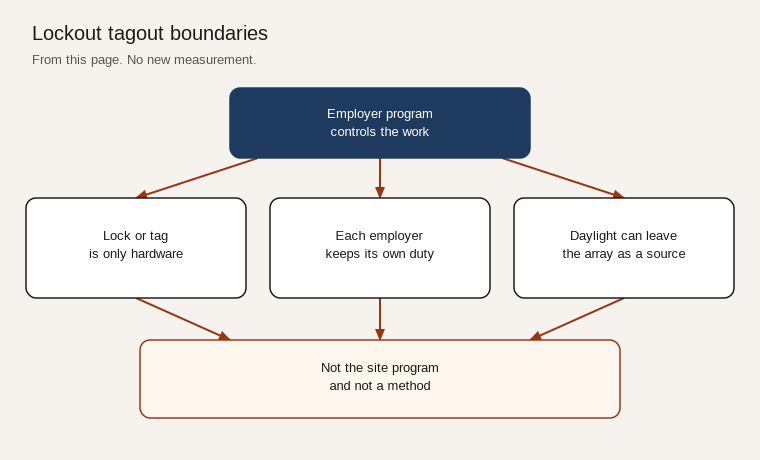
The employer program, not the hardware alone, controls the work, each employer keeps a duty, daylight can leave an array as a source, and the page is not a method, so a qualified person assesses the actual site.
The program controls the work
As of November 2026, the Electronic Code of Federal Regulations displays Title 29 as up to date as of November 19, 2026. 29 CFR 1910.147 covers servicing and maintenance where unexpected energization, start-up, or release of stored energy could injure an employee, and it sets minimum performance requirements. The employer must establish a program for applying lockout or tagout devices to energy-isolating devices and for otherwise disabling machines or equipment. The program has three parts: energy-control procedures, employee training, and periodic inspections. Before covered servicing, the machine or equipment is isolated from the energy source and rendered inoperative.
Lockout places a lockout device on an energy-isolating device, under an established procedure, so the equipment cannot be operated until that device is removed. Tagout places a tag, under an established procedure, to indicate that the equipment may not be operated until the tag is removed. Tags are warnings. The section says they do not provide the restraint a lock provides and may evoke a false sense of security. If the isolating device can accept a lock, the program uses lockout unless the employer demonstrates the employee protection the section requires for tagout. If it cannot accept a lock, the program uses tagout. The employer supplies the hardware, uses it only for energy control, and identifies the employee who applied it.
An energy-isolating device physically prevents transmission or release of energy. The definition includes a manually operated breaker, a disconnect, a line valve, a block, and similar devices. Push buttons, selector switches, and other control-circuit devices are not energy-isolating devices, so a stop at an operator station is not lockout. “Energized” means connected to a source or still containing residual or stored energy. A source may be electrical, mechanical, hydraulic, pneumatic, chemical, thermal, or other. A 1999 NIOSH alert, last reviewed on the archived page on June 6, 2014, calls hazardous energy any energy sufficient to injure. The alert is not the OSHA rule.
An authorized employee locks or tags out in order to do the servicing. An affected employee operates the equipment or works where that servicing is performed. A coordination meeting does not authorize anyone. Under 29 CFR 1910.269 and 29 CFR 1926.950, “qualified” means the training those sections specify, including distinguishing exposed live parts and maintaining the approach distances the section itself states. This page states no distance. The employer’s written program, and a person who meets it, control the work. This page is not that program.
Several rules use the same words
1910.147 excludes construction and agriculture; maritime work under 29 CFR parts 1915, 1917, and 1918; utility generation, transmission, and distribution installations under the utility’s exclusive control, including related communication or metering equipment; electrical exposure on utilization installations, which Subpart S covers; and oil and gas well drilling and servicing. Normal production is outside it. Servicing during production is covered only if a guard or other safety device is removed or bypassed, or if any part of the body must enter a point of operation or an associated danger zone. The employer decides whether a minor, routine task falls under the section’s narrow exception.
1910.269 covers operation and maintenance of generation, control, transformation, transmission, and distribution lines and equipment within its stated applications, including utilities and equivalent industrial installations. It does not apply to construction as defined in 29 CFR 1910.12, except specified tree-trimming and the generation-installation work identified in 1926.950(a)(3), and it does not apply to Subpart S practices. Supplementary standby generation used only to supply a workplace is pointed to Subpart S. 1910.147 also has narrow cord-and-plug and hot-tap conditions. This page does not apply them.
Paragraph (d) is lockout/tagout for energy sources in generation installations, including related communication or metering equipment. Paragraph (m) is deenergizing of sources used exclusively for transmission and distribution. Generation-facility installations that are not integral to, or inextricably commingled with, the generation process are under 1910.147 and Subpart S. OSHA’s lockout eTool says a 1910.147 program meets 1910.269(d)(2)(ii) only when it addresses the hazards in paragraph (d), and that 1910.147 does not fulfill paragraph (m).
Paragraph (m) requires that conductors and parts deenergized under some other procedure be treated as energized. If a system operator controls the disconnection, the employer designates one employee in charge of the clearance and follows the order in paragraph (m)(3). This page does not set out that order. OSHA’s electric-power eTool treats incomplete disabling under 1910.269 as live work and says the standard does not define where generation ends. Criteria, including a demarcation written into the hazardous-energy program, sit in OSHA Instruction CPL 02-01-038. This page does not apply that directive.
A mechanic working on mechanical parts of an electrically powered machine is a 1910.147 question. Work on or near exposed deenergized utilization parts is a 1910.333 question. OSHA’s eTool on that relationship says one program may serve both only if it also meets 1910.333(b)(2)(iii)(D) and 1910.333(b)(2)(iv)(B) when shock exposure is involved. Those paragraphs stay in the employer’s program.
Construction of transmission and distribution lines and equipment is 1926 Subpart V, including new work and alteration of existing lines and equipment. Generation-installation work must comply with 1910.269. Complying with 1910.269 can satisfy Subpart V provisions that do not point elsewhere in part 1926, but it does not excuse those other provisions. A general-industry course is not the rule for building a new line.
OSHA’s State Plan list, read in November 2026, includes Maryland and Virginia and does not list the District of Columbia. State plans must be at least as effective as OSHA. The Maryland page says MOSH incorporated related federal standards and lists additional unique standards that do not themselves add a lockout rule. Exclusions remain, including maritime work, military bases, and stated federal property. The Virginia page says VOSH adopted most OSHA standards and lists unique standards, including an overhead high-voltage line statute. This page does not read that statute and states no distance or voltage from it. District of Columbia private-sector coverage is a question for federal OSHA.
Each employer still has a duty
A contract does not move the program by silence. For activities inside 1910.147, the on-site and outside employers tell each other their procedures, and the on-site employer makes sure its own employees understand the outside employer’s restrictions. For generation activities inside 1910.269(d), each employer makes sure its own personnel understand the procedures in use. That paragraph does not replace paragraph (m).
Before work covered by 1910.269(a)(3), and before covered construction under 1926.950(c), the host informs the contract employer of specified installation characteristics, known listed conditions, and the design and operating information needed to protect the contract employer’s employees. Parts of that duty use existing records and reasonable diligence rather than a new site inspection, and missing listed information has to be obtained. The contract employer instructs its crews, warns the host of unique hazards before work, and reports an unanticipated hazardous condition within 2 working days after discovery. The employers then coordinate work rules. A meeting that never names the sources, the procedure, or the authorized person has not done this.
Where 1910.147 applies, a crew needs protection equivalent to a personal device, and more than one crew means an authorized employee keeps that protection continuous across the job and across shift changes. Paragraph (d) has the same kind of requirement for the generation work it covers. This page does not describe the arrangement.
A clearance and a facility program answer different questions. Paragraph (m) is employee protection on transmission and distribution lines, including the link to a system operator. A 1910.147 or 1910.269(d) program covers the machines those sections address, including non-electrical energy under paragraph (d). Opening the utility device does not identify stored energy or a generator that can feed the bus. Releasing the clearance does not close the facility procedure.
What the scope has to name
The window has to fit the procedure, including a crew change. The scope names who holds the written program for each source and who is authorized or qualified under the rule that applies. Handover should show what is released and the inspection record. Under 1910.147, and under 1910.269(d) for generation work that paragraph covers, that inspection is at least annual, by an authorized employee other than the person using the procedure being inspected, and the record names the equipment, the date, the employees included, and the person who performed it.
After January 2, 1990, where 1910.147 applies, replacement, major modification, and new equipment need energy-isolating devices designed to accept a lockout device. For generation installations under 1910.269(d), the text uses November 1, 1994. The dates are not interchangeable, and neither proves a given device accepts a lock. Tagout on a device that can be locked requires the employer to demonstrate equivalent protection.
Servicing under 1910.147 includes installing, setting up, and inspecting when unexpected energization or a release of energy could injure someone, so a test label does not remove the question. Whether commissioning is covered is the employer’s call. An operations contract is a different document. Soleil’s commercial solar maintenance guide describes what a maintenance scope often names. It does not isolate equipment.
1910.147(f)(1), and a comparable passage in 1910.269(d), address temporary removal of devices so equipment can be energized for a test or for positioning. Each sets an order. The written procedure controls that transition. This page does not restate it and states no price. An outage request can set a window. It does not authorize a person or list every source.
Daylight and other sources one device does not erase
Residual energy still counts as energized, and a generator that can close onto a bus is another source. The Department of Energy’s photovoltaic page, updated September 2, 2026, states that these devices convert sunlight into electrical energy. OSHA’s solar lockout page states that the equipment can generate electrical energy and that servicing can expose workers to unexpected energization or stored energy from panels and circuits. Employers may have to use 1910.269(d) or 1910.147; which one is the employer’s determination. Stopping an inverter, or opening a device downstream of the array, does not remove sunlight. The array remains a source in daylight. This page does not describe a way to make modules or array-side conductors safe to work on.
NFPA’s 70E development page, read in November 2026, lists a 2027 edition and says the standard assists with OSHA 1910 Subpart S and 1926 Subpart K. That is NFPA’s description, not an adoption finding and not 1910.147. IEEE’s NESC page describes the National Electrical Safety Code as safeguarding rules for utility workers and the public during work on electric supply and communication lines, and it identifies a 2023 edition. The code text was not read here. No clearance or distance from either document is stated. A contract that requires one must name the edition.
An illustrative campus outage
This scene is illustrative. It is not a Soleil Energy project, and it is not a method. A campus plans switchgear replacement while a utility controls the feeder, a generator can feed the bus, and a rooftop array feeds an inverter.
| Decision before the window | Why it is scope, not improvisation |
|---|---|
| Which program governs the switchgear, and which rule governs the feeder? | 1910.147, 1910.269(d), and 1910.269(m) are not aliases. Line construction can be 1926 Subpart V. |
| What must the host and contractor exchange first? | The applicable section assigns the exchange. A sign-in sheet is not that exchange. |
| Does the window cross a shift or a second crew? | Protection has to stay continuous. The written procedure says how. |
| What can still supply energy after the utility device is open? | The generator, stored energy, and the illuminated array are separate from the feeder. |
| Who may apply or remove control? | Authorization and electric-power qualification come from the governing program, not from attendance. |
| What record comes back? | Clearance status, facility-procedure status, and the procedure’s inspection record are different documents. |
No row is permission to open, lock, test, or restore anything. “We will lock it out,” “the clearance means the bus is dead,” “tag the breaker,” and “inverter off means the solar is off” each skip a boundary above.
Common questions
Does 1910.147 cover a utility line or a new substation?
Not as a blanket. Utility installations under the utility’s exclusive control, and construction employment, are outside it. Covered operation and maintenance use 1910.269(d) or 1910.269(m), and construction of transmission and distribution lines and equipment uses 1926 Subpart V. A utilization disconnect can fall under Subpart S. The employer matches the work.
What should the contract require before the outage is approved?
Name the program for each source, the employer who holds it, and confirmation that the other employer has been informed. Keep any test that energizes equipment inside the written procedure, not a schedule note. Use January 2, 1990 only with 1910.147, and November 1, 1994 only with 1910.269(d). Ask for clearance status and the procedure’s inspection record at handover. “Follow OSHA,” with no section and no procedure, is not that requirement.
Why does a solar array stay hazardous in daylight?
Modules convert sunlight into electrical energy, and an inverter stop is only a control action. Under 1910.147, a control-circuit device is not an energy-isolating device. Opening a downstream device does not make the array side a deenergized machine. The employer’s program has to treat the illuminated array as a source. This page does not describe the work.
Can an owner use this page as the site program?
No. It does not document a procedure, authorize an employee, or verify that energy is controlled, and it does not decide enforcement in Maryland, Virginia, or the District of Columbia. The employer’s own procedures must state the scope, authorization, and verification content 1910.147 lists. A person who meets that program controls the work.
Bring the window and the program owner
Soleil Energy’s power group takes scope conversations for substation, switchgear, and commissioning work, including testing coordinated with the utility. A useful conversation names the voltage class in the owner’s terms, the available window, which employer holds the written program, and the handover expected when the clearance and the facility procedure both close. The conversation does not establish the program, choose the OSHA section, or authorize anyone to isolate equipment.
Project requirements depend on the site, equipment and applicable rules. Confirm design and installation decisions with the appropriate qualified professional.