
NACS vs CCS charging compares two North American vehicle inlets, not two charging networks. A Combined Charging System Type 1 inlet keeps an SAE J1772 alternating-current face and adds separate direct-current contacts. A North American Charging System inlet, documented in SAE J3400, uses the same two current-carrying contacts for single-phase alternating current or direct current. The inlet decides which connector mates without an adapter. It does not set building capacity or network software.
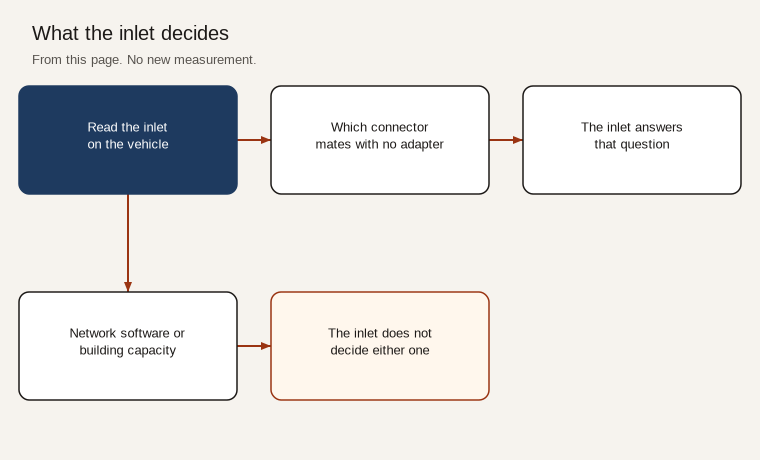
Match the connector to the inlet on the car, and keep network software and building capacity as questions the inlet does not decide.
| Question | What it settles | What it leaves open |
|---|---|---|
| Vehicle inlet | Which connector mates without an adapter | Building capacity or network software |
| CCS Type 1 | An alternating-current face plus separate direct-current contacts | A speed rating from the shape alone |
| NACS, in J3400 | The same contacts for alternating current or direct current | Truck charging or utility interconnection |
| Two cables on one port | Which inlets can mate | A second session at the same time |
| Charger-to-network messages | Remote management of that charger | Which inlet the cable fits |
The coupler is only one layer
A driver sees a cable end and a door on the car. The owner of a site sees a stack: the vehicle inlet, the connector on the cable, the charger that sources power, the software that runs that charger, and the utility service behind it. Treating those as one purchase is how a plug debate produces the wrong equipment.
DOE’s Alternative Fuels Data Center separates the words: a station location is the place, a port charges one vehicle even if several connectors hang on it, and a connector is what plugs into the car. SAE Recommended Practice J3400_202409, revised September 2024 and first issued December 2023, covers the hand-mated coupler that carries direct current or single-phase alternating current on two current-carrying contacts. J3400/2_202505, May 2025, defines the connector and inlet dimensions. Those are hardware documents, not a network map.
In U.S. rules and DOE material, the combined light-duty inlet is CCS Type 1, also called the SAE J1772 combo. This page stays with that inlet and with NACS as documented in the J3400 family.
How a CCS Type 1 inlet is arranged
CCS Type 1 puts alternating-current charging and direct-current fast charging on one inlet. DOE’s station guide says the CCS connector accepts Level 1, Level 2, and direct-current fast charging, and that the fast-charging connector adds two bottom pins. The Joint Office is more specific: CCS1 uses the five-pin SAE J1772 layout for Level 1 and Level 2, plus two additional bottom direct-current pins. One door takes a J1772 connector for slower charging and a CCS Type 1 connector for fast charging.
The shape is not a speed rating. DOE ties charging time to state of charge, the battery, the vehicle’s internal charger, and the site equipment. J1772 remains the alternating-current connector on typical Level 1 cordsets and on Level 2 equipment that uses it, and DOE’s consumer page also lists NACS for Level 2. Existing J1772 cables can still charge a CCS Type 1 car on alternating current. DOE’s station guide states that Tesla vehicles come with a J1772 adapter. Treat any adapter as that maker’s instruction.
How a NACS inlet is arranged
The Joint Office records the November 2022 renaming, the June 2023 task force, the December 2023 Technical Information Report, and the 2024 vote that made J3400 a Recommended Practice. J3400/2 is a separate dimensional standard. A specification should cite the edition. The functional contrast is the power path: the Joint Office says NACS uses the same pins for alternating-current Level 1, Level 2, and direct-current charging, and SAE’s public scope says two current-carrying contacts carry either direct current or single-phase alternating current. This page does not state a pin count or a current ceiling the public scope does not give.
The vehicle and the charger still have to agree whether the session is alternating current or direct current. DOE lists J3400 for every charging level and names it beside CCS and CHAdeMO for direct current. Some lines on that page still read as if only one brand used J3400. Treat that as an older snapshot, not a November 2026 census.
What the inlet does not decide
The inlet does not choose the billing company, the back-office protocol, or the service size. It also does not settle truck charging. DOE describes the Megawatt Charging System as a separate development for medium- and heavy-duty vehicles and points to SAE J3271. Exporting power is a further split. IEEE 1547-2018 covers interconnection of distributed energy resources with the utility system. It is not an inlet drawing. Matching J3400 or CCS Type 1 does not answer a utility interconnection.
Three conversations sit behind the plug
People say a charger “speaks CCS” when they mean three different links. The definitions in 23 CFR 680.104, and the interoperability rules in 23 CFR 680.108, keep those links apart. The notes below follow that structure. They are not a wiring procedure.
The vehicle talks to the charger
For covered chargers, section 680.108 requires charger-to-EV communication conforming to ISO 15118-3, with hardware capable of implementing both ISO 15118-2 and ISO 15118-20. By February 28, 2024, covered software had to conform to ISO 15118-2 and be capable of Plug and Charge, which section 680.104 defines as starting a paid session from the plug-in and ISO 15118 certificates, without another customer step. That link can run on either inlet. It does not replace the contacts, and a hardware claim of a later ISO 15118 part is not proof that export is turned on.
The charger talks to a network
Open Charge Point Protocol, OCPP, runs the other direction. Federal text calls it an open-source protocol between chargers and the charging networks that remotely manage them. Section 680.108 requires covered chargers to conform to OCPP 1.6J or higher and, by February 28, 2024, to OCPP 2.0.1. Covered chargers must also be designed so the network provider can be switched without a hardware change.
The Open Charge Alliance dates OCPP 1.6 to 2015, OCPP 2.0.1 to 2020, and OCPP 2.1 to 2025, and it states that 1.6 and 2.0.1 are not compatible. Version 2.1 keeps 2.0.1 application logic and adds functions that include ISO 15118-20 support. A line that says only “OCPP” is incomplete. DOE’s development guide notes that OCPP separates the appliance from the back end so a host can change networks without replacing the charger. Either inlet family can use it. Do not infer the protocol from the plug.
Open Charge Point Interface sits between networks, not between the car and the charger. Federal text says OCPI lets charging networks exchange information and services for drivers. Covered networks had to be capable of OCPI 2.2.1 by February 28, 2024. An app that roams is not evidence that a connector fits a car.
One port still charges one vehicle
DOE and the federal definitions both allow more than one connector on a port, and both say the port charges one vehicle at a time. A pedestal with a CCS Type 1 cable and a J3400 cable can cover a mixed row. It does not create two sessions. Count ports for simultaneous vehicles. Count connectors for which inlets mate without an adapter.
CHAdeMO, the third direct-current connector DOE still lists, is a different inlet on mostly older vehicles. On covered projects, section 680.106 limits permanently attached CHAdeMO connectors to fiscal year 2022 NEVI funds. It is not a hedge between NACS and CCS.
What is still open as of November 2026
As of the SAE Mobilus records read on November 22, 2026, the system document is still Recommended Practice J3400_202409 and the dimensional standard is J3400/2_202505. This page did not have the paid text, so it does not paraphrase unread clauses. Cite the edition, and check for a later revision before fabrication.
The Joint Office page, whose timeline stops in 2024, said most models then on sale used CCS1, that makers had committed to J3400 beginning in 2025, and that non-Tesla vehicles built through 2024 would keep a CCS1 port. On January 16, 2026, CharIN described some non-Tesla models already sold with native NACS inlets, some networks installing both families, and an expectation that native J3400 inlets would become common over the following model years. Respondents still flagged adapter safety, shared power pins, and inlet location. No federal sales census read for this page supports a precise share. The practical assumption is overlap: CCS Type 1 cars stay in service while J3400 inlets arrive.
Adapters are a bridge, not a design
An adapter lets one family mate with the other inlet. The Joint Office distinguishes portable adapters from station-fixed ones and, for federally funded fast charging, says the adapter should be permanently attached, integrated by the charger manufacturer, and used only on a station that meets the rest of the federal requirements. A September 2024 Joint Office notice treated adapter failures as a safety topic without stating a rate this page will invent. On April 15, 2025, CharIN said adapters remain during the overlap, urged UL 2252 certification or a vehicle-maker adapter, and pointed to shock and fire risk from parts that lack those features, plus recall listings at the National Highway Traffic Safety Administration. The vehicle maker and the listing decide fit. A qualified person installs the charger. The site owner does not certify the adapter.
The federal connector sentence is still the 2023 text
Section 680.106(c), displayed on the eCFR on November 19, 2026, still requires each direct-current fast-charging port to charge any CCS-compliant vehicle and to have at least one permanently attached CCS Type 1 connector, and each Level 2 port to have a permanently attached J1772 connector. Title 23 was last amended on September 23, 2026, and the section’s source note is still the February 28, 2023 rule. The eCFR is unofficial. Read the live section before contracting.
The Joint Office reads that rule as allowing an added J3400 connector when the CCS1 connector remains. J3400 is not written in as a substitute. Part 680, on the Joint Office’s description, covers National Electric Vehicle Infrastructure Formula Program projects and publicly accessible chargers funded with Title 23 money. A private home or workplace that is not spending those funds is not covered merely because it sits in Maryland, Northern Virginia, or Washington, DC. A grant or permit can still name a connector. Read the document that pays for the job.
Where the section applies, the electrical minimums are not inlet ratings. Covered fast-charging ports must support 250 volts DC to 920 volts DC. Corridor ports that serve designated Alternative Fuel Corridors must have a continuous rating of at least 150 kilowatts and must meet each vehicle’s request up to that level at the same time. Each covered Level 2 port must be rated at least 6 kilowatts, and the station must provide at least 6 kilowatts per port together unless the customer accepts less. Those figures are from the November 19, 2026 display of section 680.106. A car may take less. A product may be built for more. Covered chargers must also be certified by an OSHA Nationally Recognized Testing Laboratory, and covered Level 2 chargers must be ENERGY STAR certified. Listing still does not name the inlet.
Site power follows vehicles and the service
A connector choice changes which cars can connect. The service calculation starts from how many vehicles charge at once, how long they stay, and what else shares the service. DOE’s development guide tells planners to settle networking, utility upgrades, and operations with the utility before buying. DOE describes Level 2 equipment at 240 volts in homes and 208 volts in many commercial settings. Direct-current fast charging puts conversion in the station, so the upstream supply is larger. Smart charge management can hold ports inside a limit. It cannot mate the wrong inlet. For one home, the question is the panel and a connector or approved adapter that matches the car, which is the scope of Soleil Energy’s Level 2 charger installation at home guide. For a workplace or fleet, stall count and dwell time sit beside the inlet list. Soleil Energy’s commercial EV charger installation guide is that planning companion.
An illustrative office lot shows the split. Earlier pool cars have CCS Type 1 inlets and later cars have J3400 inlets. Most sit all day, so alternating-current charging can cover them, while two service vehicles need direct current between trips. Cables of only one family leave the other cars on adapters. A dual-connector port still charges one vehicle at a time. The service follows simultaneous sessions and the rest of the building, not the plastic on the connector. This scene is illustrative. It is not a Soleil Energy project.
A licensed electrician, and a licensed engineer where the design needs one, apply the adopted code, the utility rules, and the equipment listing. This page cannot set a breaker or a code edition. Maryland, Northern Virginia, and the District of Columbia do not share one amendment book. Confirm the authority having jurisdiction.
Bring the inlet list to the electrical discussion
Soleil Energy installs home and commercial charging, including service work, workplace and fleet layouts, and load management, in Maryland, Northern Virginia, and Washington, DC, as described on the service area page. Discuss charger count, electrical capacity, and load management with Soleil Energy’s EV charging team when a site there is ready for a design. Bring the inlet list, dwell times, and any grant or utility limits. That discussion does not certify an adapter or close the national transition.
Questions that change the scope
Does OCPP mean every car can plug in?
No. OCPP is the charger-to-network link. The same charger can implement a stated version and still offer one connector family. Name the connector, the OCPP version, and any OCPI roaming as separate lines. None of them mates the plug.
Must a private workplace here include CCS Type 1?
Not from the address alone. The Joint Office ties Part 680 to NEVI and other Title 23 public-charging funds. A private lot outside those funds is outside that connector sentence unless a grant, utility offer, or permit pulls it in. If the project is covered, the November 19, 2026 eCFR text still requires CCS Type 1 on each fast port and J1772 on each Level 2 port, with J3400 only as an addition on the Joint Office’s reading.
Are loose adapters a fleet strategy?
Only as a bridge. CharIN’s April 2025 statement expects adapters while both couplers remain and warns against parts that lack UL 2252 certification or vehicle-maker approval. On federally funded fast chargers, the Joint Office expects a permanently attached adapter integrated by the charger manufacturer. For daily fleet use, native connectors or that kind of listed station hardware is the steadier plan. Confirm each adapter against the vehicle instructions.
What should be rechecked before a purchase order?
The SAE edition cited here, the current text of section 680.106(c), and the fleet’s own inlet list. A later SAE revision or a CFR amendment would supersede this page’s November 2026 reading. A qualified electrical professional applies the result to the site. This article cannot set that design.
Project requirements depend on the site, equipment and applicable rules. Confirm design and installation decisions with the appropriate qualified professional.