
Open Charge Point Protocol (OCPP) is the open message set between an electric-vehicle charging station and a charging station management system. The Open Charge Alliance maintains the specification. Those messages cover authorization, session reporting, remote commands, and limits on charging. OCPP is not the connector that attaches a vehicle, and it is not the electrical service that feeds the site. Two products work together only when they implement a compatible version and the functions that site needs.
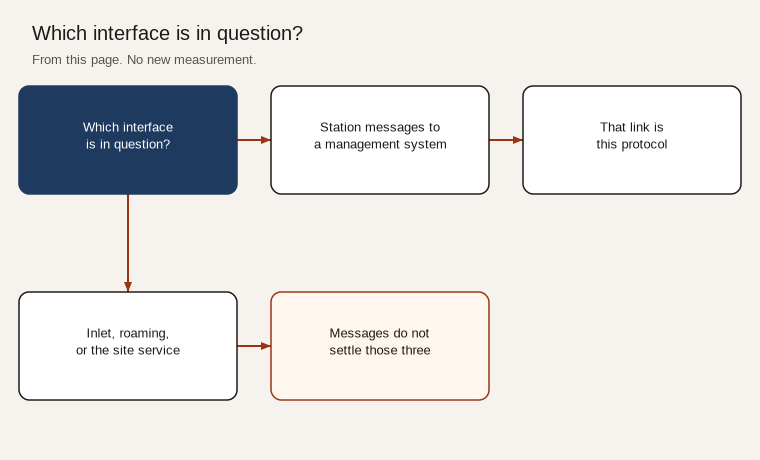
Use this protocol for messages between a charging station and a management system, and keep the vehicle inlet, roaming between networks, and the electrical service as separate decisions.
The messages run between the station and a management system
A charging station is where a vehicle plugs in. A charging station management system, often called a back office or a charging network, authorizes drivers, stores session records, and sends commands. The Open Charge Alliance describes OCPP as the open protocol between those two sides. Its March 2023 white paper calls it the industry-supported protocol for that link and an open standard with no cost or licensing barrier for adoption. The alliance publishes the specification. Its frequently asked questions say it does not ship a software library that replaces a vendor’s product.
“Networked” means the station exchanges data with some management system. It does not name the version, the optional functions, or the platform that will accept it. A private protocol can do the networking and still leave the owner on one vendor. OCPP is the shared language that makes another management system possible. It is not a right to exit a contract, a cellular plan, or a payment terminal.
The same FAQ says the protocol applies to any managed station, including a house unit used for firmware updates or a schedule. Unused functions can be omitted. A station that never talks to a management system may not implement OCPP at all.
The connector and the service are different jobs
Owners mix four interfaces that answer different questions.
| Interface | What it connects | What it does not settle |
|---|---|---|
| Vehicle connector | Plug and vehicle inlet | Which management system the station reports to |
| OCPP | Station and management system | Inlet shape, or service ampacity |
| Roaming interface | One network and another network or driver platform | The circuit from the panel to the charger |
| Site electrical service | Utility supply and site distribution | Which software version the station speaks |
Federal definitions, for the projects they cover, match that split. In 23 CFR 680.104, a connector transfers electricity to the vehicle, OCPP is the protocol to the network that manages the charger, and the Open Charge Point Interface is communication among networks. Connector rules, including CCS and J1772 where that part requires them, sit in a different section. The right inlet does not mean the platform will accept the station.
The vehicle conversation is separate. The white paper says CCS vehicles support ISO 15118-2, including Plug and Charge and a report of energy need. OCPP 2.0.1 carries certificate handling and that information to the management system. Plug and Charge on 1.6 sits in a separate application note, not in the base 1.6 text. ISO 15118 does not choose the back office.
The Open Smart Charging Protocol is a third document. The alliance says it is not actively developing it. It carries a capacity forecast from a distribution operator, or a site owner, to the back office. It replaces neither OCPP nor a load calculation.
Published versions do not all speak to one another
The protocol page, read in November 2026, lists three available versions: 1.6 from 2015, 2.0.1 from 2020, and 2.1 from 2025. The FAQ says 1.5 and the original 2.0, from 2018, are no longer actively supported.
Version 1.6 added smart charging and supports SOAP and JSON over WebSocket, plus local list management. Version 2.0.1 is not backward compatible: transaction handling changed and a device model was added. The protocol page lists device management, security, smart charging, ISO 15118 support, and display messaging. The FAQ says 2.0.1 uses JSON over WebSocket only.
Version 2.1 extends 2.0.1. The January 2025 announcement says 2.0.1 application logic continues to work and that 1.6 is not compatible with 2.1. Both older versions stay supported. Additions include ISO 15118-20 with bidirectional transfer, blocks for bidirectional charging and distributed-energy control, battery swapping, local cost calculation, and payment options such as a card terminal. A 2.0.1 station does not gain those functions because the later text exists.
Editions sit inside a version. In December 2025 the alliance announced edition 4 of 2.0.1 and edition 2 of 2.1, including certification profiles and test cases for 2.1. Edition 3 of 2.0.1 was approved as IEC 63584 in October 2024, and 2.1 edition 1 was later published as IEC 63584-210:2025. Confirm the live IEC edition before you cite a catalog number.
What the two sides exchange
The March 2023 white paper groups 2.0.1 into blocks such as security, authorization, local lists, transactions, remote control, reservations, metering, smart charging, firmware, ISO 15118 certificates, diagnostics, and custom data transfer. Implementers may skip blocks. Certification defines a minimum; extended profiles cover items such as smart charging.
The device model lets a station report components and outlets, and name the component in an error, instead of only the short 1.6 status. In 2.0.1, start, stop, and meter reports fold into one TransactionEvent, and the station assigns the identifier. A public tariff display is not the building’s utility bill. Remote commands can start a session or send firmware. None of that inspects the wiring.
The white paper says 2.0.1 defines three security profiles for authenticating the station and the management system, plus client-certificate keys, signed firmware, and a security event log. It says the same features were described for JSON 1.6 in a separate paper. “Secure OCPP,” with no version and no profile, does not say which of those you bought.
Smart charging lets the operator, or indirectly a third party, influence session current or power, or cap what the station may offer. The station stays inside that cap and inside its hardware. The message does not raise conductor ampacity, breaker rating, or service size.
A charging limit does not create capacity
Profiles can hold several chargers under a chosen cap or move charging off a busy hour. The cap has to come from the service that remains after other loads and any utility constraint. A qualified electrician or engineer sets that number for the site. This page cannot.
Version 2.1’s distributed-energy block, as the alliance describes it, is a path between charging management and resources such as solar or stationary storage. IEEE 1547-2018, on the catalog page read for this article, is a different document: interconnection of distributed energy resources with electric power systems, including performance and tests. The catalog is not a utility adoption and it is not OCPP. A distributed-energy message does not, by itself, satisfy an interconnection requirement.
How long vehicles stay, how many plug in, and what the building can spare still come first. Soleil’s commercial EV charger installation guide covers that planning. Specify OCPP when a management system is in the path. Do not use it as the service study.
A certificate covers one tested slice
For version 1.6, the certification description splits tests into profiles. Core behavior is mandatory on the station and the management system. Smart charging is mandatory for the management system and optional for the station. Advanced security, described there as TLS with client authentication, is optional on both sides. A certified station can omit smart charging.
Part 5 of 2.0.1, as the white paper describes it, defines a core profile and extended profiles. A core result covers that core on the edition tested. The test tool can exercise 1.6, 2.0.1, and 2.1, but the FAQ says it does not issue a certificate. Read the certificate, including its profiles, before calling a 2.1 product certified. A certificate does not replace commissioning on the firmware and path you bought.
Soleil Energy does not certify OCPP products and does not operate a public charging network. The certificate belongs to the vendor that submitted the product.
Funding rules name a version; most private sites sit outside them
23 CFR part 680 applies to National Electric Vehicle Infrastructure Formula Program projects and to publicly accessible chargers funded under Title 23, including a project treated as a Federal-aid highway project. It is not a code for every home, workplace, or fleet charger. The eCFR text here was displayed as current on November 19, 2026. Title 23 showed a last amendment on September 23, 2026. Confirm the funding agreement.
Inside that scope, 23 CFR 680.108 separates the links. Charger-to-vehicle communication follows stated ISO 15118 parts, with a February 28, 2024 software date for ISO 15118-2 and Plug and Charge. Charger-to-network communication follows OCPP 1.6J or higher and, by that date, OCPP 2.0.1. Network-to-network communication must be capable of Open Charge Point Interface 2.2.1 by the same date. Chargers must be designed to change network providers securely without a hardware change. Section 680.114 adds monitoring and smart charge management, and it requires a covered charger to finish a session if the link drops, at the minimum power level in the installation section. That is not every product’s behavior.
The EVRoaming Foundation maintains the Open Charge Point Interface, not the alliance. It connects driver-service providers with station operators for roaming. The foundation listed version 2.3.0 as current when this page was written. The federal text still names 2.2.1.
Maryland’s Community EVSE grant is a different text. The fiscal year 2027 announcement, modified October 9, 2026, says in section 12.13.2.1 that networked software must use OCPP 1.6 or newer. Connectors such as J1772, NACS, CCS, and CHAdeMO are hardware lines in that section. The program page, read November 22, 2026, showed a 3:00 p.m. Eastern deadline on December 9, 2026, and a migration freeze as of November 13. The grant is competitive.
The Alternative Fuels Data Center says OCPP 1.6 or higher lets a host change network back ends without replacing the equipment, and it separates networked stations from stations that only charge. That sentence does not join a 1.6 station to a 2.0.1-only platform. The center’s trends pages count ports. They do not define the protocol.
What to name in a specification
Ask for these items in writing, for the stations and the management system together.
- The version, and for 1.6 whether JSON is required. If a funding rule applies, quote that rule.
- The edition when acceptance could turn on it, and the blocks you will use, such as smart charging, a local authorization list, firmware updates, or a 2.1 function.
- Whether a certificate is required, on which side, with the identifier and profile list.
- Who runs the management system, what must be handed over before a change of system, and what happens when the network path fails.
- The electrical ceiling any profile may request, taken from the service study.
Custom data-transfer messages can hide a proprietary feature. Name that feature as an extension if you need it. Security items in the 2.0.1 white paper are not a finding that the site meets a security policy or a payment-card rule. This page does not set passwords, certificates, or device configuration.
An illustrative mismatch
This example is illustrative. It is not a Soleil project and not a vendor recommendation.
An office park wants to leave the installer’s platform later for one it already uses. The specification says only “OCPP compatible.” The stations are version 1.6 with a core certificate and no smart-charging profile. The existing platform accepts only 2.0.1, so a setting does not move them. The service is also tight in the afternoon, and someone treats smart charging as new capacity. The certificate does not show that profile, and a limit could only tell the stations to offer less. Name one version on both sides, name smart charging if the design depends on it, and keep the load calculation separate.
Questions that change the specification
Does a house charger need this protocol?
Only if someone will manage it. A unit that starts when plugged in may not speak OCPP. The circuit, panel, and permit are a different job, covered in Soleil’s guide to Level 2 installation at a house. Do not skip the protocol if a later program will require remote control.
If both products say OCPP, will they work together?
Not from the logo. Version 1.6 does not speak 2.0.1 or 2.1, and 2.1 compatibility with 2.0.1 logic does not add bidirectional charging to a 2.0.1 station. A 1.6 core certificate can omit smart charging. Demonstrate the pair on the firmware you will receive.
Is this the same thing as Plug and Charge?
No. Plug and Charge is the vehicle presenting an ISO 15118 certificate so a session can start without a card at the pedestal. Under part 680 that duty is charger-to-vehicle, and OCPP is charger-to-network. Version 2.0.1 can carry the ISO 15118-2 support in the white paper. Version 1.6 depends on the separate note that paper cites. The inlet is a third choice, and the software switch can still be off.
Can the protocol keep a site inside its electrical service?
It can carry a limit. It cannot create capacity. If extra ports fit only because a shared cap holds the load down, a qualified professional has to own that cap, including what the station does when the network path fails. A capacity forecast into the back office is still only a message.
Which rule names a version for this project?
Projects inside part 680 follow that part’s interoperability section, including OCPP 2.0.1 by the February 28, 2024 date written there. A private site is outside it unless the funding pulls the project in. A Maryland Community EVSE applicant instead uses the current announcement, which required OCPP 1.6 or newer for networked chargers in the October 9, 2026 text read here. One sentence does not satisfy the other. A project can face one, both, or neither.
Does a newer document retire installed stations?
No. The alliance still supports 1.6 and 2.0.1. A station stays on its firmware until the manufacturer supplies an upgrade the management system can run. Errata clarify a version. They are not a retrofit. If you will need a later version, put the path, the payer, and the acceptance test in the purchase documents.
Bring the protocol and the service into one conversation
Name the version and the functions you need. Keep the connector on the hardware line and service capacity on the electrical line. If a grant or federal-aid agreement applies, attach the clause that names the protocol.
Soleil Energy installs home and commercial charging in its published service area, Maryland, Northern Virginia, and Washington, DC, including panel, service, and load-management work. The EV charging service describes that scope. Soleil does not operate a charging network and does not certify protocol implementations. A useful next step is to discuss charger count, how long vehicles stay, and what the existing service can support, with the protocol version written beside those facts.
Project requirements depend on the site, equipment and applicable rules. Confirm design and installation decisions with the appropriate qualified professional.