
Operational technology cybersecurity is the work of protecting programmable systems that monitor or control physical equipment, so a security change does not make that equipment unsafe or unreliable. It covers industrial controls, building systems, and power controls such as protective relays and supervisory systems. It is not the same task as securing an office network, because a mistake can move a breaker, a valve, or a process, not only a file. A qualified professional must assess the actual system.
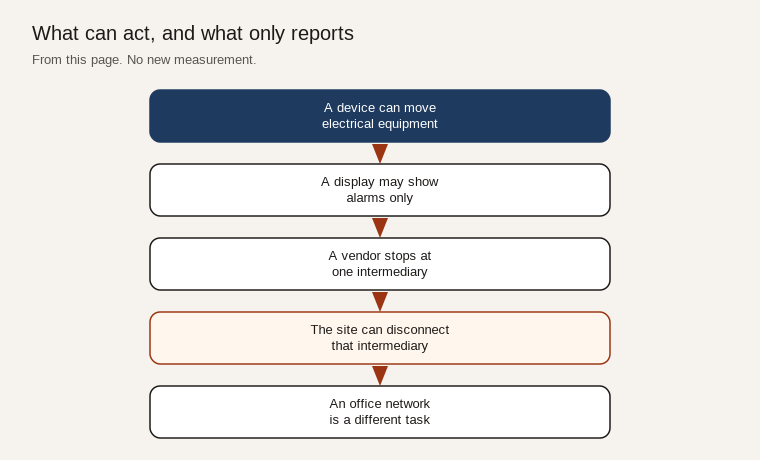
Equipment that can move a breaker or a process is separate from a display that only reports, and a vendor reaches those devices only through an intermediary the site can disconnect.
How operational technology differs from an office network
An office network moves mail, files, and business applications. Operational technology, as NIST describes it in Special Publication 800-82, Revision 3 (September 2023), is programmable equipment that interacts with the physical world, or that manages devices which do. It detects or causes a direct change by monitoring or controlling devices, processes, and events. The guide’s examples include industrial controls, building automation, transportation systems, physical access control, and environmental monitoring.
The Department of Energy’s Federal Energy Management Program, on a page last updated May 7, 2026, names wind turbines, solar arrays, building controls, and supervisory control and data acquisition systems as operational technology in energy use. Many of those systems also contain ordinary computing parts. A solar-plant controller or a substation remote terminal unit is not an office computer merely because the cable looks familiar.
The failure looks different. An office incident often exposes data, alters a record, or blocks an application. A control incident can also move equipment. NIST says objectives for these systems typically put integrity and availability ahead of confidentiality, with safety over all of them, and that a measure which impairs safety is unacceptable. Office uptime and confidential drawings still matter.
NIST notes that high delay or jitter can be unacceptable, and that information-technology security practices used without regard to the process can disrupt availability and timing. A laptop-style restart can stop equipment. In the same September 2023 comparison, typical office components last on the order of three to five years, while deployed operational-technology components often last on the order of ten to fifteen years, sometimes longer. Those are guide ranges, not a life for one relay. The Department of Energy page adds that older gear often lacks newer protections and can be disrupted by ordinary computing tools.
Support is narrower. Unapproved software can put a maker’s agreement at risk, and NIST says the vendor and the owner both need to test a change, often inside an outage planned days or weeks ahead. A radio, an old dial connection, or a commissioning laptop port can be missing from the office diagram. Joint secure connectivity principles from the UK National Cyber Security Centre, CISA, and other partners (PDF dated January 2026) say that edge can be hard to see. Find every path to a controller before debating the office firewall.
What an assessment is judging
Naming a framework is not an assessment. NIST’s publication is guidance on performance, reliability, and safety, not a private-sector statute by itself. The NIST Cybersecurity Framework page, read on November 22, 2026, presents Framework 2.0 as help for reducing cybersecurity risk, and the operational-technology guide says Revision 3 aligns with it. Alignment is not evidence a site was examined. Soleil Energy does not hold, meet, or offer that framework as a credential.
On a power project, ask which devices can start, stop, or alter electrical equipment and which only report; which paths reach a business network, a vendor, or the public internet; who may change a setting; and what the process does if a path fails. Those questions sit beside studies and commissioning. They do not replace them, and this page picks no settings.
CISA’s May 6, 2025 fact sheet, with the FBI, the EPA, and the Department of Energy, is guidance for critical-infrastructure owners, not a ruling that every commercial building is one. It still flags equipment reachable from the public internet, factory credentials on a device that can affect a process, standing remote access, and an open route from the office network into the controls. It also says to keep and test a manual way to operate if networked controls are unavailable. The method belongs to the site.
Why electrical safety changes the work
The task becomes electrical safety work when someone must open gear, connect an instrument, change a protective device, or remove a circuit from service. As of November 22, 2026, OSHA standard 1910.269 covers operation and maintenance of electric power generation, control, transformation, transmission, and distribution lines and equipment, including equivalent industrial installations and certain communication or metering equipment that only qualified employees may reach. It excludes construction except where it says otherwise, and other duties can still apply.
OSHA standard 1926.950, read the same day, covers construction of that transmission and distribution equipment, including new work and alteration, conversion, or improvement of existing equipment, in addition to other construction duties. A note treats compliance with 1910.269 as meeting requirements in that subpart which do not cite other subparts, without waiving those other duties.
Where those texts apply, training has to match the assignment, and the host and contract employers exchange installation characteristics, known conditions, and hazards before work starts. On the construction standard they also coordinate work rules. A remote session or a software change on covered equipment is therefore not a laptop ticket. Ordinary branch circuits are not automatically in that class, and some states run their own safety programs. This page does not decide coverage. The employer’s safety lead and a qualified electrical professional do.
NIST fits the same limit. Equipment may move to a known state if communications stop, so a test that drops a link can be what triggers that state. Agree what safe means before the test. Trip points stay with the person responsible for protection. A stored copy helps only if it can be restored when its network is not trustworthy.
What an owner should ask before a remote connection
Vendors often ask to reach a relay, a plant controller, or an operator screen without traveling. CISA’s May 2025 fact sheet says those tradeoffs deserve another look. If access stays necessary, it recommends a private connection off the public internet, a strong password, phishing-resistant multifactor authentication, accounts limited to the asset and the work, and removal of unused accounts. Those are outcomes for the responsible team, not values to type from this page.
The January 2026 connectivity principles ask for a written case first: why the link is required, the benefit, the acceptable risk, the harm if it is misused, whether cutoff would become harder, and which senior person owns the decision. They call the principles goals, not a minimum legal code. A private site can still ask them.
Get the answers in writing before approving a session:
| Question | Why it matters |
|---|---|
| Can the work be done on site? | A path left open remains an exposure. |
| Which asset, which task, and which hours? | “The network” is wider than one job on one device. |
| Who approves it, and who on site can end it? | Stop authority cannot depend on the remote person. |
| Does the outsider reach the controller, or only an intermediary the site can cut? | The connectivity principles say the outside party should meet an intermediary in a separate segment, so the asset is not directly exposed. |
| Are accounts personal, limited to the job, and removed after? | Shared logins outlive the visit. Ask whether factory credentials were replaced. Do not accept those secrets by email. |
| Could sign-in delay a safety action? | NIST says remote access should not bypass safety controls. An emergency exception needs a record. |
| Does the maker allow the method? | An unapproved tool can conflict with support. |
| Will operators know, and will the session be recorded? | NIST says the people operating the process should know about planned remote activity. |
| If the device stops answering, what does the process do? | Losing the display is not the same as losing control. |
| What will the handover show? | The person, the asset, the time, the change, and the check that the process was acceptable. |
An office remote-access account is not an answer. It was built for business applications, and the person at a controller is often not the owner’s employee. CISA’s fact sheet also says to separate the office network from the operational-technology network, with a buffer where process data must reach business systems. A compromised mailbox should not be a route to a protective relay. That separation is a site design. This page does not draw it.
Ask a cutoff question from the connectivity principles. If the remote path has to be removed, can the essential process continue, and do vendor contracts instead require a site visit? A cutoff that surprises the process is not a plan. Any trial belongs in an agreed window with people qualified to operate the equipment.
Outage windows and handover records
Put the change in the same window as the electrical work. NIST says those outages are often set days or weeks ahead, with testing before the change enters service. Editing software on loaded equipment is a different risk from a change with a rehearsed return to the prior file. The process owner chooses which interruption is acceptable.
Soleil Energy’s power services include substations, switchgear, protection, and supervisory-control integration. The public page asks for the voltage class and the work window. Say whether a vendor session, a firmware change, or a network check belongs in that window, which circuits must stay in service, and which records are due when the crew leaves. The published service area is Maryland, Northern Virginia, and Washington, DC, including Prince George’s, Montgomery, and Howard counties and Arlington, with no DC office. That is regional power work, not a nationwide control-system practice, and the talk does not declare a system secure.
Agree the records before the outage: which devices only report and which can command equipment; the paths found and the paths not found; who may connect and how the site ends the session; what software or settings changed; what the equipment showed before return to service; and accounts or support still open.
Solar sheets sometimes collapse this to “communications checked.” Soleil Energy’s guide to commercial solar maintenance scopes is about plant upkeep, not control-system security, and it shows why the contract should name the task and the report. An unnamed check does not say whether anyone could change equipment.
An illustrative boundary, not a design
An illustrative campus job, not a Soleil Energy project, is about to place a new service in operation. A relay can open a breaker, a controller can change an on-site solar inverter, and a workstation only shows alarms. A vendor wants a weekend connection to finish a settings file.
On a concept sketch, the relay and inverter controller sit with equipment that can affect the electrical system. The workstation does not authorize changes. The vendor reaches the controllers only through one intermediary the site can disconnect, during stated hours, with a named person present. The relay is not left reachable from the public internet.
Ask which settings may change and which stay as the protection study left them. If the session breaks off, the relay should remain on the last approved file. Confirm the remote path is off before the crew leaves, and log a later stale screen apart from whether the breaker and inverter are operating. The screen alone proves neither misuse nor a healthy plant. A qualified professional decides whether those groups match the real equipment.
Misconceptions that miss the scope
Being behind the office firewall is not isolation. NIST describes older systems as often separate, with ordinary networking and remote access reducing that separation. The firewall does not account for a radio, a vendor port, or a commissioning laptop. A framework title also does not prove which edition a contract invoked or that anyone evaluated the site. Some bulk-power duties apply only to registered entities and named assets. A commercial service is not in that set by default; the utility, the contract, and counsel are the check. Monitoring is not control: a measurement path is a different risk from a path that can change equipment.
Common questions
How do availability and safety change a cybersecurity assessment?
They limit the test, the hour, and what a pass means. A running process may not tolerate a restart or a software change. NIST says outages are often scheduled well ahead and that a measure which impairs safety is unacceptable. Where the OSHA text covers the electric-power work, training and the host-contractor exchange are part of the job. A qualified professional applies that limit on site.
Is an office remote-access account enough for a controller?
No. Require a named asset, a reason, a time limit, a person on site who can disconnect, and a method the maker and the safety lead accept. CISA’s May 2025 fact sheet says necessary remote access should stay off the public internet and use phishing-resistant multifactor authentication. The connectivity principles say the outside party should stop at an intermediary. Meeting those goals is design work for the site.
Does a dark monitoring screen mean the controls were misused?
Not by itself. The report can fail while equipment keeps running, or operators can lose sight of a real process problem. Compare the equipment’s own indications and any approved session. Do not open enclosures to look. A qualified person separates a reporting fault from a control fault.
Should factory credentials travel with the work order?
No. Ask whether factory credentials on devices that can affect the process were replaced, and whether each account ends with the job. Do not collect passwords by email. CISA’s fact sheet calls out default or easily guessed credentials on internet-connected devices that can control a process. How a site replaces and stores them is a local procedure, not a recipe here.
Does naming a framework mean the site meets it?
No. The Cybersecurity Framework organizes risk decisions. The Department of Energy page, discussing a 2017 executive order, says federal agency heads were directed to use that framework or a successor for agency systems. That is not a private-project credential, and neither NIST’s guide nor CISA’s fact sheet decides that a project meets a contract, a utility rule, or a reliability standard.
Who decides whether a test is safe to run?
The employer does, through people qualified for the electrical work and the process. On covered generation, transmission, or distribution equipment, the OSHA text requires trained employees and an information exchange before work starts. Other sites can still have electrical-safety duties. Computing knowledge is not authority to schedule a test that can move equipment unless qualified operators have set the window, the fallback, and who may stop the work.
Project requirements depend on the site, equipment and applicable rules. Confirm design and installation decisions with the appropriate qualified professional.