SCADA means supervisory control and data acquisition: a host collects measurements and can issue supervisory commands, a communications path carries that information, and a field device runs the local process. The operator screen shows what that path last reported. It does not, by itself, prove that a protective relay, a trip circuit, or a deenergized condition is sound. A qualified professional has to assess the actual system.
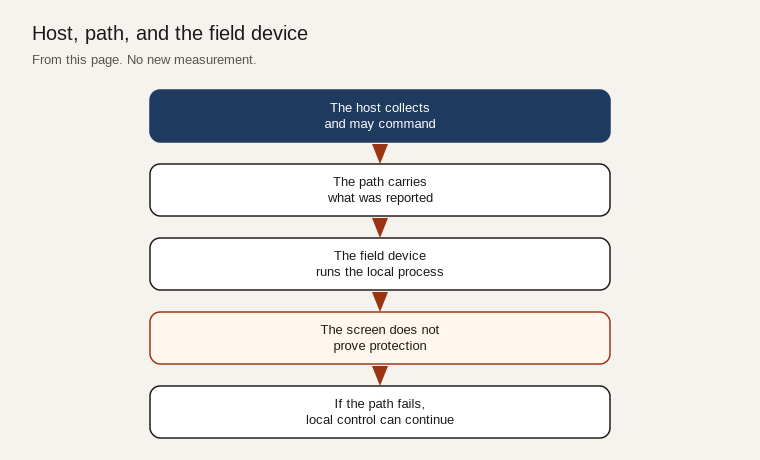
The host collects measurements and may issue supervisory commands, the communications path carries that information, and the field device can keep running the local process when the screen is no longer current.
What the host, the path, and the field device each do
NIST Special Publication 800-82, Revision 3, published in September 2023, describes these systems as a way to control dispersed assets when centralized data acquisition matters as much as control. Uses in that section include electrical transmission and distribution, pipelines, water, and rail. The system collects field information, transfers it to a control center, and displays it so an operator can monitor or control from one place in near real time. Automatic action versus an operator command is a property of that installation.
The publication separates three jobs. A control server stores and processes information from remote terminal unit inputs and outputs. The remote terminal unit or programmable logic controller controls the local process. Communications hardware moves information between the server and those field controllers. What to monitor, which ranges are acceptable, and what response to start are choices for that system. The publication’s polling example uses intervals defined for one implementation. This page does not recommend a poll rate.
An intelligent electronic device can sit beside those controllers. The publication uses a protective relay as the example. The relay may speak directly to the control server, or a local remote terminal unit may poll it and pass the data upward. In most cases, the publication says, the device has local programming that lets it act without instructions from the control center. Supervision can observe and, where the design allows, command. It does not replace that local program.
The control center is more than the server. The same description lists a human-machine interface, engineering workstations, and a data historian. The center logs field reports, displays them, may act on events, and handles centralized alarming, trends, and reporting. A workstation used to change a controller is not the operator screen. A historian is not the device that opens a breaker.
Why a screen does not prove protection
Operators use the human-machine interface to monitor and configure set points and parameters, and to see status and history. A clear graphic can be true, stale, mapped to the wrong point, or silent about a function that was never a point. Looking normal does not sort those cases.
Protection is the sharp boundary. A relay that trips from its own program does not need the host when the fault occurs. A screen that still shows breaker position may say nothing about the trip coil, the current circuit, or the settings file. The publication says redundancy is usual and may not counter a malicious attack. Redundancy is also not a protective-device test. Some critical processes include separate safety systems. The display is not automatically one of them.
Display documents do not close the gap. IEEE C37.1.3-2025 is an active recommended practice, with IEEE-SA board approval on March 27, 2025, publication on October 31, 2025, and ANSI approval on October 13, 2025. Its public catalog covers philosophy through commissioning and verification of human-machine interfaces used with electric utility automation systems. The catalog is not the practice. A display test answers a display question. It does not show that a relay will operate.
A remote indication is also the wrong proof that equipment is deenergized. 29 CFR 1910.269, read on the eCFR on November 22, 2026, with title 29 shown up to date as of November 19, 2026, covers operation and maintenance of electric power generation, control, transformation, transmission, and distribution lines and equipment, including equivalent industrial installations, with stated exceptions. The eCFR copy is authoritative but unofficial. Paragraph (m) addresses deenergizing transmission and distribution lines and equipment for employee protection. Automatically and remotely controlled switches that could reclose an opened disconnect must also be tagged at the points of control, and the automatic or remote-control feature rendered inoperable unless the design does not permit that. After the applicable steps and a clearance, deenergized status is shown by testing with a device designed to detect voltage. Conductors deenergized some other way are treated as energized. This page is not a switching procedure. An open symbol is not that test.
Construction is a different section. 29 CFR 1926.950, read the same day, covers construction of electric power transmission and distribution lines and equipment, including erection and the alteration, conversion, and improvement of existing lines and equipment. It points generation work, and certain line-clearance tree trimming, back to the operation-and-maintenance rule. Which paragraph applies is a classification of the work, not a guess from the graphic.
A plant controller and a production app are different systems
The NIST publication describes a common arrangement, not a law of physics: a generating plant may be run by a distributed control system that communicates with the supervisory system so production can follow transmission and distribution demand. One is aimed at production inside the plant. The other is aimed at dispersed assets and a central picture. One purchase line for both hides the interface where limits and status must be exchanged.
A solar production app is a third system. It shows what an inverter or gateway last sent to a portal. Soleil Energy’s guide to an offline solar monitoring screen explains that a stale app can mean the reporting path stopped while the array may still be producing, and that the app also cannot prove production. That guide is about production reporting. It is not a transmission control center, a remote terminal unit, or a relay. The records and the person allowed to issue a control are different.
What a reliability glossary means by the same word
NERC’s glossary of terms used in its reliability standards defines supervisory control and data acquisition as a system of remote control and telemetry used to monitor and control the transmission system. The entry shows board adoption on February 8, 2005, FERC approval on March 16, 2007, and an effective date of June 18, 2007. That definition is for those standards. It is narrower than the NIST publication, which also includes water, pipelines, and rail. A building screen is not automatically this term.
The same glossary defines telemetering as the transmission of measurable electrical quantities from substations and generating stations to the control center, and of operating commands back. That is a movement of measurements and commands, not a description of relay settings or of a dashboard contract.
A later control-center entry includes specified reliability facilities and, in another clause, certain transmission-owner facilities that can control transmission facilities at two or more locations in real time using this technology. It lists an effective date of July 1, 2028. A future date is not today’s applicability, and registration still has to be confirmed. This page does not decide that.
A catalog is not the specification
IEEE C37.1-2007, IEEE Standard for SCADA and Automation Systems, is inactive-reserved, inactivated on November 7, 2019. The public abstract says it defines substation requirements and treats substation integration as the design process under substation automation. An inactive abstract is not a present mandate and is not the requirement text. The contract has to name the documents actually used.
A lifecycle title is not a filled-in design. On February 24, 2026, the International Society of Automation announced ANSI/ISA-112.00.01-2025, covering lifecycle, diagrams, and terminology. The announcement calls Part 1 a vendor-neutral framework and names electricity transmission and distribution among the industries in view. Further parts are described as planned. The announcement is not the standard, and citing the title does not mean a site conforms.
The NIST publication is security guidance, not a site finding. The Computer Security Resource Center record says Revision 3 supersedes the 2015 revision. A planning note dated September 21, 2026, points to a draft of a further revision, with comments due by November 30, 2026. As of November 22, 2026, Revision 3 is the final publication. Nothing here implies that Soleil Energy holds or offers a cybersecurity authorization.
Settle the boundary before anyone draws the screen
Scope starts with functions, not a software brand. The questions below are an owner’s checklist. They are not a network design and not a remote-access method.
| Question | Why it changes the work |
|---|---|
| Which measurements reach the host, and from which device? | A value with no source cannot be commissioned. |
| Which alarms are protection, and which are information? | The function that must work with the host down stays visible. |
| Which commands may the host issue, and which stay local? | A trip program is not a graphic. |
| What does the field device do if the path fails? | The screen stops being current. Local control may continue. |
| Who may issue a control, and during which outage window? | Authority is work control, not a login picture. |
| What record shows the point, alarm, and command were tested? | A graphic review is not a field confirmation. |
Protocol and media belong to the qualified designer after the functions are known. This page does not offer a network.
A May 6, 2025 fact sheet from CISA, the FBI, EPA, and the Department of Energy urges owners to address activity that targets internet-connected operational technology. It recommends removing those connections from the public internet, reevaluating remote-access tradeoffs, and practicing manual operation. Those are headlines for the owner and its advisers. This page does not describe how to build a connection. The fact sheet also says integrators or a default configuration can introduce misconfigurations, so coming online starts a review.
What acceptance should show
Consider an illustrative feeder at a facility substation. During a planned outage the graphic shows the breaker open and the load indication has gone quiet. The picture can help the operator. If the deenergizing rule applies, the clearance and the voltage test still do. The case is not a Soleil Energy project and not a procedure.
Ask the record to keep four results apart:
- The graphic point is the field point, under a name a later technician can find on a drawing.
- The alarm came from the condition it names, when the test plan requires that, not only from a value forced on the screen.
- A command in scope was confirmed by an independent indication, such as apparatus status, not only by a note that the host sent it.
- Lost-communications behavior matches the design basis: what the field device keeps doing, and who is told.
Protection tests stay in the protection record. A successful poll does not imply a settings check or a trip check. The outage window belongs beside that record: what may be operated, what stays local, and how the system is returned. A qualified person judges the switching limits. This page sets none of them.
When the path fails, the picture and the process part
If the path stops, the host no longer has a current field picture, while the remote terminal unit or programmable logic controller can still run the local process. The screen may freeze, blank, or keep the last value, depending on the product. Which of those an owner will see is a specification item. A backup control center, which the NIST publication illustrates, does not answer what the field device does with neither center available. The federal fact sheet treats manual operation as something to practice: name what people can still operate, and do not publish a workaround that bypasses protection.
Records that still make sense later
A screen is easy to demonstrate on the last day and hard to interpret a year later. The record that should remain ties each graphic to a device, a drawing, and a test. Part 1, as announced, is a shared lifecycle and terminology. Until the contract names the clauses, the title does not improve the file.
Ask which graphic matches the installed points, where a displayed name maps to a field address, which alarms need a person, who holds accounts, and what was excluded, such as protection settings. Do not write the access method on a public page. A forgotten vendor account is a reason for the owner to review access, not a reason to publish a connection design. “Included” on a proposal line still does not say whether the host, the path, the relays, and the historian share one contract.
Common questions
Does a healthy screen mean the relays are healthy?
No. A protective relay commonly acts on local programming without the control center. A settings record and a trip check are separate from whatever the path is delivering. A display recommended practice is not that check.
Is a solar monitoring app the same thing?
No. A production app reports inverter or gateway data. A supervisory system ties field controllers to a control center for measurements and, where designed, commands. An offline app speaks to the reporting path, not to a substation remote terminal unit.
Does the reliability-standards definition cover every control screen?
No. That glossary entry is remote control and telemetry for the transmission system, inside those standards. The control-center wording that mentions this technology lists an effective date of July 1, 2028. Other industries use the same words for other architectures. Registration is a separate question.
What should handover prove about alarms and controls?
Which alarms came from the field condition, which commands were confirmed independently, and what the field device does when the path fails. A walkthrough of the graphic answers none of those. Protection results stay in the protection record.
Who decides whether remote operation is acceptable?
The owner, the employer’s qualified people, and the rule that covers the work. A clearance rule and a federal fact sheet can both say that remote paths need a deliberate decision. Neither one designs the site. A qualified professional has to assess the actual system.
Bring the boundary to a scope discussion
The useful decision is what the host supervises, what the field device still does alone, what the screen may prove, and which records survive the outage window. Soleil Energy’s power group publishes substation and switchgear work, protection, studies, commissioning, and integration of this supervisory system. That is a project conversation, not a finding from this article.
For a site in the markets that group serves, bring the one-line boundary, the outage window, and the handover questions to Soleil Energy’s power team. A qualified professional still has to assess the actual system.
Project requirements depend on the site, equipment and applicable rules. Confirm design and installation decisions with the appropriate qualified professional.