
A solar arc fault is an unintended arc in a photovoltaic circuit, most often on the direct-current side, where current bridges a break in a conductor or jumps between conductors that should stay apart. The arc can keep giving off heat while the modules are in the sun. A detector is meant to recognize that condition and interrupt the circuit it protects. It does not find the damaged connection or show that the array is safe to touch.
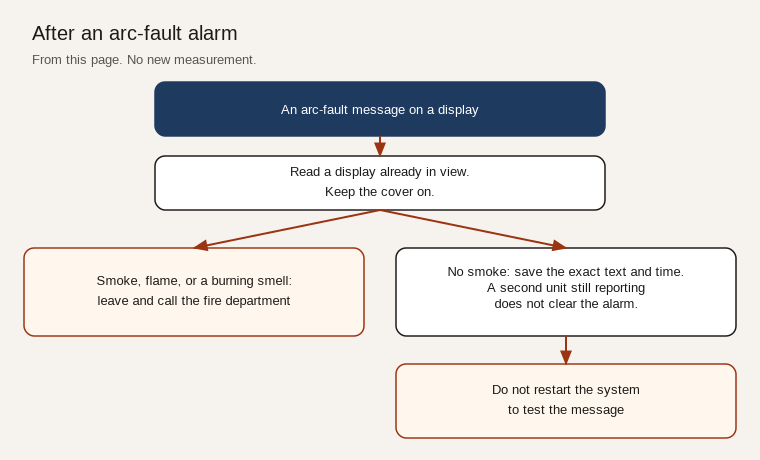
An arc-fault alarm splits into smoke, which means leave and call the fire department, or a message with no smoke, which still means save the record and do not restart the system to test it.
A series arc and a parallel arc are different failures
A series arc starts where a path that should stay continuous breaks. In a 2012 laboratory paper, Sandia National Laboratories described it as current bridging a discontinuity in a conductor. A connector that was never fully latched, a loose combiner terminal, a cracked lead, or a separated joint inside a module can be that break. If the circuit is already carrying current, an arc can form in the gap.
A 2015 subcontract report by Brooks Engineering, hosted by the National Laboratory of the Rockies, quotes the 2011 National Electrical Code phrase “failure of intended continuity.” The report says the arc can remain for seconds, minutes, or longer. Ordinary overcurrent protection may not see it as a short, because current is still trying to follow the intended path. The heat is concentrated at the bad joint.
A parallel arc is different. The Sandia paper defines it as an arc between conductors at different potentials. It groups common paths into three kinds: from a current-carrying conductor to a grounded conductor or to metal such as conduit; between conductors of different strings; and inside one string, for example in a junction box. Current has found a route it was not designed to use.
Sandia reported that many detectors listen for broadband noise on the direct-current conductors, and that series and parallel arcs can make nearly the same noise. A device that opens the circuit for a series arc may open during a parallel arc too. Opening the circuit does not necessarily extinguish a parallel arc and may make that arc worse, because current can keep flowing on the unintended path. A shutdown is a stop, not proof that the hazard is gone.
The December 2018 operations and maintenance report, also hosted by the National Laboratory of the Rockies, links arc-fault repair to a broken wire or a loose connection and assigns post-storm making-safe work to people with the training and protective equipment, not to the person who got the alert.
Why the alarm is a fire concern
UL 1699B is the standard for photovoltaic direct-current arc-fault circuit protection. Its scope says the protection is intended to mitigate arcing faults that may pose a risk of fire ignition under certain conditions if the arcing persists. Edition 1 was published on August 22, 2018, and the UL Standards & Engagement catalog shows an ANSI-approved revision dated July 9, 2024. The devices are for solar photovoltaic systems as described in Article 690 of the National Electrical Code. As of November 2026, that is a product-safety standard, not a ruling that a given roof or ground array complies with a local code.
Modules produce direct current. The Department of Energy describes direct current as flow in one direction, and the inverter as the equipment that turns that output into alternating current. While the sun is on the modules, a damaged direct-current connection can keep receiving current. That is a different event from a trip of an ordinary branch breaker in a house panel.
The 2015 field guide says such fires had occurred but were rarely documented in public, and it names connectors, combiner terminals, and module leads as common series-arc locations. Flame, smoke, a burning smell, or the sound of arcing is an emergency: leave and call the fire department. Do not open enclosures or pull connectors. A monitoring message with no smoke is still not owner work. Keep the equipment closed and take the record to a qualified person.
What a detector is for
The UL 1699B scope read in November 2026 names four kinds of equipment: photovoltaic direct-current arc-fault circuit interrupters, arc-fault detectors, interrupting devices, and inverters, converters, and charge controllers with that interrupter function built in. A detector recognizes a signature. An interrupting device opens a circuit. An interrupter does both. An inverter may contain the function instead of a separate box. UL Solutions lists UL 1699B among the standards it uses when evaluating photovoltaic inverters and converters. A brochure line is not the model marking, the listing, or the manual.
The same UL 1699B scope covers devices rated 1500 volts or less, for direct-current systems supplied by a photovoltaic source. It says the devices are not intended to detect glowing connections. A terminal can overheat and damage insulation before it becomes an arc the product is designed to see. A quiet monitoring portal does not prove every joint is sound. Equipment that also provides overcurrent protection, disconnection, combining, or inversion must meet the standard for that other job as well.
A trip does not show where to look
The 2015 guide says finding the failure is hard when the circuit is still intact. An open string is easier to notice than a joint that still passes current or arcs only sometimes. Connectors are a common source and are often hard to see on a roof. Thermal checks described in that guide are for technicians. This page does not describe opening a combiner, unplugging leads, or measuring along a string. Because series and parallel noise can match, the message may not name the arc type. Do not move disconnects to find out.
A repeated alarm is not a nuisance call
The 2015 guide says a small arc is harder to pick out of a large combined current than on one string, and it treats nuisance trips as a design limit. Neither fact lets an owner call the message false. Starting the system again re-energizes the circuit. The 2018 maintenance report lists a manual reset of an arc-fault trip as repair for an inverter specialist, in a table of specialist work. This page gives no sequence for clearing an alarm and no way around a detector.
What an owner can see without opening equipment
Read the portal or a display that is already visible. Do not remove a cover.
- The exact fault name or code, and whether it says arc fault rather than ground fault, isolation fault, or a communications error.
- Date, time, and whether it repeated.
- Any inverter, combiner, or string the display names.
- Whether that unit stopped producing while other equipment kept reporting.
- Smoke, odor, or damage you can see without opening an enclosure.
- Recent roof work, cleaning, animals, storms, or new electrical equipment.
A dead portal is not the same problem. Soleil’s guide to a monitor that is offline is about a lost connection. Weak output with no arc-fault text is covered in the guide on a system that is not producing. Neither page is a reason to clear an arc-fault alarm.
Do not climb the array, pull connectors, pull fuses, or move disconnects unless you are the qualified person for that work and you have a site-specific procedure. Everyone else keeps people away from smoking or damaged equipment, saves the record, and calls a qualified person. If there is fire, call the fire department first.
What to hand that person
29 CFR 1926.32, as displayed on the eCFR in November 2026, defines “qualified” in the construction safety rules as a person who by degree, certificate, professional standing, or extensive knowledge, training, and experience has shown the ability to solve problems in the work. That definition is not a solar license and does not authorize energized work. The owner hands over records. A video does not transfer the role.
| Record | Why it matters |
|---|---|
| Exact fault text, code, date, time, and any equipment name on the display | A paraphrase can mix up an arc fault, a ground fault, and a lost connection. |
| A screenshot or export, and whether output stopped | Shows what was recorded, and whether one unit stopped while another still reported. |
| Make, model, and serial number from a nameplate photo, covers left on | The manual and the listing are specific to that model. |
| Recent work, weather, animals, or cleaning | A disturbed connection is a clue, not a conclusion. |
| Any drawing or string map already on file | The next person should not have to redraw the array first. |
| What nobody touched after the alarm | A restart hides the original state. Say so if it already happened. |
Share a monitoring login only if you choose to. If the installer has closed, Soleil’s guide on an installer that is gone covers leftover paperwork. Soleil’s commercial solar operations and maintenance guide is the planned-inspection scope. An arc-fault alarm is unplanned, and a contract does not replace an inspection of the conductors.
Which code edition applies is a local question
As of November 2026, one National Electrical Code edition is not in force everywhere. This page does not state a trip time, and it does not turn an older paper into the rule for a new permit. The 2015 field guide, quoting the 2011 code, says Article 690.11 required arc-fault detection on photovoltaic systems operating above 80 volts and mounted on buildings, and it describes the 2014 edition as extending that detection beyond buildings. That is the report’s reading of those two editions. Later editions changed exceptions and wording. Do not buy, omit, or disable equipment from that 2015 sentence.
Maryland places electrical rules outside the building performance standards. COMAR 09.12.51.04, as displayed in November 2026, points to the local electrical code and the National Electrical Code as adopted by the State Fire Marshal, authorized fire officials, or building officials under Public Safety Article, Title 12, Subtitle 6. COMAR 09.12.50.02-1 incorporates the 2020 edition of NFPA 70 into the Model Performance Code, with an exception about outdoor receptacle ground-fault protection, not photovoltaic arc-fault rules. COMAR 09.12.50.03 says those incorporated standards are the model code, with amendment notes effective May 29, 2023. Confirm the edition the fire official and the locality are enforcing.
Virginia’s 13VAC5-63-10 incorporates the 2020 edition of NFPA 70 into the 2021 Uniform Statewide Building Code. That page showed this text on November 22, 2026. Historical notes put the amendment effective January 18, 2024. The permit date can still matter, and the page does not restate the photovoltaic section.
The District of Columbia Department of Buildings construction codes page, opened in November 2026, says the 2017 DC Construction Codes include the 2014 National Electrical Code, as amended in Title 12 of the DCMR, effective May 29, 2020, and that Title 12 is the official text when public copies are incomplete. An older permit may remain under an earlier edition. In all three markets, a qualified person matches the listing to the edition, the permit, and the nameplates. This page cannot.
Other alarms are not this one
A ground fault is current to ground or grounded metal. An arc fault is arcing at a break or between conductors. Damage can produce both, which is why the 2018 report mentions them together after storms, but the device and the likely location differ. A ground-fault note is not a reason to open a combiner after an arc-fault trip.
If the portal went dark, keep treating a stored arc-fault event as one. Shade, an alternating-current breaker, or a failed inverter can cut output with no arc. Do not rename an arc-fault display as ordinary low output. Module-level electronics change the layout. They do not change the owner’s job, and they are not something to unplug as a test.
An illustrative alarm, and the stop
Consider an illustrative office with two inverters. On a clear afternoon the portal shows an arc-fault message on one inverter, that inverter’s output falls away, and the other inverter keeps reporting. There is no smoke. From the sidewalk the array looks ordinary. The owner saves the screen, writes the time and the exact text, photographs the nameplate without opening the cover, and leaves every disconnect as it is.
That packet can start an assessment. It does not name the failed part, and a second inverter that keeps reporting does not prove the rest of the array is unaffected. The owner does not clear the message or unplug leads. If smoke appears, people leave and the fire department is called.
Bring the record to Soleil Energy
Soleil Energy’s monitoring and operations service includes performance monitoring, fault diagnosis, and maintenance, including systems another company installed. A useful request carries the fault export, make and model, address, whether anyone restarted the system, and whether anyone saw smoke or damage. A screenshot is not a finding that the array is safe, and it is not a code decision. A qualified person must assess the actual site.
For more than one site, say which alarms fired and who can grant access. Do not ask for the detector to be disabled so production can resume.
Questions that change the next call
Does the message mean the building is on fire?
Not by itself. Smoke, flame, or a burning smell means leave and call the fire department. No visible fire is not a reason to keep operating. The arc may have stopped when a device opened, or a parallel arc may still be energized. Only an inspection separates those outcomes.
Can it be started again to see if the message returns?
No. Restoring power to test the alarm can re-energize the damaged joint. The 2018 report puts a manual reset of an arc-fault trip with specialist inverter repair. If someone already restarted it, say so. A quiet screen after a restart is not a cleared fault.
Will it catch a terminal that is hot but not yet arcing?
Do not count on it. UL 1699B says these devices are not intended to detect glowing connections. A quiet stretch is not evidence that every connector is sound.
Is a house-panel arc-fault breaker the same device?
No. UL 1699B is the photovoltaic direct-current standard, covering detectors, interrupters, and inverters with that function. A branch breaker on ordinary building wiring is a different product. Report which device showed the text. One trip does not explain the other.
What if the installer is gone, or only some modules have electronics on the leads?
Call a qualified person with the export, the models, and any permit set you still have. Do not unplug module-level devices to test the message. The District’s 2014 code set, Virginia’s referenced 2020 edition, and Maryland’s path through the fire official are not interchangeable. Soleil Energy states that monitoring and maintenance can include systems it did not install, but taking a site still depends on the equipment and the assessment.
Project requirements depend on the site, equipment and applicable rules. Confirm design and installation decisions with the appropriate qualified professional.