
A hybrid solar inverter converts direct current from a photovoltaic array into alternating current and can also exchange power with a battery. A photovoltaic-only inverter stops at the conversion to the grid. Whether the hybrid unit can charge a battery from the array, from the utility, or keep selected loads on during an outage depends on its listed modes and the site, not on the product name.
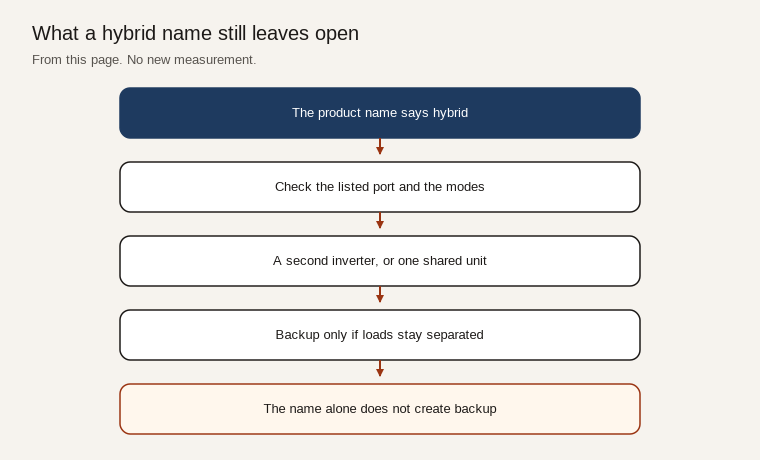
A hybrid name still has to show a listed battery port and allowed modes, whether a second inverter stays or one shared inverter replaces it, and whether backup loads are separated from the utility.
A photovoltaic-only inverter has one power job
Photovoltaic modules produce direct current. The utility and ordinary building loads use alternating current. An inverter switches the direct-current input back and forth and filters it into a sine wave the grid can accept. The Department of Energy’s inverter overview, updated March 31, 2025, describes that conversion and groups inverters with other power electronics.
That overview separates grid-following inverters, which time their switching from the utility waveform, from grid-forming inverters, which can create the timing signal themselves. A photovoltaic-only rooftop inverter is ordinarily grid-following. It is not a source that keeps a building up after the utility is gone. In general, the same page says, small inverters ride through minor voltage or frequency disturbances and disconnect if a disturbance is large or long, so they do not energize lines crews may treat as dead.
Grid-support functions, when they apply, need a source the inverter can actually control: production happening now, or storage. With only an array, there is nothing to dispatch at night or under deep shade. The Department of Energy’s design overview, updated July 8, 2022, also expects an inverter to be replaced at least once in the 25-year lifetime of an array. That is a planning note about equipment life, not a backup claim and not a date for any one unit.
A photovoltaic-only listing speaks to a photovoltaic input. It does not show that the hardware was evaluated for a battery fault current, a battery management system, or a second mode of operation.
The hybrid unit adds a battery port
Behind the meter, “hybrid solar inverter” usually means a multiport converter. Appendix D of the National Renewable Energy Laboratory’s 2020 behind-the-meter solar-plus-storage overview (Zinaman, Bowen, and Aznar; now hosted by the National Laboratory of the Rockies) describes the common direct-current-coupled case. One inverter is shared. The battery port is bidirectional. The array port is not. When the hardware allows it, the battery can charge from the array and from the grid. That is a 2020 architecture description, not a list of current models.
It still converts array power, and it manages charge and discharge under one alternating-current rating. The inverter overview notes that an array can charge a battery on direct current or after conversion to alternating current. A brochure name does not pick which path you have.
“Battery-ready” is sales language. It often means a battery can be added later. The battery, its management system, and the communication the manufacturer evaluated still have to be within the listing. An empty connector is not that evaluation.
The label is also loose. Pacific Northwest National Laboratory’s 2021 outage guide, updated September 29, 2021, uses “hybrid” both for an alternating-current-coupled grid-tied drawing and for bi-modal or multi-modal inverters that can run without a grid signal. Read the ports and the listing.
Power and stored energy are different. The Department of Energy’s storage overview, updated March 31, 2025, separates the amount that can be stored from the rate that can be released, and it says some energy is always lost in the round trip. The port has to pass the rate. The battery has to hold the amount. A short burst does not say how long selected loads will run.
Coupling chooses the project, not a winner
Alternating-current coupling puts a separate inverter on the battery. Array power becomes alternating current before it can charge storage, so a working photovoltaic inverter can often stay. The 2020 appendix associates that layout with many retrofits. Direct-current coupling lands the array and the battery on one hybrid inverter, so array power can reach the battery before the shared alternating-current limit. A retrofit of that kind replaces the photovoltaic inverter and can change monitoring and the utility agreement.
Those multiport products, the appendix said, then came in few sizes and were mostly residential, though that could change. A house-scale chassis is not automatically listed for a larger service, and that appendix’s notes on which layout was common are historical.
Direct-current coupling is a family. Some off-grid systems use a charge controller and a separate inverter. The 2021 guide calls a direct-current-coupled battery, using the site inverter, often the lower-cost and higher-efficiency add-on when that inverter is already compatible. A unit listed only for a photovoltaic source is not that case. The choices are a second inverter or a listed replacement.
Two effects follow, with no universal winner. Power a photovoltaic inverter will not pass never reaches an alternating-current-coupled battery. A shared hybrid inverter can send that excess to the battery when the port allows it. The 2020 appendix calls the lost portion clipping and does not price it. Storing energy for later also means more conversions on the alternating-current path, which the appendix treats as higher loss. Using the array as it produces can favor the direct path instead. Use the equipment’s measured curves, not a ranking.
The useful question in the appendix is which flows are allowed among the load panel, the array, the storage, and the utility.
| Decision | Alternating-current coupled | Shared hybrid inverter |
|---|---|---|
| Hardware | Array inverter plus battery inverter | One inverter, bidirectional battery port |
| Existing array inverter | Often stays, if still inside its listing | Usually replaced |
| Array energy the array inverter cannot pass | Not available to store | May charge the battery if the port accepts it |
| Outage supply | Set by the battery inverter’s listed modes and the transfer gear | Set by the hybrid unit’s listed modes and the transfer gear |
Neither column creates backup by itself.
Outage operation is a separated local system
Grid-tied arrays are built to stop when the grid stops. The Department of Energy’s resilience overview, updated May 18, 2026, says residential panels alone are not enough, because these systems depend on the grid and switch off when it does. Producing on their own takes a properly configured inverter and storage. The inverter overview says solar-plus-battery equipment runs without grid support only when it is designed to. A hybrid nameplate is not that design.
The 2022 National Renewable Energy Laboratory and Sandia report on intentional islands, by Narang and coauthors, summarizes IEEE 1547-2018 this way: if an unintentional island forms on the area system, the resource detects it and ceases to energize that system, tripping within 2 seconds, unless it forms an intentional island that is isolated from the area system. As of November 2026, the serving utility’s rule is what applies, and a qualified professional confirms it for the site.
Backup, when it is really in the design, leaves parallel operation on purpose. The 2020 appendix requires a move from the normal service entrance to a backup load panel that feeds the customer and not the utility. The 2021 guide describes an automatic transfer switch that opens the premises connection while backup runs, often into a subpanel, because the equipment is not meant to carry every circuit.
A local island, in the 2022 report, contains no utility equipment. The term can mean one house. It continues only while sources inside the boundary can carry the loads that remain. Surplus cannot go out to the utility once that path is open. If the battery will not take more charge and the backup loads are smaller than the array, output has to be reduced. That is balance, not a promise of runtime.
A stand-alone plant that never runs in parallel is not an intentional island under the definition those authors quote, and legally required life-safety systems fall under other codes. Optional backup of a few circuits is neither. The authors also note that a local island already separated can be read as outside IEEE 1547-2018, which targets parallel operation. They take a broader view. The standard still does not replace the listing or the authority having jurisdiction.
Restart after shutdown is separate. The 2021 guide calls black start recharging from the array and restarting while the grid is still out, and it associates that with hybrid or multi-modal inverters on direct-current-coupled batteries. It says some alternating-current-coupled batteries need a grid signal first. That is a 2021 generalization. Confirm the listed mode.
Soleil Energy’s outage guide covers circuit lists and restart for Maryland readers. Neither page estimates runtime.
Listing, code adoption, and interconnection are three reviews
A listing asks whether the product was evaluated for the sources and modes printed on it. UL Solutions says test scope depends partly on whether the unit is standalone or meant to connect to a utility, and it names UL 1741 for inverters, converters, controllers, and interconnection system equipment used with distributed resources. That is product evidence, not a permit and not an address approval.
Its grid-code page says conformance with IEEE 1547.1, the interconnection test procedures, is shown by certification to Supplement A or Supplement B of UL 1741. Which supplement and which settings profile a utility wants is local. Confirm it with that utility as of November 2026.
The IEEE 1547-2018 record scopes interconnection and interoperability of distributed resources, including inverters, at typical distribution voltages, for a 60 Hz source. It names performance, operation, testing, safety considerations, maintenance, abnormal conditions, power quality, and islanding. That page is a catalog, not the clauses. A Department of Energy note of January 9, 2019 assigns the adoption choice to states, and the choice of functions to commissions, municipalities, and cooperative boards. Its timeline for the test standard is outdated. The National Laboratory of the Rockies collection, updated December 6, 2025, helps those authorities. It does not approve a house.
Putting a battery on a photovoltaic-only inverter is a different problem. UL’s code-authority note, from an IAEI article in July/August 2020, says that field combination is not an energy storage system. Equipment used outside the sources it was investigated for is not installed per its listing, and the mismatch can mean fire and shock hazard. The note contrasts the sources: array operating current is roughly 85% of array short-circuit current and is limited by the modules, while a lithium-ion bank in a short circuit could reach fault current up to 50 times its rating. Those are the article’s characterizations, not design inputs.
The same note treats the energy storage system as the assembly evaluated together under UL 9540, including controls and protection. It describes the 2020 National Electrical Code as requiring that complete system to be listed, so separately listed parts are not the system. The 2020 laboratory report notes that authorities often adopt a code edition late and may add local rules. As of November 2026, the permit office identifies the edition for the address.
The utility’s interconnection review then decides whether this equipment may operate in parallel under that tariff: point of connection, export, and technical screens. It does not choose the backup panel. The inspection is a third decision, against the adopted code. A qualified electrician or engineer applies all three on site. This page sets no trip points, battery voltage, or conductor size.
Swapping the inverter or adding storage can reopen those reviews even if the modules stay. Soleil Energy’s replacement guide is where failure signs and warranty limits sit, and where a battery plan has to be settled before a replacement is ordered. Adding a battery to existing solar explains why the inverter already on the wall decides the retrofit path.
One moment, labeled as arithmetic only
Illustrative arithmetic, not a design and not a record of installed work. If the array can deliver 6 kW of direct current and the building is using 2 kW, a hybrid port that can accept the rest could send 4 kW into the battery while 2 kW serves the building. A quarter hour of that charge, before losses, is:
4 kW × 0.25 hours = 1 kWh.
State of charge, limits, temperature, loss, and export rules are omitted. The numbers size nothing and are not Soleil Energy results. Alternating-current coupling sends the array through its own inverter first, so power that inverter cannot pass is never stored. In an outage, neither layout can export the surplus. The island stores it, uses it, or curtails it.
Questions that change the scope
Collect the inverter model, its listed sources, the interconnection agreement, and the loads someone wants in an outage. Then require written answers.
| Question | Why it matters |
|---|---|
| Battery input on the listing, or array only? | Second inverter, or a replacement |
| Battery covered by the same system evaluation? | Listed pair, versus a combination the listing does not cover |
| Which loads are past the transfer equipment? | The outage boundary |
| Charge from the grid, the array, or both? | A controls and tariff question, not a label |
| Restart from the array after a full shutdown? | Behavior on a long outage, if the mode exists |
| Who files with the utility, and which code edition applies? | Whether the hardware can actually be approved here |
Common questions
Does battery-ready mean the battery is already covered?
No. It means the maker plans a later battery for that model. Coverage is the listed port, the charge path, and any off-grid mode the certificate actually names.
Will the whole building stay on?
Only when the design says so. Many systems feed a subpanel because the converter and battery are not sized for every load. Sources inside the island still have to match what remains connected. A qualified professional makes that match.
Can the present photovoltaic inverter stay?
Yes, if an alternating-current-coupled battery is added and that inverter remains inside its listing. A shared hybrid inverter usually replaces it. The 2021 cost comment for direct-current coupling assumes the old inverter is already compatible. If it is not, there is no cheaper path hiding in the name.
Is a listing the same as utility approval?
No. The listing is the product. Supplement A or B evidence, where the utility asks for it, is how that product was tested. Interconnection is permission to operate this installation in parallel. The permit is the adopted code. Each stops at its own question.
Must the battery charge only from the panels?
Not always. The 2020 appendix treats grid charging through a multiport inverter as optional. Some systems are built so the battery charges only from its array. The manual and the utility terms decide. The product name does not.
Match the converter to the site
For a house, start with the inverter in place, a battery listed with the converter under consideration, and the circuits that matter in an outage. Soleil Energy’s residential solar service covers that equipment and interconnection scope for homes in its Maryland, Northern Virginia, and Washington, DC service area. Bring the model, a recent bill, and the backup list. The conversation is not a compliance finding. A qualified professional still has to assess the installation.
Project requirements depend on the site, equipment and applicable rules. Confirm design and installation decisions with the appropriate qualified professional.