
Solar availability is the share of a defined period in which a photovoltaic plant, or a named part of it, can deliver power, or the share of expected energy left after hours when it cannot. The figure is useful only after the agreement names the equipment, the hours in the denominator, and the outages left out. It is a measured ratio with those limits, not a promise of production and not a measure of sunshine.
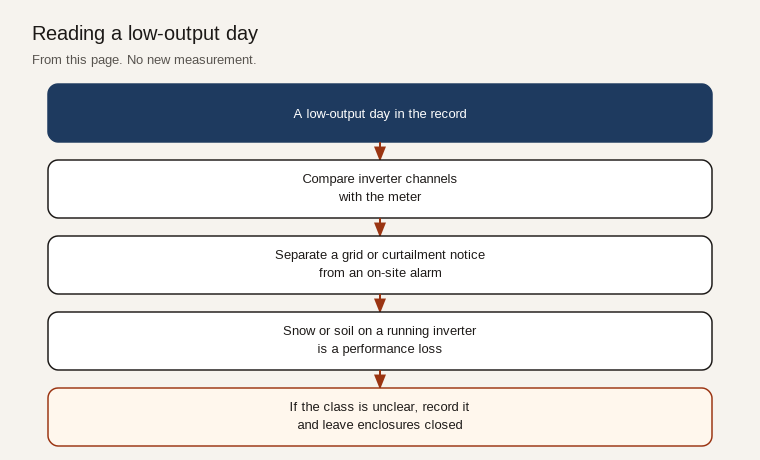
A low-output day is sorted by whether the meter still moved, whether a grid or curtailment record explains the stop, and whether snow or soil on a running inverter is a performance loss rather than an availability outage.
Time-based and energy-based ratios are not interchangeable
Time-based availability asks what fraction of named capacity was capable of operating during the hours the contract counts. Energy-based availability asks what fraction of expected energy was lost because equipment was not operating. Equal clock time is not equal energy, because a clear midday hour produces much more than an hour at the edge of the day.
In the December 2018 guide Best Practices for Operation and Maintenance of Photovoltaic and Energy Storage Systems, the National Laboratory of the Rockies gives Appendix F as a time-and-capacity formula, not an energy weight: one minus the sum, across outages, of unavailable hours times unavailable DC nameplate, divided by production-window hours times plant DC nameplate. The window is hours when sunlight lets the inverters reach the input voltage they need. Unavailable hours are hours in that window when an equipment fault stops a component, and unavailable nameplate is the DC rating of the modules on it. Degradation sits outside the ratio.
Energy availability, as that guide reads IEC 61724-3, is expected energy while the system is operating, divided by total expected energy. Operating means inverters are peak-power tracking and feeding the grid. Partial operation counts expected energy only for the units that are running, and weather is required. As of November 2026, the IEC webstore lists IEC TS 61724-3:2016, edition 1.0, published 19 July 2016, with the February 2018 corrigendum in the catalog copy, and a stability date of 2026. The public abstract separates energy during available time from unavailable periods so measured energy can be compared with expected energy for weather the stakeholders define. The paid clauses are not on that page. Confirm whether a successor exists before treating the 2016 text as final.
The equipment boundary decides what down means
The 2018 guide says energy availability may be reported for the whole system or for blocks, and that a block figure is fairer when healthy blocks keep producing. A poster by Klise, Hill, Walker, Dobos, and Freeman, preserved by the Office of Scientific and Technical Information, says a raw tally includes every unavailability, while a contractual ratio can exclude events and is often taken at the inverter, or at a subsystem, combiner, string, or module if those instruments exist. Conventional generating-unit language does not settle a plant whose fuel is irradiance.
The February 2024 report Availability and Performance Loss Factors for U.S. PV Fleet Systems counts energy-weighted inverter availability as one minus lost energy divided by lost energy plus actual energy, and only a full inverter zero counts. Clipping, thermal derating, partial curtailment, and a DC fault that leaves the inverter producing do not reduce that ratio, so a dead string can disappear. If the contract should catch string or tracker faults, the text and the data have to say so.
The 2018 guide, in the spirit of IEEE 762, calls a unit available when it can provide service as specified, whether or not it is in service and whatever its capacity. It is unavailable when a failure, an external restriction, testing, maintenance, other work, or an adverse condition keeps it from that specification. A curtailment or setpoint is not automatically a failure, but it looks like one if the energy model ignores the order.
Exclusions move the result more than the formula
The 2018 guide separates events outside management control from faults the operator carries. A grid outage, a power cut, and a shutdown requested to protect the grid are not a malfunction, and operators should not be penalized for that class. Appendix F calls all-in availability the fraction of a period in which the system is generating. Technical availability sets aside categories outside the plant equipment’s control, such as a requested shutdown, no electrical connection, and force majeure.
The 2018 draft list, from a then-draft of IEC 63019 rather than the paid clauses, names full and partial capability, set points, environmental and electrical limits, requested shutdown, maintenance, corrective work, forced outage, suspended status, force majeure, and missing information. As of November 2026, IEC TS 63019:2019 is edition 1.0, dated 9 May 2019, with stability date 2029. The catalog gives categories, an overlap priority, and entry and exit points for assigning time, across modules, inverters, collection, interconnection, the site, and functional services. Formulas are guidance, annexes are examples, and not every time-based metric is fixed. The paid clauses were not read here. Cite the 2019 text, not the 2018 preview, and state a priority when an inverter fault overlaps a grid outage so the hour is not counted twice or dropped. A setpoint the energy model ignores will look like an equipment failure.
As of November 2026, the IEEE page for project P762 lists an active revision, approved 6 December 2023, adding storage including hybrids on top of IEEE 762-2023. The 2023 description covers time-based and energy-weighted indexes, outside-management-control events, and variable-energy-resource unavailability. Text still on that page from 1987 calls availability the fraction of time a unit can provide service and stops the unit at the high-voltage terminal of the generator step-up transformer. That boundary is the 1987 wording only. The 2023 clauses are not on the page, so do not copy a thermal denominator onto a photovoltaic plant and skip the sun window.
Missing data and a dark screen are not the same outage
The 2018 guide says a useful report shows both availability ratios, insolation, delivered energy, and expected production. Faults, grid events, owner shutdowns, weather, soiling, and force majeure may still need a manual log, and a tile with no interval export cannot be audited. The 2024 method treats a zero inverter channel as a data gap, not lost energy, when the meter still shows production. When the whole link is quiet, it compares meter energy across the gap with a National Solar Radiation Database model and counts a loss only if the shortfall exceeds model uncertainty. Blank intervals need a written rule: scoring every blank as down punishes the link, and scoring every blank as up hides a trip. An instant alarm on a dead link, which the 2018 guide says creates false calls, is not permission to open an enclosure.
A dirty irradiance sensor makes performance look better, the same guide says, because the plant is judged against an under-read sun. Most pyranometers in that guidance need recalibration about every two years. The 2024 study used National Solar Radiation Database data at a 4-kilometer, 30-minute resolution instead of neglected site sensors.
Availability is not efficiency, yield, or sunshine
Cell efficiency is not plant availability. The Department of Energy page on photovoltaic performance and efficiency, updated 5 May 2026, defines it as the share of sunlight on a cell that becomes electricity. The 2018 guide keeps that fact apart from the performance ratio and from the energy performance index, which uses measured weather and an agreed model. An all-in index keeps every hour. An in-service index drops downtime and should sit beside energy availability, so one outage is not counted twice and not omitted from both.
The Department of Energy page on inverters and grid services, updated 31 March 2025, says an inverter turns array direct current into grid alternating current and that small inverters generally ride through small disturbances, then disconnect when a disturbance is larger or long. That trip is a class to assign, not proof a module failed, and an ordinary grid-tied array is not a backup plant unless it was designed to run apart from the grid. Storage uptime in the 2018 guide is a separate ratio. Do not paste it onto the photovoltaic figure.
An illustrative comparison of one outage
The arithmetic in this section is illustrative. It is not a Soleil Energy project and not a figure to copy into an agreement.
Assume four equal inverters and a 10-hour production window, the hours when sunlight is enough for an inverter to start. One inverter is fully offline for 4 of those hours. Using the 2018 capacity-weighted structure, the unavailable fraction is 4 hours times one quarter of nameplate, divided by 10 hours times full nameplate, which is 0.10. Time-based availability for the day is 0.90. That result does not change if the 4 hours are at noon or at the edge of the window.
Now weight that outage by expected energy. If the inverter would have delivered 480 kWh at midday and the plant was expected to deliver 3,200 kWh that day, the lost share is 0.15 and energy availability is 0.85. If those hours are early and expected energy is only 80 kWh, the lost share is 0.025 and energy availability is 0.975. Same clock event, same time-based result, two energy-based results, if the other inverters match the model and no exclusion removes the event.
Read a low-output day in a safe order
This order is for reading records, not for energized work. Do not open a combiner, inverter, disconnect, or other enclosure from this page, and do not reset an unidentified fault. If there is smoke, arcing, or a burning smell, stay away and contact emergency services.
Soleil Energy’s guide on an offline solar monitor separates a dead data link from a stopped array. Compare inverter channels with a meter, or with a display read without opening equipment, before scoring lost production. One inverter at zero, with the meter short by about that share, is a partial outage. The whole plant at zero in daylight, with a flat meter, is a plant-level event. A stopped tracker or an open string can hide while the inverter still produces.
Separate the grid from the equipment with a utility outage or curtailment record. A trip during a large or long disturbance can be an outside event. A trip with the grid present, an alarm, and no curtailment order belongs with forced outages unless the contract says otherwise. Snow and soiling on a running inverter are performance losses. Stop when the class is unclear, and record timestamps, units, alarms, and any utility notice. Hardware replacement is a later step, covered in Soleil Energy’s guide to solar inverter replacement.
Put the definition in the agreement before any target
The 2018 guide says financiers often want one production number while operators need faults separated from grid and weather events. Fix the items below before arguing about a target.
| Item to fix in writing | Why the report changes |
|---|---|
| Time-based, energy-based, or both | Noon and morning outages trade places |
| Production window | Night hours inflate a clock ratio if they count as uptime |
| Plant, block, inverter, or component | One failed block can vanish in a plant average |
| Partial-outage rule | String and tracker faults may not zero an inverter |
| Exclusions and the proof for each | Grid, owner shutdown, maintenance, and force majeure move the result |
| Overlap priority | A fault during a grid outage must not be double-counted or dropped |
| Missing-data rule | Blanks scored as down, or as up, bias the month |
| Model, weather, and export | Energy figures follow the model, and a tile without intervals cannot be audited |
Soleil Energy’s guide to what a commercial O&M scope covers handles tasks and who owns the roof, the inverter, and the utility. Keep availability losses in a different column from performance losses. As of November 2026 the ratio is a contract term, not a Maryland, Virginia, or District of Columbia code threshold.
A fleet median is context, not a contract number
In the February 2024 report Availability and Performance Loss Factors for U.S. PV Fleet Systems, energy-weighted inverter availability for 1,128 systems that passed the checks has a median of 0.99 and a lower tenth-percentile value of 0.95 after the first six months are excluded. The report says those results sit above the PVWatts default availability of 0.97, and that larger systems and larger inverters tend to land lower, with a wide spread. The sample is partner fleets, not a census and not a Maryland, Northern Virginia, or DC subset. Copying 0.99 into a contract copies one cohort into a different formula. The December 2024 executive summary of IEA PVPS Task 13 report T13-28, Best Practice Guidelines for the Use of Economic and Technical KPIs, marks availability as both technical and contractually binding for asset owners, EPC firms, O&M providers, and consultants, and it says data-quality routines still vary. Only that summary was read here.
Questions that change the reported number
How do time-based and energy-based definitions change a monthly report?
A capacity-weighted time ratio treats an offline hour as the same hit anywhere in the production window. An energy ratio charges that hour for expected energy, so work moved into a dim morning can protect the energy figure and barely move the time figure. Publish both, with the exclusion log.
Should hours without sun sit in the denominator?
Only if the contract says so. The 2018 model window is hours when sunlight is enough for the inverters to start. No single irradiance cutoff appears on the public pages read for this article.
If monitoring is offline, is availability down?
Not by itself. The 2024 method withholds a loss when the meter shows energy the inverter channel missed. Without a written deadline for closing the gap, whoever holds the server picks the friendlier assumption.
Do soiling and snow reduce availability?
Not under the 2018 guide or the 2024 method, while inverters keep running. Put those losses with the performance index or a weather note unless the contract expressly calls heavy snow cover unavailable.
Ask Soleil Energy to read the records against the definition
Soleil Energy’s monitoring and O&M service covers performance monitoring, fault diagnosis, repair, and reporting, including systems another company installed. Response times on that page are agreed per site, not taken from a general claim. The service-area page identifies Maryland, Northern Virginia, and Washington, DC, naming Prince George’s, Montgomery, and Howard counties and Arlington County, with service in the District and no office there.
Bring the equipment list, a recent inverter and meter export, the alarm history, utility outage or curtailment notices, and any contract pages that define availability. Soleil Energy can compare those records with the written definition and show where it is missing. That conversation does not set a ratio, does not decide code compliance, and does not replace a qualified professional’s assessment of the site.
Project requirements depend on the site, equipment and applicable rules. Confirm design and installation decisions with the appropriate qualified professional.