
Solar lease vs PPA distinguishes two ways a host can use on-site solar without buying the equipment. A lease charges for use of the system. A power purchase agreement, or PPA, charges for the electricity the system delivers. In both, someone other than the host usually owns the equipment during the term. The written contract is what allocates price, maintenance, incentives, and the end-of-term choices between the parties.
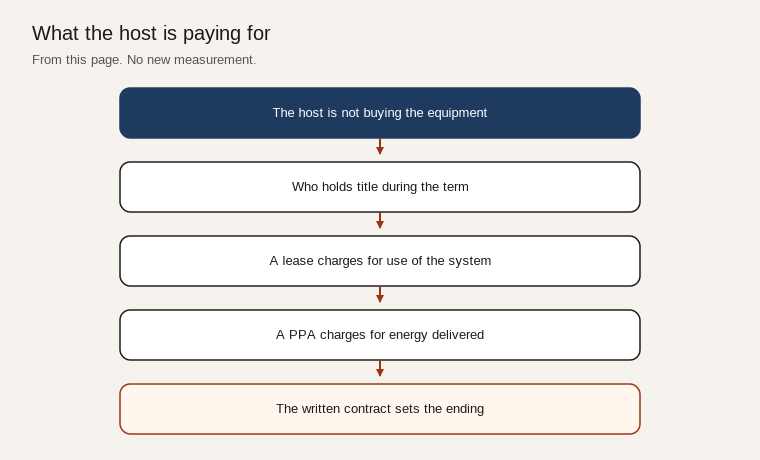
Decide who holds title, then whether the host pays for use of the equipment or for electricity delivered, and read the contract for maintenance, incentives, and the end of the term rather than the product label.
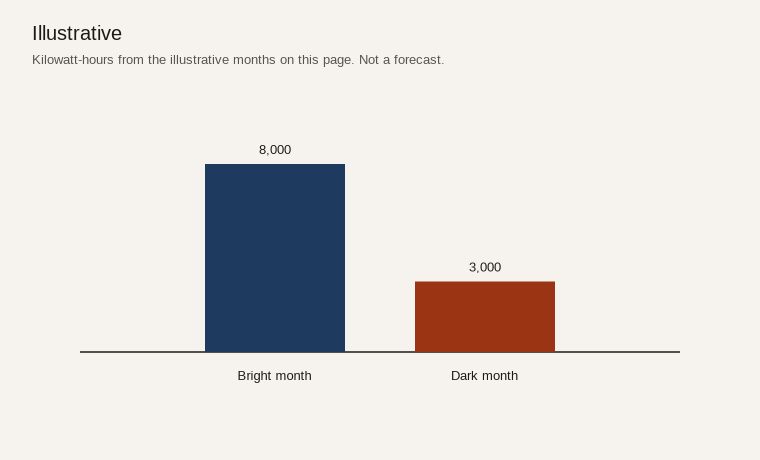
The bars repeat the illustrative bright month and dark month already written on this page and are not a forecast or a rate.
Ownership first, then the bill
The commercial decision is who holds title, whose name is on the utility account, and what event creates a payment. Those answers drive cash flow, tax position, certificate claims, and what a lender or later buyer must accept.
The Federal Trade Commission, in an April 2022 consumer article, states the household version. A lease or a PPA means you do not own the system. A lease pays to use equipment a company installs. A PPA pays for power that system produces, at the provider’s price. Commercial paper uses that split unless the contract changes it. The article is not a tax ruling.
The Department of Energy’s 2023 solar and storage blueprint draws the same line for governments. A third party installs, finances, owns, operates, and maintains the system. The customer pays for electricity produced under a PPA, or a fixed monthly amount under a lease. Treat the blueprint’s incentive comments as a 2023 overview. Credit rules below are from Internal Revenue Service instructions read on November 22, 2026. An off-site contract is a different product. This page is about equipment on the host’s property.
What the payment is buying
| Decision | Solar lease | On-site PPA |
|---|---|---|
| Who usually holds title during the term | The lessor | The third-party project owner |
| What creates the host’s payment | Use of the equipment | Measured electricity delivered |
| A low-output month, before special clauses | The scheduled payment can stay due | The energy charge can fall with delivery |
| What is not automatic | Title, a tax credit, or certificates | Title, unused potential output, or certificates |
The Department of Energy blueprint says that if the array produces nothing on a given day, the customer would not incur a PPA cost for that day, though utility purchases can continue. A minimum payment can undo that result. Compare the monthly lease amount or the price per kilowatt-hour, any escalation, and where energy is counted: inverter, interconnection, or a formula.
Illustrative only: an array delivers 8,000 kilowatt-hours in a bright month and 3,000 kilowatt-hours in a dark month. A delivery-based PPA bills those months on different quantities. A fixed lease charge does not, unless another clause changes it. These figures are not a forecast, a rate, or a Soleil Energy result.
Virginia draws that line for homes only. Effective January 1, 2027, section 54.1-1117.1 defines a residential lease as use of someone else’s system and a residential PPA as a sale of its electricity. It does not govern commercial or government contracts. If a commercial label and the payment math disagree, rewrite the draft.
What else the contract actually controls
Title during the term is not title at the end. The FTC says the customer does not automatically own the system when a lease ends. The contract should state whether the customer can renew, buy, or have the system removed, and at what cost. The same article says that after a residential lease the company must remove the system and restore the roof, and that ending early can be difficult and expensive. On a commercial building the signature copy controls, including any purchase formula and the method for setting it.
Operation can split from title. The FTC says the contract should name who maintains and repairs the system and whether the host pays, and that a bid should say what happens if the roof later needs repair. A roof’s ability to carry the array is a site judgment for a qualified professional. If the contract sets a production expectation, the remedy should name the meter, the period, excluded outages, and what is paid or repaired. A sales-sheet figure is not that clause.
Transfer and certificates are contract terms too. The FTC says to check whether a household contract can move to a buyer and whether that buyer must meet a credit test or pay a fee. A lender may also have to consent before equipment is attached. The FTC says a non-owner cannot claim the renewable energy certificates. The Department of Energy’s federal electricity-contract page, updated May 13, 2026, says the owner may claim incentives and may sell the certificates, and that an agency cannot claim to be using power generated on-site when the certificates are sold. The same page shows federal on-site purchase terms of 5, 10, or 30 years under different authorities and says third-party sales are not allowed in every market. Private and local buyers do not inherit those federal term limits.
Incentives, as of November 2026
No single solar credit follows the host. The Instructions for Form 3468 (2025), read November 22, 2026, cover a section 48 energy credit in Part VI and a section 48E clean electricity investment credit in Part V. They point readers to IRS.gov/Form3468 for later legislation.
For section 48 property that generates electricity from solar energy, or provides heat, cooling, or process heat, those instructions set the applicable percentage by beginning of construction and by whether prevailing-wage and apprenticeship requirements or a limited exception are met: 30% before 2025 if they are met and 6% if not; 10% and 2% for construction from January 1, 2025, through June 15, 2025; and 0% if construction begins after June 15, 2025.
Section 48E is not that table. The instructions’ note on Public Law 119-21 says the credit ends for wind or solar facilities placed in service after 2027 if construction begins after July 4, 2026, and it adds prohibited-foreign-entity limits. Part V allows no credit if construction includes material assistance from a prohibited foreign entity and begins after 2025, or, for tax years beginning after July 4, 2025, if the taxpayer is a specified foreign entity or a foreign-influenced entity in the cases described there. Construction may be shown by the physical work test or the 5% safe harbor in the Form 3468 instructions. A bonus described there does not revive a credit the base rules end.
The taxpayer files Form 3468 for each facility or property. Applicable entities under section 6417(d)(1)(A) may elect to treat a section 48, 48E, or 48C credit as a tax payment. The elective pay and transferability page, read the same day, says the IRS treats that amount as a tax payment and refunds the overpayment. Other eligible taxpayers, not those applicable entities, may transfer all or part of an eligible credit to a buyer for cash. Pre-filing registration is required, and the registration number must be on the return.
Hosting does not make the host that taxpayer. The FTC article says household lease and PPA customers do not get the credits or incentives, which go to the owner. The instructions add a narrow lessor election under section 48(d) as in effect on November 4, 1990: after the election, the lessee rather than the lessor gets the investment credit, and the instructions point that lessee to rehabilitation-credit lines. Do not assume a commercial solar lessee can use it for section 48 or section 48E. The credit may also be refigured if the property is disposed of before 5 full years after it is placed in service, or if credited leased property is returned early. A contract price does not prove a credit was available.
Maryland, Northern Virginia, and the District
Soleil Energy’s published service area is Maryland, Northern Virginia, and Washington, DC. Permission to host someone else’s generator, and permission to sell the host electricity, are local. These texts were read on November 22, 2026. The tariff and any remaining program capacity still have to be checked for the account.
In Maryland, section 7-306 treats a customer that owns and operates, leases and operates, or contracts with a third party that owns and operates solar as an eligible customer-generator when the facility is on the premises or contiguous property, interconnected in parallel, and intended primarily to offset the customer’s own use. The same section generally limits that system to 2 megawatts, with stated exceptions, and gives the customer-generator or its assignee title to the renewable energy attributes. The Public Service Commission describes rooftop solar as customer-owned or third-party-owned, and possibly eligible for net metering and solar renewable energy credits. The statute offers that tariff until the earlier of 3,000 megawatts of rated capacity owned and operated by eligible customer-generators or July 1, 2027. A customer-generator already on it that day stays eligible until decommissioning, a capacity-increasing modification, a new interconnection agreement, or statutory repowering, whichever comes first. Community solar is a different product.
Virginia is narrower for sales. Section 56-594.02, including its 2026 amendments, runs a pilot in each investor-owned utility’s territory. On-site solar may be sold only to that eligible customer-generator, under a financing PPA, with notice to the Commission and the utility at least 30 days prior. Aggregated capacity may not exceed 500 megawatts for jurisdictional customers and 500 megawatts for nonjurisdictional customers, and a facility may not exceed three megawatts. A third-party PPA outside the pilot is prohibited there, except a full-load licensed supplier under section 56-577. Cooperative territory is separate. A lease label can still hide a sale. Counsel and the utility decide.
In the District, section 34-1501 defines a customer-generator as a customer that owns and operates a facility of not more than 1000 kilowatts on the premises for its own use. The text read that day does not extend the definition to a lease or a third-party sale. Confirm the Commission’s current net-metering rule before treating either contract as eligible. Retail supply choice is a different contract from hosting an array.
Interconnection is separate from both documents. Soleil Energy’s commercial interconnection guide describes that process and does not replace the tariff or a Virginia pilot notice.
C-PACE is not either contract
Maryland C-PACE is property-assessed financing, not a lease or a PPA. The Maryland Clean Energy Center program page says private capital can finance commercial solar, repaid as a property-tax surcharge after the county adopts an ordinance and agrees with the Center. After payoff, owners keep the improvements. The page also describes full-project funding and no upfront cost, over a term longer than 20 years. That is an administrator’s description, not a commitment that every lender will fund every array, and the surcharge is still repayment. If C-PACE is stacked on a PPA, name the equipment owner, the tax owner, and the surcharge if the PPA ends. Soleil Energy’s Maryland grants and C-PACE guide is background, not the ordinance.
Compare the two drafts on the same questions
Score a lease against a PPA only after both drafts name the legal owner, the tax owner, and the utility account; the payment unit, meter, escalation, and extra fees; what is owed in a zero-output month and if output misses the production expectation; who maintains, insures, monitors, and may stop the system; the end-of-term options and removal standard; who holds the certificates; and what a sale, refinance, or tenant change requires. A tax-exempt host should also attach the memo on who, if anyone, is expected to claim or transfer a credit.
Soleil Energy’s commercial installation guide covers what a Maryland installation includes before a price means anything. The commercial model guide shows how load and the tariff enter the analysis. The commercial credit-deadline guide discusses timing and should be checked against the Form 3468 instructions before a date is used.
Misreadings that should stop a signature
A lease is not title, and a purchase option is not title today. A PPA does not erase the utility bill: delivered solar energy is one charge, and the tariff’s remaining energy, demand, and fixed charges are another. The FTC makes that household point.
Virginia’s investor-owned pilot, not a lease label, decides whether a third-party sale is allowed. District retail choice is not permission to host a third-party generator. Elective pay is not a refund for hosting someone else’s array. Underwrite a lease for poor-output months and a PPA for the meter, any minimum take, and the state’s sale rule. A lease billed per kilowatt-hour should go back for a rewrite.
A site-specific scope is the useful next step
Bring the address, the utility, interval use if it exists, roof or land condition, the expected hold period, and whether the organization can use a credit or must look at elective pay. Soleil Energy can review that scope in Maryland, Northern Virginia, and Washington, DC, including how ownership and interconnection fit the electrical service. The conversation does not set a price, a credit, or a production commitment.
Questions the draft still has to answer
Who owns the equipment at the start and at the end?
The lessor or the project owner usually holds title during the term. The host owns it later only by using the written purchase option. If the title clause, the option, and the removal clause conflict, the draft is not finished.
Which pages decide the comparison?
Payment, escalation, production, maintenance, roof access, certificates, default, and the end of the term. Then read any lender consent or fixture filing. A seller’s summary email is not the instrument.
Does elective pay go to a public host if a developer owns the array?
No. An applicable entity may elect payment of a section 48 or section 48E credit it can claim, after pre-filing registration. Another eligible owner may transfer an eligible credit for cash. Hosting does not make that election. A sentence that the price “includes the credit” is not the filing.
What belongs in the file if the roof must be replaced?
Who may require removal, who pays, how charges change while the system is down, and how any production expectation treats the downtime. A roof that already needs work should be sequenced first. A qualified person assesses the structure. This page does not.
Do household disclosure rules cover a commercial signer?
No. Virginia’s statute effective January 1, 2027, is for residential customers and residential systems. A commercial or government signer needs its own counsel, its procurement rules, and, for a third-party PPA in investor-owned territory, the notice in section 56-594.02.
Who may say the building uses the solar power?
The party the contract and the applicable program recognize. Federal procurement guidance read for this page treats a sale of the certificates as inconsistent with an agency claim that it is using power generated on-site. A private building still has to be checked against its own contract and state rule. Proposal copy does not move the certificates.
Project requirements depend on the site, equipment and applicable rules. Confirm design and installation decisions with the appropriate qualified professional.