
A solar performance guarantee is a contract term that compares a photovoltaic plant’s measured energy over a stated period with the energy an agreed model expects under the weather of that same period. Any remedy applies only as that contract writes it, after the adjustments and exclusions the clause names. It is not a fixed annual total, a module warranty, or proof that a financial pro forma was correct.
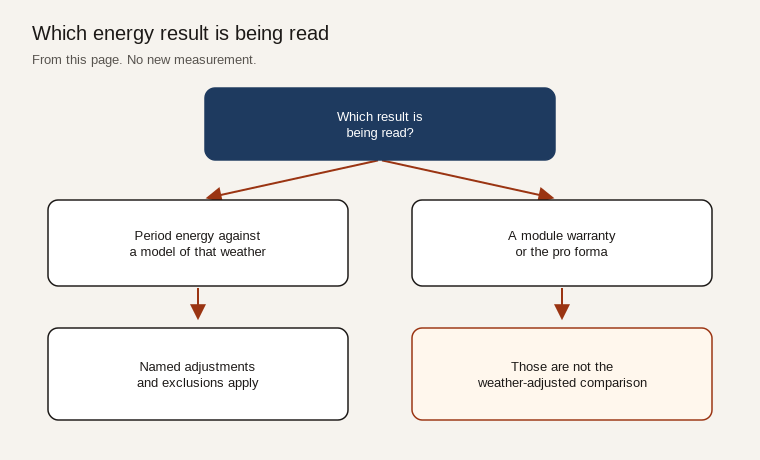
Period energy rerun on the weather of that period, a module warranty, and an investment pro forma answer different questions, so a pass or a miss on one does not settle the other two.
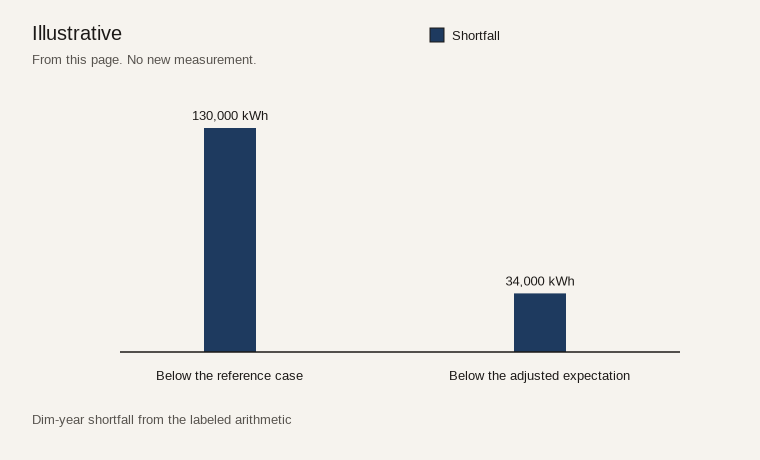
The bars repeat the dim-year shortfall already labeled as illustrative arithmetic, one against the reference case and one against the weather-adjusted expectation.
What the comparison actually measures
The useful question is how the year’s kilowatt-hours compare with the model after sunlight and the named exclusions are put back in.
IEC TS 61724-3:2016, on the IEC publication record, compares a plant’s measured energy with expected energy from actual weather the stakeholders define. Operating hours stay separate from unavailable hours. The published scope leaves the prediction method to the users. The model may be detailed or, for a small system, a performance ratio. The scope prefers a long test, ideally about a year, and says the model should stay fixed once the procedure starts.
The 2018 NREL operations and maintenance guide compares produced energy with energy expected from measured weather and an agreed model. An all-in index uses every hour. An in-service index drops hours the system was down. A long outage can look acceptable on one and poor on the other.
Sandia’s PV Performance Modeling Collaborative, last modified September 28, 2022, defines the performance index as measured energy divided by model-predicted energy. Unlike a performance ratio, it should stay near one when the plant matches the model, without a seasonal swing from temperature alone. Near one is a description on that page, not a required contract band.
The 2013 NREL report defines performance ratio as alternating-current energy relative to direct-current nameplate and plane-of-array sunlight. Temperature sits inside the uncorrected ratio, so winter and summer can disagree when the hardware has not changed. The weather-corrected form adjusts cell temperature toward the irradiance-weighted average from the agreed weather file and does not adjust snow or soiling.
What a performance guarantee does not promise
A performance guarantee does not promise one quantity of kilowatt-hours in every weather year. A dim year should lower the expectation. Using the unadjusted pro forma total as the pass mark skips that step.
It does not promise a bill, a credit price, or a tax result. The comparison stops at energy or at a ratio of energy and sunlight. Credit eligibility depends on statute, current Internal Revenue Service instructions, and project facts. A qualified tax professional has to answer that.
It is not a module warranty. Section 6.7.1 of the 2018 NREL guide separates a product warranty, for materials and workmanship, from a manufacturer power warranty, for declining module power under stated test conditions. Neither is a year of plant energy at the meter. A module can meet its schedule while the plant misses because of soiling, an inverter, shade, or downtime. Soleil Energy’s warranty guide sorts those layers. The plant clause exists only if someone signed it.
It is not an availability commitment unless the text says so. Downtime and energy delivery are different scores. Energy availability, in that NREL discussion, weights hours by expected energy rather than by the clock.
It does not approve interconnection or financing. Maryland C-PACE, as the Maryland Clean Energy Center described it on November 22, 2026, is private financing for qualifying commercial improvements, including solar equipment, repaid as a property surcharge in a county that has adopted the program. That is not an energy test. Interconnection is separate. Soleil Energy’s Maryland commercial interconnection guide covers that state only. Virginia and the District of Columbia use their own utility rules.
A test year is not the pro forma
A pro forma is the investment case: an energy figure, then prices, costs, degradation, and financing. The energy line is often an exceedance figure, not one future year.
Dobos, Gilman, and Kasberg, in a 2012 NREL paper, define an exceedance probability as the chance a stated annual-energy level will be exceeded. A P50 value is expected to be exceeded with 50 percent likelihood, and a P90 value with 90 percent likelihood. The paper treats them as multi-year risk figures, not one year’s pass mark. A typical meteorological year file, the paper notes, uses typical months and omits outlier years, so it may fit a preliminary design better than a financial case that should include bad years.
The test period does not rerun that case. Section 10.1 of the 2018 NREL guide says a multi-year yield report uses average historical weather, while actual output follows the weather that occurs. Keep one model and apply it to measured weather, including curtailment. The 2013 report says to agree the weather file first, because a different file changes the ratio even when the design does not.
A dim year can miss the pro forma and still meet a weather-adjusted contract. A bright year can do the reverse. A P90 figure was never a statement about one particular year, and prices in the pro forma are not retested at the meter.
A short power test is a different gate
These documents do not ask the same question.
| Document | Question it can answer | What it leaves open |
|---|---|---|
| Module product warranty | Did materials or workmanship fail under that warranty? | Energy at the plant meter |
| Module power warranty | Does module power still meet its declining schedule? | A weather-adjusted year of plant energy |
| Availability commitment | Could the plant operate on the basis the clause defines? | Whether those hours matched the energy model |
| Short power or capacity test | At agreed conditions, does measured power match the model? | Energy across a full year |
| Performance guarantee | Does period energy meet the adjusted expectation? | Price, tax, and the pro forma |
| Pro forma | What energy and cash-flow case did the investment use? | A contractual remedy |
ASTM E2848-13, reapproved in 2023 and last updated August 9, 2023, reports power at plane-of-array irradiance, ambient temperature, and wind speed. Capacity is not an energy-generation capability, and one measurement does not project energy over time. For a contractual test, reporting conditions and the irradiance plane must be agreed first. The standard states no universal pass fraction.
IEC TS 61724-2:2025, published September 22, 2025, defines a power performance index: measured power under the test conditions divided by expected power from the design. The test is typically three to five days, usually at final completion, and only while inverter alternating-current limits are not binding. The 2025 edition adapts the 2016 procedure for bifacial arrays, clipping, and curtailment. That short test is not the year-scale comparison.
IEC 61724-1:2021, published July 21, 2021, defines monitoring classes and updates irradiance and soiling guidance, including bifacial systems. Class limits are in the standard. Naming the series without an edition and a class leaves the instruction unfinished.
How the measured period is adjusted
The adjustment is the clause. A remedy does not help if the formula is vague.
Name sunlight for the same interval as the energy. The 2018 appendix, an example rather than a required form, discusses plane-of-array irradiance and orientation-corrected global horizontal irradiance. The 2013 report prefers a reference device matched to the modules, in the array plane, and the parties still have to name calibration and a backup if the sensor fails. A drifting sensor moves the expectation either way.
Temperature drives the seasonal bias in an uncorrected performance ratio. The 2013 method uses one heat-transfer model for the weather file and the test, aimed at that file’s irradiance-weighted average cell temperature. Snow and soiling stay in the corrected ratio, so the clause must say who owns washing. Otherwise the contractor can be charged for dirt, or the owner can lose the ability to see neglect.
Outages need the same sentence. The 2018 guide says to state whether grid outages, power reductions, and planned maintenance count, and not to penalize events outside management control. It gives no universal list. Curtailment belongs in the comparison. A utility export limit is not a failed inverter. Say which hours are excused and whether they leave measured energy, expected energy, or both.
Clipping is separate. The 2013 report says not to use a performance ratio for acceptance when inverters clip, because those hours punish the design. The 2025 power test evaluates only unconstrained periods.
A multi-year performance guarantee may lower the expectation as modules age. That schedule is negotiated, and this page does not set it. Name the model file, version, losses, and as-built list before the period. The Part 3 scope allows a bad model to be revised, then held fixed. A midyear edit that absorbs dirt or an outage is a new deal.
Name the meter. Inverter output, a data logger, and a revenue meter differ by losses, auxiliary load, and nighttime use. The 2013 sample uses the delivery-point meters the contract defines. The model must predict that same boundary.
Who owes it, and which lines to read
The obligor is the party that signed the performance guarantee. The 2018 guide does not draft the clause. It reports that some third-party-owned projects include one for energy, availability, or both, and that operations firms and insurers also offer similar terms. A whole-plant construction warranty is often shorter than a module warranty. The signature block controls. A module manufacturer has not automatically accepted plant energy.
Remedies are local too. The 2018 appendix is one example of a payment from a performance-ratio gap, with the revenue rate blank. Those sample factors are not repeated here. No coverage fraction, damage rate, or cap is a physical constant, so none is stated on this page. Payments, holdbacks, retests, caps, and later-year offsets appear in some contracts and not in others. Only the signed text says which.
| Contract line | What must be written, not assumed |
|---|---|
| Obligor | Who owes the comparison, and whether a sale assigns it |
| Period | Start, end, and whether completion is a separate gate |
| Metric | Energy, performance ratio, energy or power index, or availability |
| Model | File, version, weather file, and the rule that it stays fixed |
| Sensors | Instrument, plane, calibration, and the backup if data are lost |
| Adjustments | Temperature, soiling, snow, degradation, clipping, curtailment |
| Exclusions | Grid events, owner acts, planned maintenance, and the log |
| Meter | Register, boundary, and whether auxiliary load is included |
| Band and remedy | Any allowed gap, payment, cap, retest, or later offset |
| Records | Who keeps raw data, and who may challenge the result |
A blank line means the comparison was not named. The irradiance plane must match the array, including a second tilt or tracker backtracking, and ASTM E2848 requires that plane to be agreed before a contractual test. A data logger is not the revenue meter. Soleil Energy’s commercial operations and maintenance guide lists maintenance tasks. Those tasks do not define the formula. The papers should say which tasks keep the plant inside the model’s assumptions.
An illustrative year, with the weather put back in
These figures are illustrative arithmetic, not a Soleil Energy project, a threshold, or a contract term. Temperature, soiling, clipping, degradation, and outages are ignored so the sunlight step is visible.
The reference-year model, used here as unadjusted pro forma energy, is 1,200,000 kWh. In a dim year, plane-of-array irradiation is 0.92 times that reference. The adjusted expectation is 1,200,000 kWh times 0.92, or 1,104,000 kWh.
Measured energy of 1,070,000 kWh is 34,000 kWh under the adjusted expectation and 130,000 kWh under the pro forma. The weather-adjusted clause uses the smaller gap. This example does not decide whether that gap is paid.
Measured energy of 1,140,000 kWh is 36,000 kWh ahead of the adjusted expectation and 60,000 kWh behind the pro forma. Missing the investment case and meeting the contract can be one year.
If irradiation is 1.08 times the reference, the adjusted expectation is 1,296,000 kWh. Measured energy of 1,240,000 kWh is 40,000 kWh ahead of the pro forma and 56,000 kWh behind the adjusted expectation. The denominator decides which gap matters. Neither gap is money until the remedy page says so.
Use the clause in a commercial decision
The buyer’s question is whether risk left after the clause matches the pro forma. A short, narrow performance guarantee leaves later years and worse weather with someone. If a third party owns the plant, the host may not be the beneficiary. The beneficiary is whoever the clause names.
Soleil Energy’s renewable energy work includes commercial solar design and construction, plus later monitoring. The service-area page identifies Maryland, Northern Virginia, and Washington, DC, names Prince George’s, Montgomery, Howard, and Arlington counties, and states that the District is served with no DC office. Those pages are not a form performance guarantee.
Bring the draft clause, the model, the weather file, the meter boundary, and any production and irradiance records. Monitoring and maintenance matter because the comparison needs stored data. Soleil Energy can discuss that scope in its service area. The discussion does not replace the contract’s independent engineer or counsel on the remedy.
Questions to settle before signing
Is a performance guarantee the same document as a panel warranty?
No. One covers equipment under its own test. The other covers plant energy, or an index of it, after weather adjustment. A module claim can be real and still too small to move the annual clause. Check who pays removal and reinstall labor. That labor is often outside the manufacturer document.
Can the plant miss the pro forma and still satisfy the clause?
Yes, if the year is dimmer than the long-term case and the clause reruns the model. A bright year can do the reverse. Comparing raw kilowatt-hours with an unadjusted P50 or P90 figure leaves weather risk in the result. That choice should be visible before signing.
Does a passing multi-day test close the annual question?
No. ASTM E2848 says capacity is not energy capability. The 2025 power test is typically a few days at completion. The Part 3 procedure prefers about a year and reports unavailable time separately. Curtailment or a later inverter failure can dominate the annual result without appearing in the short test.
Who pays if energy is short?
Only the signer, through the remedy as written. That may be a construction contractor, an operations firm, an insurer, or a third-party owner, not automatically the module maker. Find the threshold, cap, retest, and any later-year offset. A blank is not filled by a technical guide.
Can weather adjustment hide poor maintenance?
Yes, if the formula removes losses the operator was hired to prevent. Irradiance and temperature corrections remove weather. Soiling and downtime stay or go by sentence. Read an in-service index next to availability. A mid-test model edit that swallows dirt or an outage breaks the instruction to keep the model fixed.
Does the clause change interconnection or a tax credit?
No. Interconnection stays a utility process, and the Maryland guide covers only that state. A performance guarantee does not waive a study. As of November 22, 2026, confirm any credit or transfer with a qualified tax professional and current official instructions. The clause and a pro forma are not evidence a credit is available.
Project requirements depend on the site, equipment and applicable rules. Confirm design and installation decisions with the appropriate qualified professional.