
Solar string mismatch is the extra power a photovoltaic array loses when connected modules or strings cannot each run at their own maximum power point. In series, one current flows through every module, so the weaker module sets that current unless a bypass diode redirects it. In parallel, strings share one voltage, so a different length, tilt, or condition can cut what a string delivers. The gap is an electrical constraint, not proof by itself that hardware has failed.
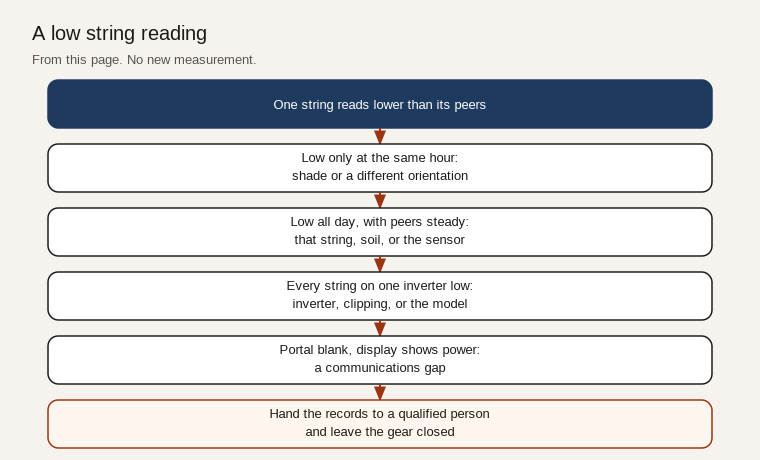
A low string is sorted by whether the gap follows the hour, whether same-plane peers stay steady, and whether a blank portal with power still on the inverter display is a communications gap rather than a failed array.
Series wiring makes current the shared limit
A string is modules wired so their voltages add. Current in that path is the same at every module. PVEducation’s series-mismatch explanation states the result: total voltage is the sum of the individual voltages, and a current mismatch means the combination’s current equals the lowest current. A short-circuit-current mismatch is both more common and more severe than an open-circuit-voltage mismatch, because shade on part of a module readily cuts current.
Near open circuit, a lower short-circuit current changes voltage only modestly. Once the string is asked for more current than the weak module can supply, the combination cannot exceed that short-circuit current. At low voltage, the extra current is dissipated in the weak cell and can damage it. A normal open-circuit voltage can therefore sit beside a constrained operating current.
Power is current times voltage. The Department of Energy’s performance primer, updated May 5, 2026, adds the temperature effect often mixed into this story: higher cell temperature raises current slightly and lowers voltage by much more. A hotter string is not the same problem as a string whose current collapsed from shade, soil, or cracked cells.
Parallel strings are forced to one voltage
Sandia’s PV Performance Modeling Collaborative states the array rule. Each device has its own maximum-power current and voltage for its irradiance and temperature, and manufacturing leaves even matched hardware a little apart. Series strings must carry one current. Parallel strings must share one voltage where they join. The array runs at the compromise that maximizes combined output, not at every device’s own maximum.
Sandia defines mismatch loss from the gap between array output and the sum of each module’s own maximum, after direct-current wiring losses are set aside. Uneven irradiance is often modeled apart from performance or temperature differences, so a single model line can hide more than one cause.
Strings on one maximum-power-point tracker input share that input’s voltage. Strings on separate inputs can sit at different voltages. An east plane and a west plane on one input share one compromise all day. Two strings with different module counts do the same through voltage. Whether an input already separates those strings is on the one-line diagram, not a change to make from this page.
Bypass diodes limit heating and still move the curve
A bypass diode sits across a cell or a group of cells, in parallel and with opposite polarity. PVEducation’s bypass-diode note says the diode is normally reverse biased and idle. If mismatch drives a cell into reverse bias, the diode conducts, current from the stronger cells continues in the external circuit, and reverse voltage on the weak cell is limited. That is how the diode reduces hot-spot heating.
Diodes usually cover groups of cells. Once a diode conducts, that group stops adding its normal voltage, the curve gains a step, and the tracker chooses among the steps. The installed datasheet, not a textbook sketch, records the grouping.
PVsyst’s note on bypass diodes and partial shading rejects the shortcut that shade on the bottom cell row merely trims the string to the unshaded groups. With one string on the input, or strings shaded the same way, operation can stay near the unshaded groups, minus the diode drop. Unshaded strings in parallel impose one voltage, and the shaded string can be left on the diffuse-light part of its curve, so its direct-beam contribution is lost. If that lower voltage falls outside the inverter’s tracking window, the one-string advantage can disappear too. The graph is a clear-sky case. A note that many 60- or 72-cell modules use three diodes is a modeling convention, not a census.
A low string is not one diagnosis
A chart with one string below the others has several honest explanations. Uneven light is the everyday case: a vent, tree, parapet, or the next row, or snow, a dirt band, and bird droppings. Shared series current means the loss need not match the shaded area. Design mismatch is present on a clear day when azimuths, tilts, series counts, or a replacement module’s current rating differ. A short string beside a long one matters because parallel strings share voltage.
Aging adds mismatch later. The December 2018 operations guide hosted by the National Laboratory of the Rockies (report NREL/TP-7A40-73822, with Sandia National Laboratories and the SunSpec Alliance) says module degradation rates are often on the order of 0.5% per year, citing Jordan and Kurtz 2012, and that modules do not degrade at one rate. That spread induces a circuit-level mismatch loss the guide says should be modeled. Some module-level power electronics reduce the added loss. They do not erase soil, shade, or a dead module.
An open connection, failed fuse, damaged connector, or mislabeled conductor can zero one string while the inverter keeps converting the rest. A bad sensor can show the opposite: a weak channel while inverter power matches the peers. The guide lists module mismatch among the reasons a model and a measurement disagree, with wiring, rating, shading, soiling, and degradation. Clipping is a further lookalike. Monitoring should account for periods when array power exceeds what the inverter will convert, and for curtailment. A stale portal is not a current measurement. Soleil’s guide to solar monitoring that has gone offline separates a broken data link from production.
What the pattern is allowed to suggest
The table chooses the next question. It is not a fault code. No public percentage separates a healthy string from a failed one on every array.
| What the records show | Question worth testing | Do not jump to |
|---|---|---|
| One string low only at the same hour | Shade, or a different orientation | A blanket module replacement |
| One string low all day; same-plane peers steady | Soil, a bypassed group, an open path, or a bad sensor | A new inverter |
| Every string on one inverter low together | Inverter limit, clipping, a shared input, or the weather model | A failed module in every row |
| The gap widened over years, not overnight | Uneven degradation adding mismatch | One recent wiring error |
| Portal blank; inverter display shows power | Communications | A dead array |
| The change followed roof or combiner work | A connection or label error for a qualified person | An owner repair |
Compare strings that share module type, series count, tilt, azimuth, and exposure at the same time. A passing cloud makes sequential readings lie. The 2018 guide says each orientation needs its own plane-of-array irradiance sensor. Inverter energy hides which string moved. String-level data can limit the expected-energy count to operating strings, and still miss cell-level hot spots that do not yet cut output.
Field tests answer a different question than the portal
The 2018 guide says monitoring inaccuracies are why periodic array checks are common. Open-circuit voltage, operating current, or a field current-voltage trace can find direct-current faults the monitor misses. The guide limits standard field current-voltage tracing to around 5%, because irradiance, temperature, and electrical sensors all contribute. A trace shows defects already cutting output. It misses hot spots that are not yet a large electrical loss, and traces taken days apart compare only when conditions are written down.
That work is at combiner equipment. The guide says arc-flash protection enters the decision, and that some topologies may be too hazardous to test live under the NFPA 70E edition it cites (2012). A later edition may apply locally. As of November 2026 this page does not set the edition or the method. A qualified person does. None of this is an owner task.
Thermal images flag symptoms, not a finished cause. The guide says they can show failed strings, diode problems, and hot spots, and that without validated processing the picture is a rough location. The April 2021 executive summary of IEA PVPS Task 13 report T13-24, Qualification of Photovoltaic Power Plants using Mobile Test Equipment, says electroluminescence can show cracks without proving the power effect. String electrical tests speak to average module performance. A claim that needs each module against its specification may require a module-level measurement. A daylight curve is read with irradiance and module temperature, then translated to standard test conditions. Where a method disconnects strings, the summary notes voltage can reach up to 1500 volts and that only a qualified electrician should do the work. A contract that says “test the strings” should name which strings, the conditions, and the decision allowed.
An illustrative string, in round numbers
Illustrative figures only, not a measurement and not a Soleil project: three series modules, each near 36 volts and 9 amperes at its own maximum in full light, would together sit near 108 volts at 9 amperes. If shade cuts one module to 6 amperes before its bypass diode conducts, the string is held at 6 amperes. If the diode then conducts, that module stops adding its normal voltage and the tracker sees a lower-voltage, higher-current choice. Unshaded neighbors on the same input can instead pin the shaded string near its diffuse contribution. Change the count, the shade, or the inverter window and the figures change. They show the trade. They do not size equipment.
What reduces the constraint, and what it leaves
The Department of Energy’s inverter primer, updated March 31, 2025, separates the architectures. A string inverter’s output falls if any panel on that string has a problem such as shade. A microinverter on each module keeps that problem from reducing what the other modules can deliver, and it can cost more. The primer does not rank one layout for every roof.
Module-level electronics, and one string per tracker input, shrink that coupling. They do not clean a soiled module or replace a failed one. Moving planes onto separate inputs can also push voltage outside a tracking window and touch interconnection paperwork. This page does not prescribe that work. A qualified professional compares the as-built map with the inverter range and the code edition adopted locally. As of November 2026 that edition is not a national default.
Records that make an assessment specific
Bring documents, not a verdict:
- Module model, series count, and tracker input or inverter for each string.
- Tilt, azimuth, and known shade at morning, noon, and afternoon.
- Whether the gap is one string, one input, or the whole inverter, and whether it follows the clock, the season, or a work date.
- Timestamped screenshots, alarms, and any outage or curtailment flag.
- Photos of soil, snow, debris, and damaged glass or backsheet, from a safe vantage. Stay off the roof. Leave combiners, inverters, and disconnects closed.
- When on-site sensors were last checked, and whether any replacement module matches the string’s current rating.
Soleil’s guide to what a commercial solar maintenance scope covers shows how a contract names tests and reports. Any performance commitment still needs its own metric, weather data, and exclusions. Scorched equipment or damaged conductors are a stop: do not open the gear.
Replacement is a result, not the first test
If peer strings on the same inverter are producing, that inverter is converting. The outlier is the string, its conditions, or its sensor. Soleil’s guide to solar inverter replacement fits a unit that is down or silent in daylight. Washing or waiting out snow can close a temporary gap. A clear-day gap against true peers is what a qualified inspection sorts into a bypassed group, a connection fault, a sensor error, or a failed module. A string average is a weak file when a claim needs each module. Nothing here is a remote diagnosis.
Questions that change the next step
Why can a thin shaded band cost more than its area?
Series modules share current, and strings on one tracker share voltage. In the PVsyst clear-sky case, unshaded neighbors can hold a partly shaded string near its diffuse contribution. That extra electrical loss depends on grouping and on the inverter window. It is not a fixed fraction of the shaded area.
Does a modest current gap mean a module failed?
No. Manufacturing spread, temperature, cloud, soil, and sensor error all move current. Sandia treats a small manufacturing difference as normal once devices share a circuit. A large, repeatable gap on one string of a matched plane is what justifies a qualified look. This page states no cutoff.
Will module-level electronics remove the problem?
They remove much of the coupling between modules. A microinverter keeps one shaded module from pulling the others down, and some module-level electronics reduce the extra loss from uneven aging. The weak module still produces only what its own cells can. The hardware is not a repair for an unnamed fault.
Can a normal open-circuit voltage clear the string?
No. A short-circuit-current mismatch barely moves open-circuit voltage and still caps operating current. If a qualified person tests the string, the test has to match the question: open-circuit voltage, operating current, or a curve with irradiance and temperature. One voltage is not the inverter’s operating point.
Should the inverter be replaced because one string is low?
Only when the inverter is the failed stage. One low string beside healthy strings points at that string, its conditions, or its sensor. All strings down, or no daylight output on the inverter display, is the pattern in the inverter-replacement guide. A new inverter leaves shade or a diode problem in place.
What should a maintenance contract say about this?
Say whether current is per string or only per inverter, how a peer is defined, and which follow-up a persistent gap includes. State that a field trace has limited accuracy and that a string result is an average. Keep that work separate from any performance commitment, and define the commitment against measured weather.
What to hand a service assessment
Soleil Energy’s monitoring and O&M service includes performance monitoring, preventive maintenance, and fault diagnosis for inverter faults, string failures, and communication dropouts, including on systems the company did not install. The useful request is an assessment that starts from the string map, the timestamps, and the safe observations above.
The service-area page, checked November 22, 2026, names Prince George’s, Montgomery, and Howard counties in Maryland, Arlington County in Northern Virginia, and Washington, DC, with no DC office. A qualified professional has to assess the site, the equipment, and the adopted code. This page does not select hardware or authorize work on energized conductors.
Project requirements depend on the site, equipment and applicable rules. Confirm design and installation decisions with the appropriate qualified professional.