A standing seam metal roof is a metal panel covering whose side joints are raised seams, made by turning up adjacent edges and then folding or interlocking them. The holding clips sit inside those joints instead of through the weather surface. Seam type controls how the joint closes, and clip design controls whether a panel can change length as temperature changes. A solar clamp answers neither question by itself. A qualified professional must assess the actual roof.
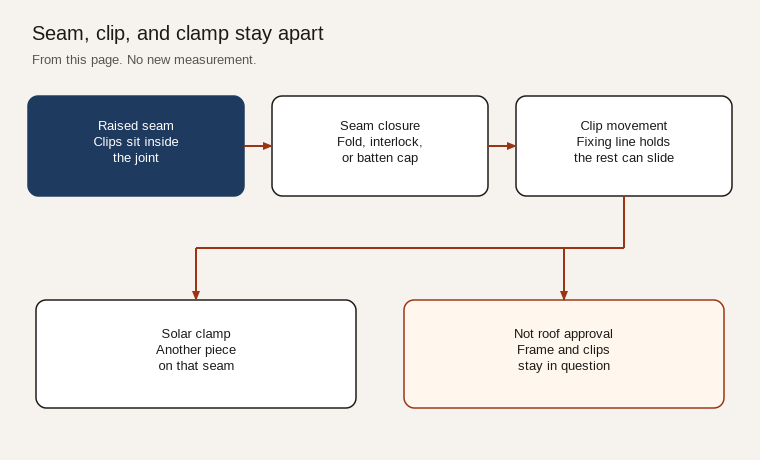
Separate how the raised seam closes from which clips can move, then treat a solar clamp as another piece on that seam rather than as approval of the roof or the frame.
A raised joint is not a screwed-down metal roof
The National Roofing Contractors Association defines a standing seam as a joint made by turning up the edges of two metal panels and then folding or interlocking them. That glossary entry, read on November 22, 2026, describes the joint. It names no metal, thickness, slope, or wind rating.
On this concealed-fastener roof, the clips that tie panels to the supports sit in the side joints. On an exposed-fastener, or lap-seam, roof, screws pass through the weather surface and stay visible in the pans. Both are metal. They do not move with temperature, or take equipment, the same way.
The 2024 International Building Code, on the International Code Council site as read November 22, 2026, sets a different minimum deck slope for standing-seam metal roof panel systems than for lapped, nonsoldered seams: one-quarter unit vertical in 12 units horizontal. That is a model-code floor, not a product approval. The manufacturer’s range can be steeper, and Maryland, Northern Virginia, and the District may enforce another edition. Confirm the adopted text with the building official. A photo of ribs is not a specification. The panel name and the shop drawings identify the joint.
Seam type is how the joint is closed
Standing seam is a family. NRCA’s phrase, folding or interlocking in a variety of ways, is the scope.
An interlocking seam engages one formed edge with the other, often by a snap over a clip. The legs close the joint. A folded seam is closed in the field with a hand tool or a mechanical seamer. NRCA defines a double-lock standing seam as one that uses a double overlapping interlock between two panels. A single fold and a double fold are different joints. “Standing seam” alone has not named which.
A batten seam is related, not identical. NRCA uses that name for a profile that may have a square or rectangular snap-on cap, or that may be formed around a beveled wood or metal batten. A cap over a batten is not a machine-folded double lock.
The closure changes the work. A field-folded seam needs the seamer, the sequence, and any sealant the instructions require. A snap joint can be wrong on a low slope even when the model code allows some standing-seam system at one-quarter in 12. As of November 2026, none of these names carries a wind pressure, a metal thickness, or a warranty length. Those live in the tested assembly and in that product’s warranty.
Clips exist so the panel can move
Panels change length as temperature changes, along the sheet and away from whatever holds them. Longer runs accumulate more movement. If the roof ignores that, the fasteners, the seam, or the pan has to absorb it.
The Metal Construction Association’s page for its standing-seam clip guide, read November 22, 2026, says most of these installations need specific fastening so the roof can accommodate thermal expansion and contraction and limit fatigue of the attachment. Clip choice, that page says, belongs with the panel manufacturer or the design engineer. The guide file returned an application error that day, so nothing here quotes its dimensions or load tables.
ASTM E1514-98(2023)e1, read on the ASTM site on November 22, 2026, specifies structural standing seam steel roof panel systems. The performance items in its scope are only the panels, the concealed clips, the clip anchorage, and the joint sealers. The abstract requires design for the specified loads and for thermal effects without seam separation, permanent buckling, or loss of weather-tightness. It is not a license to mix clips across brands. Functional, legal, insurance, and cost choices sit outside it.
ASTM E1637-98(2025)e1, the aluminum counterpart read the same day, uses the same limited scope and is plainer about movement. Clips must be compatible with the panel. A fixing line must anchor the panels so they stay aligned and can resist in-plane gravity and thermal forces. That line is the controlled anchor. It is not a reason to pin every support.
Clip movement is the gap between those demands. The fixing line stops the run from migrating. Everywhere else, the clip has to let the sheet change length. Pin every clip and the seam takes the stress. A sliding clip painted shut or blocked by a curb becomes another pin. Omit the fixing line and the run can walk.
ASTM E1592-25, updated September 3, 2025, and read the same day, tests these sheet-metal systems under uniform static air pressure. Its scope includes standing seam panels in a stated thickness range of 0.012 in. to 0.050 in. That range limits the method. It is not a thickness to order. The method notes that service performance also depends on the supports and on thermal expansion and contraction. A test that omits the real clips, fixing line, and support stiffness is not a description of that roof.
Schedules name two behaviors, and the names do not cross brands. A one-piece clip stays fixed while the panel is meant to slide on it. A two-piece clip has a fixed base and a top that moves with the seam. A folded seam often needs that movement inside the clip. A snap joint sometimes slides on a stationary clip. Read that product’s schedule. Trim at the eave or ridge can also clamp an end the clips were meant to release.
Spanning between supports is its own decision
The name does not say whether the panel spans purlins or needs a solid deck.
In the 2024 IBC text read on November 22, 2026, metal roof panels go on a solid or closely fitted deck unless they are specifically designed for spaced supports. Where the panel is both deck and covering, structural standing-seam systems are tested to ASTM E1592 or FM 4474. Exceptions point some steel and aluminum roofs to other structural chapters. That is another path, not a waiver of engineering. ASTM E1514’s note says these structural steel systems are used with or without a deck, on low or steep slopes. “Structural” means the panels and concealed clips are designed for specified loads. An architectural installation instead relies on a continuous substrate. Seam height shows neither span nor substrate. The same code text lets some complete standing-seam systems that deliver loads to the structure be installed without removing an old covering. That exception is about removal. It is not a finding that the structure can also carry equipment. A qualified professional must assess the actual roof.
A solar clamp is not a roof approval
A raised seam is a convenient grip. That fact does not rate the building.
The U.S. Department of Energy Building America Solution Center roof-anchor guide, read November 22, 2026, says that except for raised-seam metal roofs, most roofs need penetrations for rack mounts, and that clips can grip a raised seam without piercing the panel. The guide separates equipment weight from wind, snow, and foot traffic. It says not to bear collectors on sheathing between structural members, and to involve the structural engineer or truss designer early. No new hole is a weather-surface result, not a load result.
Force still runs from the module into the clamp or rail, the seam, the panel, the clip, the support, and the frame. Any link can govern. A clamp test on one seam sample is not the capacity of the clip fasteners or the purlins. The wrong jaw can crush, slip, or miss, and a jaw can pin a clip that was supposed to slide. Metal and setscrew shape are for the two manufacturers to accept in writing.
UL 2703, on the UL Solutions photovoltaic mounting page read November 22, 2026, covers mounting systems, clamps, and ground lugs for flat-plate modules, including roof systems as a nonstructural building component, plus external fire classification of a specific module-and-rack combination. That listing does not measure these purlins, this deck, or these clips.
FM Approvals Examination Standard 4476, October 2024, read as the published PDF on November 22, 2026, draws the same line. Section 1.2.4 qualifies standing seam or metal panel roofs without flexible photovoltaic modules under FM Examination Standard 4471, Class 1 Panel Roofs. Section 1.2.6 says 4476 does not qualify rigid modules fastened with clips to those roofs; they fall under FM Examination Standard 4478. FM’s lap-seam page, published September 8, 2024, and read the same day, describes 4471 as covering combustibility, wind uplift, foot traffic, and hail on a complete assembly, using a specimen 12 by 24 feet. A 4471 record belongs to the roof that was tested. Modules and clamps are another assembly unless listed with that roof. ASTM E1592 does not fill the gap: it pressures panels and anchors, sets aside cases such as metal over wood sheathing, and is not a module test.
A manufacturer warranty is a contract on written conditions. It does not find that the building can carry the equipment, and it does not find that every clamp is allowed. Read the accessory and penetration exclusions. Get the roof manufacturer’s written position on the named clamp and seam, and the mounting manufacturer’s position on that seam and module. Fastening through the panel is the other family. It can be appropriate when the seam cannot take the load, and it can also add holes and pins the concealed clips were meant to avoid. Neither family is automatic. A qualified professional must assess the actual roof.
What to settle before a price
These are owner questions, not a design.
| Question | Why it changes the job |
|---|---|
| What are the panel, the seam type, and the metal? | Clamp fit and warranty language follow the product. |
| Where is the fixing line, and which clips move? | A new grip can pin a joint the clip was meant to release. |
| Does the panel span, or does it sit on a deck? | That choice sets the load path and whether an E1592 test is the relevant structural record under the 2024 IBC text. |
| Which assembly was tested, and to which standard? | A 4471 roof and a 4478 rigid-module system are separate FM evaluations. |
| What does the roof warranty allow on top? | The warranty is a contract. It does not replace a structural check. |
| Who designs the added equipment structurally? | Clamp, roof, and frame are one path. |
Bring drawings if they exist, the warranty, leak history, and a note of any equipment, including solar. If people stay in the building, say which areas must remain dry.
An illustrative office roof
This example is illustrative. It is not a Soleil Energy project, and it states no wind pressure, metal thickness, or warranty length.
A one-story office has a low-slope standing-seam steel roof on purlins. A proposal clamps modules to the seams, promises no new holes, and names a clamp and a module, but not the panel, the clip, or the fixing line. Confirm the clamp matches that seam. Find the fixing line, or have someone qualified establish how the clips move. Ask whether the purlins were designed only for the roof, whether the roof manufacturer allows that clamp, and whether any listing is only a UL 2703 evaluation of hardware. A snap seam with a double-lock clamp fails on fit. Sliding clips locked by the layout fail on movement. An unreviewed structure fails even when the clamp fits. A qualified professional must assess the actual roof before that proposal is a scope of work.
Condition is separate. Soleil Energy’s guide on replacing a roof before solar explains why a covering due to be opened again is a poor base for a long-lived array. The guide on which roofs can carry solar compares seam clamps with other attachments. If water is already inside, document it before modules hide the source, which is the subject of the guide on leaks under solar panels.
Questions that change the scope
How can an owner tell this roof from other metal roofs?
Raised side joints and no fastener rows in the pans are the field clues. Screws in the flats usually mean a through-fastened roof. A batten cap can mimic the look and still be the other NRCA profile. The panel name on a drawing or label is what counts. Appearance does not show clip type or span.
Why is an unpierced clamp still a structural attachment?
It puts force into the seam, then into the clips and the supports. ASTM E1514 treats clip anchorage as part of the roof. UL 2703, as UL describes it, treats the mounting hardware as a nonstructural component. No new hole is not the same fact as no new load.
Does the model-code slope approve a low-slope installation?
No. One-quarter unit vertical in 12 units horizontal is the 2024 IBC minimum read on November 22, 2026. A product can require more slope. Confirm the edition enforced at the address.
Does an FM Approved roof include the modules?
Only if that record includes them. FM 4476 places standing-seam roofs without flexible modules under 4471, and rigid modules on clips under 4478. Match the listing to the products being bought.
Which papers are worth finding first?
The panel and seam, the clip schedule, the fixing line, support spacing, original structural drawings, the warranty, and notes of repairs that pinned panels or added curbs. If a new standing-seam system will span over an old roof, the 2024 IBC exception is only a start. Someone still has to show the structure can take the loads. Missing drawings call for investigation, not a guess.
Start from the roof you have
Soleil Energy’s construction practice includes roofing and exterior work on commercial and residential buildings, including renovations. That work is offered in Maryland, Northern Virginia, and the District of Columbia, as stated on the service-area page. The useful next step is a roof-condition and project assessment, not a generic metal-roof price.
Bring the manufacturer if you know it, seam or clip drawings, the warranty, leak notes, and any equipment you might add. Say whether the building stays occupied. The conversation can separate a seam or flashing repair from an attachment that needs its own structural design. It cannot declare the roof adequate from a description. A qualified professional must assess the actual roof before seam type, clip movement, and a solar attachment are treated as one design.
Project requirements depend on the site, equipment and applicable rules. Confirm design and installation decisions with the appropriate qualified professional.