
Power factor correction supplies reactive power near inductive loads so the utility supplies less of that reactive power for the same real work. Power factor is the ratio of real power to apparent power. Capacitors are the usual equipment, though other machines can supply reactive power too. Correction can change current, voltage, and some billed quantities. It does not, by itself, set a utility penalty, prove a harmonic limit, or choose how equipment is switched.
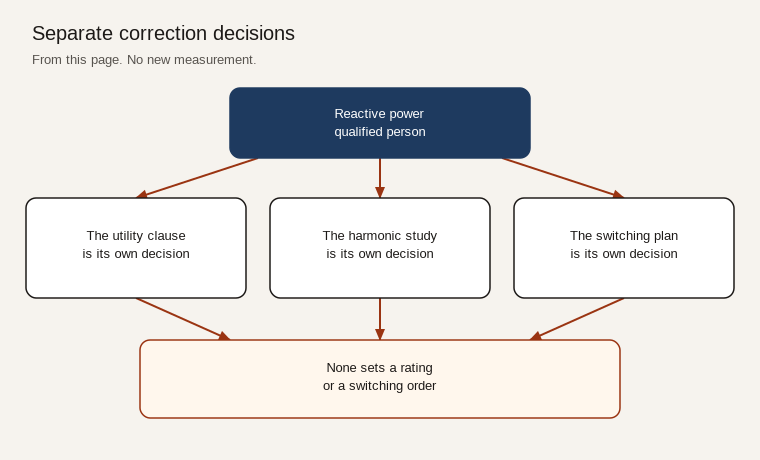
The utility clause, the harmonic study, and the switching plan answer different questions, and none of them sets a capacitor rating or a switching order, so a qualified person assesses the actual site.
Real power, reactive power, and the ratio
The U.S. Energy Information Administration defines power factor as the ratio of real power, in kilowatts, to apparent power, in kilovolt-amperes, for a given load and time. Apparent power is the product of voltage and current and includes both active and reactive power. Real power performs work. Reactive power establishes and sustains the electric and magnetic fields of alternating-current equipment such as motors and transformers. Generators, synchronous condensers, or capacitors can supply it, and it directly influences voltage.
In a sinusoidal system, the Department of Energy motor-systems guidebook, revision 2 of March 2000, also treats that ratio as the cosine of the phase angle between voltage and current. Inductive current lags. Capacitive current leads. A tariff can treat those signs differently. Drives and rectifiers draw current in pulses, so the ratio is no longer only that angle. Shunt capacitors offset fundamental reactive power. They do not remove harmonic current, and a low reading is not yet a bill line.
What correction changes on the conductors
The guidebook describes power capacitors as sources of leading reactive current that counter lagging current from inductive equipment. Current supplied locally is current the utility does not have to deliver, and the associated loss falls only upstream of the capacitors. A bank at the service can unload the utility delivery and the main transformer while plant feeders still carry reactive current. Capacitors nearer the motors unload more of the building wiring. Neither placement removes the real power the process converts into work.
Synchronous machines and static compensators can also supply reactive power. A shunt capacitor is passive: its output follows voltage, and connecting it changes the network at other frequencies. The guidebook says induction-motor reactive power stays nearly constant while real power rises with load, so a lightly loaded motor draws more reactive current for the work it delivers. A full-production snapshot can hide a light-shift problem, and any bill effect still depends on the rate. That is three decisions: the utility clause, the harmonic study, and the switching plan.
A utility adjustment is its own decision
No national rule sets a commercial power-factor charge. As of November 22, 2026, the mechanism, if there is one, is in the serving schedule. Two posted tariffs show how far apart those mechanisms are. Neither is an equipment design.
Pepco’s Maryland electric tariff, in the current Maryland filing whose cover records a distribution and revenue-deferral update effective November 1, 2026, still contains Rider PF on Third Revised Page No. 35. That page was issued May 2, 2007, and effective June 1, 2007. The cover does not describe it as changed in the November 2026 update. Confirm it has not been superseded before relying on it.
Rider PF applies to Schedules GS, GT LV, GT 3A, GT 3B, MGT LV II, MGT LV III, MGT 3A II, and MGT 3A III if Pepco finds a leading power factor or a lagging power factor of less than 85 percent. If equipment satisfactory to the company is not installed within 90 days of notification, the kilowatt charges on the listed GT and MGT schedules, or the kilowatt-hour charges on Schedule GS, are multiplied by 1.1111. Leading power factor counts. The multiplier hits those specified charges, not every line, and it states no capacitor rating.
Schedule TM-RT covers rapid-transit delivery and certain station chiller plants. Rider PF does not list it, so it is not the rule for an ordinary commercial building. Twenty-Ninth Revised Page No. 12 was issued November 4, 2026, effective for usage on and after November 1, 2026. The reactive-demand sentence is on Twenty-Seventh Revised Page No. 12.1, issued August 6, 2024, and effective for usage on and after July 29, 2024. Billing reactive demand is the maximum 30-minute coincident reactive demand minus the reactive power for an 85 percent power factor, with a charge for the excess. Read that posted charge on the page.
Virginia Electric and Power Company Schedule GS-1, Small General Service, in the filed Virginia tariff, was filed December 9, 2025, and is effective for usage on and after January 1, 2026. Paragraph IV.E says that when the customer’s power factor is less than 85 percent, a minimum demand of not less than 85 percent of the customer’s maximum kilovolt-ampere demand may be established. The word is “may.” This is a floor under billed demand on a schedule whose opening section limits who is on it. It is not Pepco’s multiplier. Dominion’s intermediate and large schedules were not read for this clause.
Soleil’s guide to demand charges explains how Pepco, Baltimore Gas and Electric, and Dominion set billed kilowatt demand on the schedules that guide covers. A power-factor adjustment can sit beside that demand charge or be absent while it remains. Baltimore Gas and Electric’s power-factor language, and Pepco’s District of Columbia rider, were not the pages read above. Do not copy the Maryland multiplier or the GS-1 floor onto them. The schedule reading can justify a study. It cannot set capacitance, detuning, or a control sequence.
A harmonic study is not that decision
The DOE guidebook identifies adjustable-speed drives as a significant source of fifth-harmonic and seventh-harmonic current, and it treats resonance near the third, fifth, seventh, eleventh, and thirteenth as the usual trouble spots. It says the extra heat can fail capacitors or transformers. Inductive reactance rises with frequency and capacitive reactance falls, so where they cross the network can amplify a nearby harmonic. The chapter ties that point to short-circuit strength and capacitor reactive power. This page does not give the estimate. A qualified engineer runs it from the one-line. A plant full of drives can improve the fundamental power factor and worsen harmonic voltage at the same time. The guidebook says to consult the capacitor supplier or a specialist. A billing target is not permission to connect a bank.
IEEE 519-2022, published August 5, 2022, sets steady-state goals at the point of common coupling, the interface between sources and loads, and notes that transients may exceed them. It is not a capacitor-application procedure. The numeric tables were not read here, so no distortion percentage is repeated.
IEEE’s May 2005 interpretation of IEEE Std 18-2002 separates the documents for that older edition. IEEE 18 is the unit standard, IEEE 1036 is the bank application guide, IEEE 1531 addresses filter components, protection, and control, and the interpretation points to IEEE C37.99 for shunt-bank protection. It says the continuous contingency capability discussed there was not the normal design voltage. No ratings from it are repeated. IEEE 18-2002 has been superseded, and the full text of the edition in force was not read. The DOE discussion notes that capacitors supplied with harmonic filters cost more than plain capacitors and are typically associated with larger installations. Plain steps, a detuned bank, a passive filter, and an active filter are different products. The harmonic study, not the tariff, decides which is acceptable.
A switching plan is a third decision
A fixed bank sized for the billing peak can be too large when production stops, and the meter can then show a leading power factor. On Pepco Maryland Rider PF, that leading result is itself a trigger.
The DOE guidebook distinguishes capacitors that stay energized from capacitors switched with motors: a fixed base, steps on larger motors, or an automatic controller for many small motors. Those are patterns, not a specification. This article does not give a rating, a step size, or a switching order. Each closed step adds capacitance, so the resonant frequency moves, and a study of the all-on bank does not describe one step. The same chapter notes that poor power factor increases voltage drop, that capacitors can move voltage back toward design conditions, and that excess capacitance can raise voltage when the load falls. No numeric voltage limit is stated here. The switching plan also does not say whether the tariff uses a multiplier, a kilovolt-ampere floor, or an excess-reactive charge.
Why the three answers cannot stand in for each other
| Decision | What it can settle | What it leaves open |
|---|---|---|
| Utility clause | Which schedule applies, what changes, and whether leading reactive power counts | Whether capacitance is acceptable, and how it is stepped |
| Harmonic study | Whether proposed capacitance amplifies harmonics or overloads equipment | The bill, and the day-to-day control sequence |
| Switching plan | Which steps are on at which load, including a failed step | The tariff, until the resulting power factor is checked against it |
An all-on harmonic model is not a switched bank. A controller that ignores the tariff can create a leading power factor the rider treats as a problem.
Illustrative example, not a Soleil project and not a design. A warehouse runs many induction motors in the afternoon and few at night, with drives on the conveyors. A vendor offers a fixed bank from the lagging afternoon, left closed all night. On a Pepco Maryland schedule in Rider PF, that leading night reading can matter as much as the afternoon, and the rider calls for equipment satisfactory to the company. On Dominion GS-1, the clause read here is only a possible kilovolt-ampere demand floor, and only under 85 percent. Another Dominion schedule was not read. The harmonic study has to include the all-night state if the bank cannot open. A qualified professional must assess the actual site.
What a study has to be given
Start from records, not from a target ratio.
| Input | Why it is required |
|---|---|
| Schedule, riders, and a recent bill | Shows the quantity the utility adjusts |
| One-line and transformer data | Sets the impedance a harmonic study needs |
| Interval data, including any reactive channel | Shows a peak-hour problem, a light shift, or both |
| Drives and other nonlinear loads | Shows where harmonic current comes from |
| Existing capacitors, filters, and controls | Avoids studying equipment that is gone |
| Space, voltage, and the outage window | Bounds what can be installed and when |
| Any utility notice and its date | Shows whether a clock has already started |
Keep the output separable: what the schedule does, whether plain capacitors are acceptable, and which switching states are allowed. NFPA 70, the National Electrical Code, is identified by NFPA as of November 22, 2026, as the 2026 edition, enforced through adoption. The capacitor rules in the adopted edition were not read for this page. Nothing here is a compliance finding. The authority having jurisdiction applies the edition that covers the address.
Generation at the same meter is a different interface
IEEE 1547-2018, published April 6, 2018, covers interconnection of distributed energy resources, including power quality, at typical distribution voltages. It is not a specification for a load capacitor bank. An inverter setting can change reactive power at the meter and can oppose capacitors left on line. It replaces neither a harmonic study nor the utility’s interconnection review. Soleil’s commercial solar interconnection guide treats utility permission, building permits, and wholesale participation as separate decisions. New generation or storage also changes the load a bank was matched to.
Stored energy is a limit, not a procedure
Capacitors store energy after disconnection. OSHA’s general-industry rule, 29 CFR 1910.333, requires release of stored electric energy that might endanger personnel before work on or near exposed de-energized parts. Capacitors shall be discharged, and high-capacitance elements short-circuited and grounded, if that energy might endanger personnel. If they are handled while meeting the requirement, they shall be treated as energized. This article does not turn that duty into steps. The employer sets the procedure.
29 CFR 1910.269 covers operation and maintenance of generation, control, transformation, transmission, and distribution, including equivalent industrial installations. Paragraph (a)(1)(ii)(B), as displayed on November 22, 2026, says it does not apply to electrical installations or work practices covered by Subpart S, where 1910.333 sits. A utilization capacitor and a utility bank are not automatically the same rule. Which section applies is for the employer and a qualified person. Nothing here is a finding that a site is safe to work.
Questions that change the project
Does correction cut the energy the process uses?
It can reduce loss upstream of the capacitors. It does not remove the real power the loads convert into work. Whether the bill moves is a rate-structure question, which is how the DOE guidebook treats it.
Does a stated 85 percent become the capacitor rating?
No. As of November 22, 2026, 85 percent is a billing test on Pepco Rider PF, Schedule TM-RT, and Dominion GS-1. None of those sentences is a capacitor rating or a step count.
Can the harmonic study wait because the tariff never mentions harmonics?
No. The clause bills. It does not measure resonance. Drives can inject fifth-harmonic and seventh-harmonic current either way, and the DOE chapter says to examine that when capacitors are added.
Why does light load belong in the switching plan?
Motor reactive power does not fall in proportion to shaft load, and a fixed capacitor does not unload with the motor. Pepco Rider PF includes a leading result, and each closed step moves the resonant frequency.
Does an inverter setting replace the bank?
No. IEEE 1547-2018 governs interconnection of generation and storage, not a load capacitor bank. Soleil’s commercial interconnection guide keeps that review separate from sizing or switching capacitors.
What does correction change about scope, cost, or approval?
It can add a tariff reading, a harmonic study, a switching sequence, stored-energy duties, an outage, and a utility notice with its own clock. Those items drive equipment and cost. The utility, the authority having jurisdiction, and a qualified professional still decide separately.
A scope discussion starts from the one-line
Soleil Energy’s power practice includes feasibility studies, distribution equipment, and commissioning from generation through the point of use. A useful next step is a scope review that starts from the current one-line, the serving schedule, and the measurements already in hand, and that states which of the three decisions are included. That conversation does not establish that capacitors are appropriate, does not replace the utility’s tariff, and does not take the place of a qualified professional’s assessment of the actual site.
Project requirements depend on the site, equipment and applicable rules. Confirm design and installation decisions with the appropriate qualified professional.