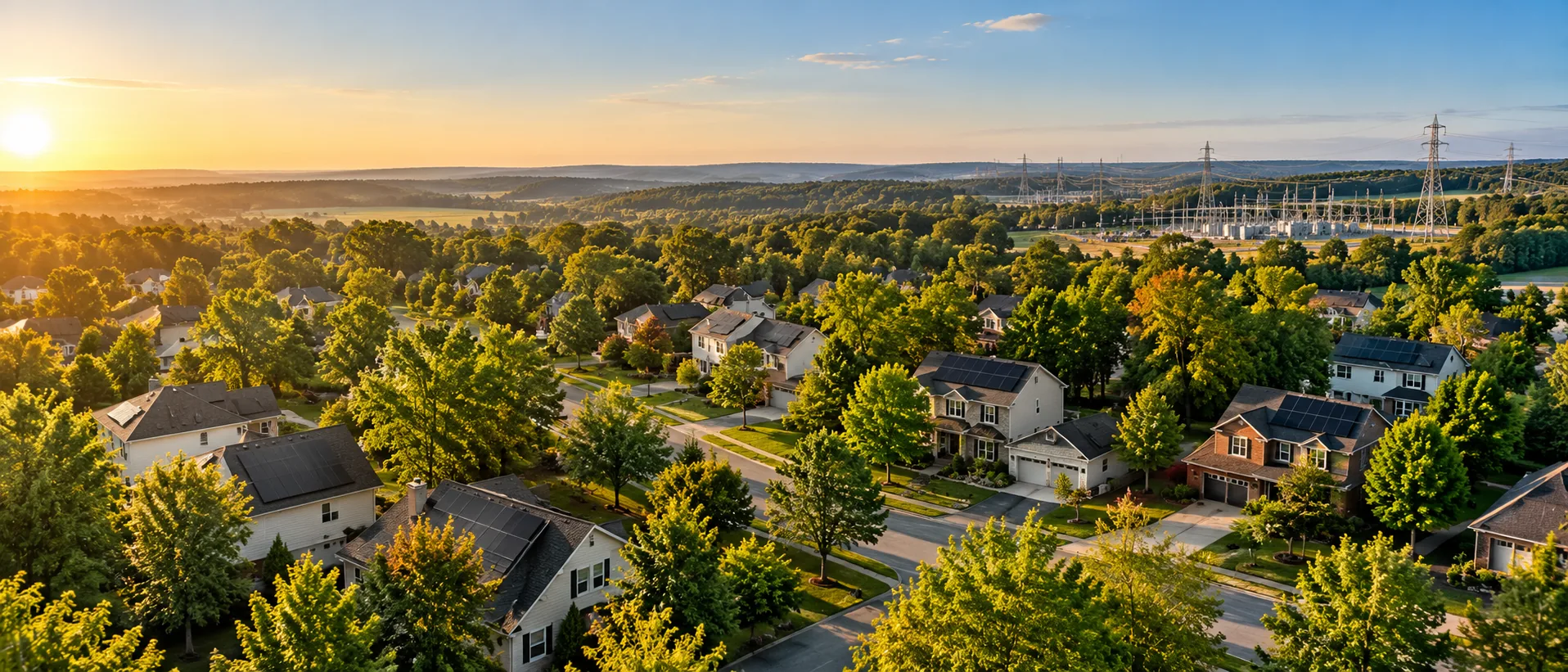
Underground power distribution is the portion of an electric distribution system in which conductors and associated equipment are installed below grade rather than on poles. It moves power from a source, such as a substation or riser, toward loads through direct-buried cable, conduit, or a duct bank, with access at vaults or pad-mounted equipment. The choice affects routing, ownership, and how crews reach a fault. It is not premises wiring on the load side of the service point.
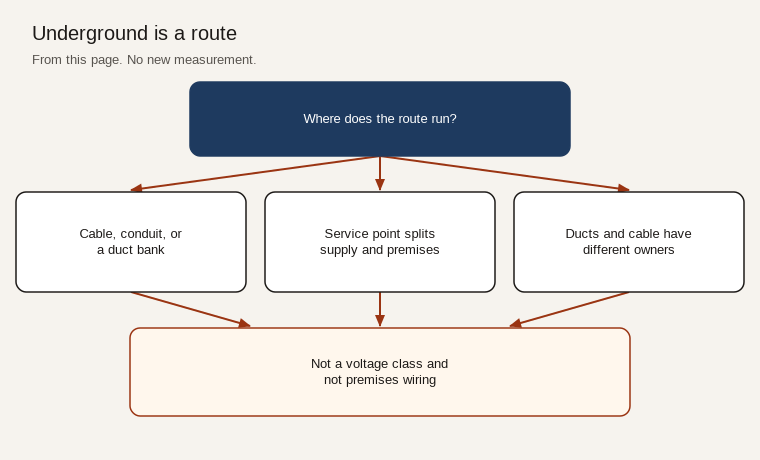
Treat underground distribution as a below-grade route from a source toward loads, then separate the service-point ownership boundary, the civil structure, and the cable before anyone treats burial as a voltage class.
Underground describes the route, not a voltage class
A circuit can be overhead, underground, or both. Underground names the construction, not a voltage. OSHA’s electric-power eTool, read as of November 2026, says 29 CFR 1910.269 does not itself separate transmission from distribution, then gives typical ranges. Transmission is typically from 69 kV up to 765 kV. Distribution is typically from 4 kV to 46 kV, and it includes secondary systems under 1,000 volts. Those ranges are not a feeder’s assigned voltage. The utility or circuit owner sets that value. A qualified professional must use it on the site.
The eTool treats substations as both transmission and distribution facilities under 1910.269. A getaway and a pad-mounted lateral can both be buried and still differ. NERC’s September 2025 overview describes high-voltage transmission and lower-voltage distribution, with transformers stepping voltage up for transport and down at substations. Generation, transmission, and their controls are the bulk power system there, and the mileage it cites is for lines greater than 100 kilovolts. That is not a burial rule. Name the source, the load, and the owner. A plant collector, a utility primary, a campus loop, and a building lateral remain different projects.
The service point is an ownership boundary
IEEE’s NESC Rule 011 scope sheet says the National Electrical Safety Code covers utility supply and communication facilities, including distribution under the exclusive control of utilities or their authorized representatives. Line-side underground or overhead facilities are in scope on an easement, right-of-way, contract, conditions of service, or other authorization. Premises wiring beyond the service point is not. The sheet shows the line side under the NESC and the load side under the National Electrical Code, issued by the National Fire Protection Association. The serving utility usually sets the service point.
It can also cover similar systems that qualified persons control exclusively, when a regulating body authorizes them, including an industrial complex or a utility-interactive system. It does not cover systems on the premises-wiring side. A customer-owned campus primary can therefore differ from a utility lateral. As of November 2026, confirm the adopted editions and the written service point. The sheet explains Rule 011. It is not adopted code text, and this page applies neither code. A qualified professional must. A purchase order that skips the split drops ducts or cable from both bids.
OSHA 1910.269 covers operation and maintenance of generation, transmission, and distribution lines and equipment, including utility systems and equivalent industrial installations limited to qualified employees. It does not apply to construction work as defined in 29 CFR 1910.12, except stated tree-trimming and generation cases, or where Subpart S covers the installation. New work and later maintenance can sit under different OSHA parts. The employer classifies the task. This article does not.
Direct burial, a duct bank, and a vault are different assets
Direct-buried cable goes in the earth under the adopted standard and the utility specification. Replacement usually means opening the route. The September 2024 Department of Energy guide, from Lawrence Berkeley National Laboratory, names trenching and tunneling as common techniques and says heat and moisture can degrade insulation. It gives no depth or ampacity to copy, and neither does this page.
A duct bank is a civil structure installed before the cable and reused only if bends, pulling points, and spare cells allow another pull. A full bank, or a bend the cable cannot pass, makes the next circuit another excavation. Fill and pulling limits belong in the design.
Vaults, manholes, handholes, and pads hold splices, switches, separable connectors, or transformers. OSHA’s enclosed-space eTool addresses manholes and vaults with operating transmission and distribution equipment. If workers are qualified, the work is routine, and the hazards are only electrical, it points to 1910.269(e) and 1910.269(t). Otherwise it points to permit-required confined spaces in 1910.146. An attendant trained in first aid and rescue stays above the opening when those rules apply. This page gives no entry steps. A qualified person must assess the space. The eTool requires identification of a cable being worked unless its identity is obvious. OSHA’s energized-work page lists underground splicing as deenergized work. Opening a switch alone does not establish that condition.
Burial changes which outages occur, not whether outages occur
The September 2024 DOE guide treats underground lines as less exposed to weather and wildfire, including vegetation, animals, vehicles, lightning, and ice, and as lowering the risk from fallen overhead lines. Failure rates are lower than overhead, but repairs generally take longer because the cable and the fault are harder to reach, especially without monitoring. Heat, moisture, flooding, dig-ins, and earthquakes in some regions remain. Wet ground can block the work. An urban lateral, a rural tap, a floodplain, a wildfire program, and an ordinance are different reasons to bury a line. Ask which hazard is reduced and which repair delay is accepted. A qualified professional compares them on this route.
Civil scope and electrical scope often have different owners
Poles are visible. Ducts, easements, and cable are not, and they are often bought separately.
| Decision | What to write down |
|---|---|
| Route | Who selects it, what it crosses, and where pavement or buildings block access |
| Civil structure | Who designs ducts, encasement, vaults, and pads, and who restores the surface |
| Cable | Who supplies, pulls, splices, and terminates it, and to which specification |
| Equipment | Who owns transformers, switches, and connectors, and who may enter them |
| Land rights | Easement, license, or conditions of service, and whether replacement is included |
| Spare ducts | Whether empty cells are required, by whom, and for which future circuit |
| Outage and records | Which circuits must stay in service, and who keeps a locator-ready as-built |
The IEEE sheet notes that a property agreement may be required where an easement is unavailable, including some railroad or other controlled lands. If grade closes before that right is signed, the bank may sit where no one will pull cable.
Soleil Energy’s construction page covers civil, structural, and electrical building work. It is not a utility underground standard. The power page covers overhead and underground distribution, including pad-mounted transformers. The scopes meet when a building and a feeder share a corridor. They are not one contract, and neither page is a permit.
An illustrative campus route
Consider an illustrative campus, not a Soleil Energy project and not a design. The utility point of delivery is near the property line, and a primary route must reach pad-mounted transformers at separate buildings.
In one deal the developer builds the duct bank and vaults, and the utility owns the cable and transformers. The risk is whether the utility accepts the alignment and the clashes with other lines. Empty cells, if required, are a civil deliverable that carries nothing at opening.
In the other, the customer owns cable and transformers past a written service point, and therefore owns splice records and fault response. “Underground to the buildings” fits both deals and specifies neither. Ownership can change the later safety standard, because exclusive control is part of the boundaries above. The sketch states no depth, size, or ampacity. Those follow the circuit, the heat around it, and the adopted specification. A qualified professional uses the documents that apply to the real alignment.
Notice rules are not the same in Maryland, Virginia, and the District
As of November 2026 the statutes differ. This is not a digging procedure. Marking distances and exposure methods stay in the code. Follow that text and the one-call instructions. A qualified professional must assess the site.
Maryland § 12-101 treats buried electric conduits, cables, wires, and manholes as underground facilities, and excludes a storm drain. An owner operates the facility and has the right to bury it. Section 12-124 requires a one-call ticket before excavation or demolition. The start date is not sooner than three business days after the ticket, nor later than twelve. A business day excludes Saturday, Sunday, and legal holidays. The ticket then lasts twelve business days, and the described work may not exceed 1,320 feet. Only owner-members are notified, so an unregistered private circuit may be unmarked.
Virginia § 56-265.15 includes public or private property buried to convey electric energy. Section 56-265.17 requires a locate request first and notifies member operators. Except for emergencies and the unmarked-line case in that section, work waits for a positive response. Notice lasts fifteen working days, excluding Saturdays, Sundays, and state and national legal holidays, and each request may not exceed one-third of a mile. Unregistered cable stays unmarked.
D.C. Code § 34-2704 requires one-call notice before excavation in public space or on private property. Section 34-2709 excepts imminent danger to life, health, or property if operators are told directly. The ordinary window is at least 96 hours and no more than ten days ahead, excluding Saturdays, Sundays, and legal holidays. One notice is capped at 1,320 feet and lasts fifteen such days. The District of Columbia Public Service Commission calls 811 a free, FCC-designated national number that reaches Miss Utility in the District, and also says to call at least two working days ahead. That consumer line does not replace the statute. Maryland counts harm to a coating or housing as damage, and Virginia counts impact that the operator’s practice would repair, so a nicked jacket can matter while the lights stay on.
What still has to be known after backfill
Keep an as-built alignment, duct and cable identifiers, splice locations, and the name of whoever must update them. A sheet marked not for construction will not find a fault.
IEEE 400-2023, published 17 November 2023 and read as of November 2026, guides field testing of shielded power cable systems rated 5 kV and above. The listing compares methods and points to narrower companion documents. It is not a procedure and not a ruling that a campus must use one test. Name the method, edition, sections, and acceptance criteria if a test is required. The title does not cover every building cable. Fault indicators help only when installed, and the operator decides vault access. This page sets no interval.
An interconnection order does not design the duct bank
FERC’s Order No. 2023 explainer describes how transmission providers study requests to connect generating facilities. The page notes that Order No. 2023-A later revised parts of the rule, and it says the explainer is not a legal document. Cluster studies and readiness showings are study reforms. They do not choose a duct, a cable, or a burial condition. As of November 2026, the binding text is the provider’s tariff after the Commission acts on the compliance filing, not the explainer’s original dates.
A project may still need a getaway on its side of the point of interconnection, with its own easements and one-call duties. The study does not accept those ducts. NERC’s September 2025 overview covers bulk-power adequacy and operating reliability, not a state distribution rule or a utility manual. Check any claim that feeder protection is a bulk-system duty against the current standard and the facility’s status. Burial neither creates that duty nor waives the manual.
Settle the route before it is covered
Treat this as a checklist, not a specification. It assigns no depth, separation, or cable rating.
- The nominal voltage, and the document that assigns it.
- The written service point, and who owns ducts, cable, and transformers.
- The adopted standard and edition, and where the NESC, the NEC, or both apply.
- Crossings of other buried lines, and which one-call statute matches the parcel.
- Vaults, spare ducts, and pulling geometry the cable owner will accept.
- Circuits that stay in service, any named test, and who updates the as-built.
- Water, heat, and surface loading for this alignment. Depth and ampacity are engineered for the site, not taken from this article.
A qualified professional must assess the actual site before any item is treated as closed. This page is not a utility letter or a permit.
Questions that change the scope
Does undergrounding remove weather outages?
It reduces overhead exposures named in the September 2024 DOE guide. It does not end outages. That guide says underground faults generally take longer to locate, and flooding, heat, and dig-ins remain. Ask which causes are being reduced and how a cable fault will be found.
Who owns a spare duct?
The duct, the cable, and an empty cell are separate. An unaccepted spare is only concrete. Write who may use it, and who keeps the occupancy log, before comparing bids. A bend the bank cannot make means a new excavation.
Will one call show private campus cable?
Not by itself. Each statute notifies members. Virginia includes private electric lines in the definition, yet the request reaches notification-center members. Use the owner’s records with the ticket. Paint is not a survey of every other line, and a planning request is not permission to excavate.
Do FERC or NERC rules set depth or cable rating?
No. The Order No. 2023 explainer reforms interconnection studies. NERC’s September 2025 overview addresses bulk-power reliability. Depth, separation, and ampacity come from the adopted code, the owner’s specification, and conditions on the route. Those figures are not here. A qualified professional must set them for the soil and the load on this route.
When is the alignment too late to change?
It is late once pavement or other utilities close the corridor, or once unaccepted ducts are already built. Freeze the line while grade can still move and the service point, crossings, vaults, and land right are agreed. The illustrative campus fails if the cable owner rejects the alignment or a vault blocks fire access. That is a planning check, not a digging step.
Bring the boundary to a scope discussion
The usual gap is civil work versus cable, or a one-line with no route anyone can maintain. Soleil Energy’s power work includes overhead and underground distribution and pad-mounted transformers. A feeder or duct-bank interface can be discussed against the known limits and the outage window.
Start from Soleil Energy’s power page. Bring the assigned voltage, the written service point, the land-right limits, and whether the alignment can still move. Building work on the same site is a separate construction-scope discussion. It does not replace the utility standard. Neither talk approves a route, sets an ampacity, or replaces the qualified professional who must assess the actual site.
Project requirements depend on the site, equipment and applicable rules. Confirm design and installation decisions with the appropriate qualified professional.