
Power transformer vs distribution transformer asks which job a transformer does and which published rule covers it. The comparison is not settled by one capacity number. Power-transformer product standards, distribution-transformer product standards, and the US efficiency rule each describe different equipment, and a unit can meet one description without meeting the others. As of November 2026, those texts overlap. A name on a proposal is not a design. A qualified professional must assess the actual site.
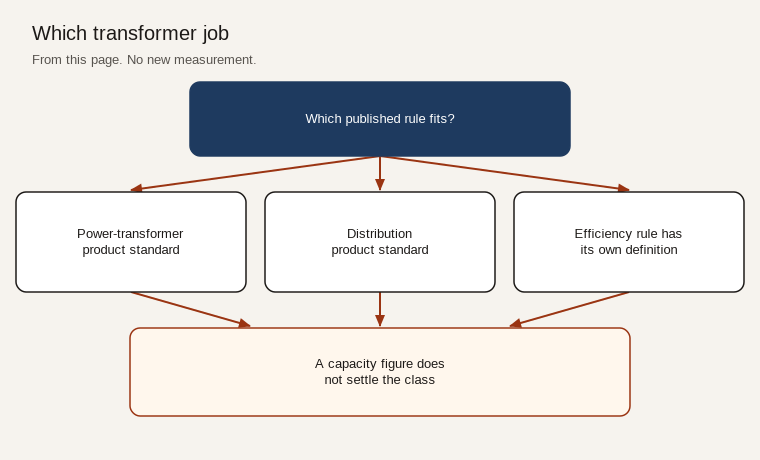
Identify the circuit on each side and the document written for that job, because a power-transformer standard, a distribution-transformer standard, and the federal efficiency rule can describe different equipment.
Start with the circuit, not the nameplate size
A transformer changes alternating-current voltage between two parts of a system. The classification depends on the circuit on each side and on the document written for that job.
The Occupational Safety and Health Administration’s illustrated glossary separates substation roles. A step-up transmission substation uses a large power transformer to raise generation voltage for transmission. A step-down transmission substation can supply subtransmission or distribution lines. A distribution substation sits nearer the end user and lowers voltage for industrial, commercial, and residential service. OSHA’s substation glossary also says some substations are little more than a transformer and switches, while others contain several transformers.
OSHA gives typical distribution voltages from 34,500Y/19,920 volts to 4,160Y/2,400 volts, plus examples of higher transmission voltages. Treat them as that glossary’s examples, not as a national definition of voltage class and not as a capacity limit. The same page lists power transformers as substation equipment and, separately, describes distribution-substation transformers. A location inside a substation does not select the product standard.
IEEE C57.12.80-2024 is the active terminology standard for power and distribution transformers. Its public abstract says the document compiles terminology. That abstract does not state a capacity dividing line. This page does not invent one, and it does not treat an unread glossary entry as a specification rule.
Each product standard covers a slice of equipment
As of November 2026, the IEEE pages below were the active editions noted. A specification should name the edition it requires. A short abstract is not the full standard. None of these scopes assigns a class, a capacity, or a cooling method to a site.
| Public scope read for this page | What that scope describes | Boundary that is easy to misuse |
|---|---|---|
| IEEE C57.12.00-2026 | Liquid-immersed distribution, power, and regulating transformers, with 601 V or higher in the highest-voltage winding | It covers both names. It is not a capacity split. |
| IEEE C57.12.10-2017 | Liquid-immersed power transformers and autotransformers, base-rated 833 kVA and above single-phase and 750 kVA and above three-phase | That floor belongs to this product standard only. |
| IEEE C57.12.20-2023 | Overhead, liquid-immersed, self-cooled distribution transformers, 500 kVA and smaller | That ceiling is for this overhead product, not for every distribution transformer. |
| IEEE C57.12.34-2022 | Pad-mounted, compartmental, self-cooled distribution transformers, 10 MVA and smaller | A distribution product standard can sit well above the overhead ceiling. |
| IEEE C57.12.36-2026 | Distribution substation transformers, set between the C57.12.10 and C57.12.34 products | “Substation transformer” is not a synonym for C57.12.10. |
The table maps public scopes. It is not a substitute for the purchased edition. IEEE C57.12.00-2026 is listed as active, superseding the 2021 edition, with board approval in November 2026, while the page title still says approved draft. Do not assume a utility specification has adopted that action. The scope excludes instrument transformers, certain regulators, furnace and rectifier transformers, grounding transformers, mobile transformers, and mine transformers. Mention in that document does not classify a regulator.
IEEE C57.12.10-2017 covers step-up or step-down service, including units with switchgear or a substation, at 50 Hz and 60 Hz. Its capacity floor is not a universal divider. An older title on the same page already separated some ratings with load tap changing from ratings without it, so tap equipment is specified rather than inferred. A revision project is listed. Confirm the edition.
IEEE C57.12.20-2023 limits that overhead product to high voltage 34,500 V and below and low voltage 7,970/13,800Y V and below. IEEE C57.12.34-2022 covers radial or loop-feed terminations and not the accessories shipped with the transformer. A revision draft exists. Until it is specified, the 2022 text is the published standard. Self-cooled is a limit of those two scopes, not a cooling assignment for a site.
A distribution substation product already occupies the overlap
IEEE C57.12.36-2026 defines the distribution substation transformer as the small power transformer applied as more than a limited version of the C57.12.10 power transformers and as more than a large distribution-class transformer under C57.12.34. IEEE publishes a product for that middle ground instead of forcing every unit into one of the other names.
The 2026 abstract does not restate a capacity band. The 2017 description on the same page gives a range from 112.5 kVA to 10,000 kVA, primary voltage at 69,000 V and below, and secondary voltage from 34,500 V to 120 V. Use that only as the 2017 description. A three-phase rating can sit above the C57.12.10 floor and inside the C57.12.34 ceiling, so a class name plus a capacity still does not identify the standard or the accessories.
The federal efficiency rule is a third boundary
Congress and the Department of Energy use “distribution transformer” for an energy-conservation program. That legal term is not the IEEE product map.
42 U.S.C. 6291(35), as presented by the Legal Information Institute and read on November 22, 2026, defines a distribution transformer by an input of 34.5 kilovolts or less, an output of 600 volts or less, and operation at 60 Hertz. That paragraph states no capacity range. It excludes a tap span whose highest tap is at least 20 percent above the lowest, plus listed special-purpose types such as autotransformers, regulators, grounding transformers, and rectifier transformers. The Secretary may exclude other special-application units by rule. The House code site did not return this section that day, so confirm the official code text before putting it in a contract.
As displayed on eCFR, current as of November 19, 2026, 10 CFR 431.192 keeps those voltage and frequency tests and adds a capacity of 10 kVA to 5000 kVA for liquid-immersed units and 15 kVA to 5000 kVA for dry-type units. It then excludes autotransformers, drive isolation transformers, grounding transformers, machine-tool transformers, nonventilated transformers, rectifier transformers, regulating transformers, sealed transformers, special-impedance transformers, testing transformers, transformers with a tap range of 20 percent or more, uninterruptible power supply transformers, and welding transformers. The same section separately defines liquid-immersed, low-voltage dry-type, and medium-voltage dry-type distribution transformers. Insulation medium is tracked inside the efficiency rule. It does not define power versus distribution.
DOE’s distribution-transformer page, last updated July 23, 2026, still summarized an older ceiling of 2500 kVA. That sentence does not match the capacity range in the eCFR text read for this article. For a purchase or a compliance statement, use the current CFR section.
10 CFR 431.196 sets minimum efficiency by category and manufacture date, including bands that end before April 23, 2029 and bands that begin on or after that date. DOE’s product page says the amended standards took effect July 8, 2024, with compliance required on and after April 23, 2029. An editorial note records that on September 9, 2025 DOE removed certain amendments effective December 23, 2024. Read the text in force for the manufacture date before relying on a 2029 table.
Notes in section 431.196 place the tabulated efficiency at 35 percent of nameplate-rated load for the low-voltage dry-type bands that were read, and at 50 percent of nameplate-rated load for the liquid-immersed and medium-voltage dry-type notes that were read. That fraction is not the building’s load. Section 431.192 defines no-load loss as excitation loss and load loss as the loss at a specified load. A result at one fraction of nameplate does not describe another load. The efficiency tables are not copied here.
A special-impedance unit, one outside the normal impedance range for its capacity, is excluded from the DOE term. The rendered range tables did not separate cleanly, so those numbers are not repeated. Impedance still must be specified because it affects voltage drop and fault current. The same section treats voltage and basic impulse insulation level as features that distinguish similar models.
Missing the DOE definition does not create a power transformer. An autotransformer, regulator, grounding transformer, rectifier transformer, or wide-tap unit can fall outside the DOE term and still be outside IEEE C57.12.10. Meeting the DOE definition does not make a unit an overhead, pad-mounted, or distribution-substation product.
What the duty changes in a project
Scope changes with the circuit, the owner, and the standard. A pole or pad at utilization voltage is a different outage and protection problem from a unit stepping transmission voltage or feeding several circuits. A utility-owned unit is not the same project as a customer vault or campus unit, and Maryland, Virginia, and the District of Columbia do not share one utility rulebook.
C57.12.10 supports limited interchangeability. It does not prove that two power transformers swap. Identify voltages, capacity, impedance, basic impulse insulation level, angular displacement, taps, cooling, insulating medium, terminations, size, and weight. If impedance may change, a qualified engineer revisits the short-circuit study. This page calculates no fault current and offers no settings. A fused overhead unit and a relayed substation unit are specified from the installation, not from the class name.
NFPA 70, the National Electrical Code, is identified by NFPA as active, with the 2026 edition current on the page read for this article. NFPA states that the Code is enforced in all 50 states, and the page describes a reorganization running toward the 2029 edition. Publication is not local adoption. No clearance or vault rule is restated here. A qualified professional applies the adopted code.
Generation does not reclassify the transformer. IEEE 1547-2018 covers interconnection of distributed energy resources at typical primary or secondary distribution voltages. Its public scope does not define power or distribution transformers. An interconnection review and a transformer specification can both be required. Confirm whether the project uses the base standard, amendment 1547a-2020, or a successor.
Liquid-filled and dry-type construction is a different decision
IEEE C57.12.01-2020 covers dry-type distribution and power transformers, ventilated, non-ventilated, and sealed, at 601 V or higher in the highest-voltage winding. The liquid-immersed general standard also covers both classes. The efficiency rule defines liquid-immersed, low-voltage dry-type, and medium-voltage dry-type distribution transformers and excludes some nonventilated and sealed units. Fire separation, containment, location, and altitude stay site questions. Do not choose the medium from this comparison.
Two illustrative inquiries, and no selected class
This comparison is illustrative. It is not a Soleil Energy project, and it assigns no capacity, product standard, or cooling method.
A commercial building steps from a primary distribution circuit to utilization voltage. The useful file names both voltages, the owner, whether the DOE tests are met, and whether a wide tap range, special impedance, or a special-purpose duty takes the unit outside that definition. It also needs the pad, vault, or pole limit and the short-circuit rating of the secondary equipment. Serving a building does not prove which distribution standard applies.
A yard transformer that steps between higher-voltage circuits, or that steps up from generation, is a different job under OSHA’s step-up and distribution-substation descriptions. Name the circuit position, the candidate product standard, taps, cooling, transport, containment, and the outage window. A capacity inside the DOE range does not make that unit a pad-mounted distribution product.
An illustrative reading of the test point: the liquid-immersed regulatory note uses half of nameplate load. That is not the building’s demand. No-load loss is present whenever the unit is energized, and load loss changes with loading. If expected loading is far from the regulatory fraction, compare bids at that loading as well as against the required efficiency statement. The comparison still does not pick a class.
Ask these questions before the class is named
| Inquiry | Why it changes the scope |
|---|---|
| Circuit position | Separates step-up, transmission, subtransmission, primary distribution, and final service. |
| Owner and outage window | Separates utility equipment from customer equipment. |
| Voltages, insulation level, frequency | Feeds the product standard and the DOE tests. |
| Capacity and impedance | Capacity overlaps the standards. Impedance affects faults and a possible exclusion. |
| Taps, medium, cooling, terminations | Keeps tap range, liquid versus dry, and hardware as separate decisions. |
| Code, utility rule, generation | Those reviews do not follow from the class name. |
A qualified professional has to judge the actual site. This article does not.
Bring the one-line to a scope discussion
When the open questions are equipment duty, replacement limits, and the interface with existing equipment or a utility circuit, Soleil Energy’s power practice is the relevant conversation. The published work includes substations, transformer services, distribution, studies, and commissioning. Bring the voltage class, the ownership boundary, the nameplate or one-line, the physical limits, and the outage window. Soleil Energy can help define that scope. Nothing here assigns a class or a cooling method, and installation follows the company’s published service area.
Questions that change the specification
Does capacity decide the class?
No. The power-transformer standard read here has a base-rating floor, the overhead distribution standard has a much lower ceiling, and the pad-mounted distribution standard extends far above that overhead ceiling. The DOE range is an efficiency boundary, and DOE’s own summary page still showed an older range. One capacity can fit more than one description.
Is every substation transformer a power transformer?
No. OSHA separates step-up substations, which use a large power transformer, from distribution substations that supply lower voltages near end users. IEEE C57.12.36 exists so the distribution-substation unit is not collapsed into either C57.12.10 or the pad-mounted standard. Location is a clue. The product standard still has to be named.
If the DOE definition misses, is the unit a power transformer?
No. Grounding transformers, regulators, autotransformers, rectifier transformers, wide-tap units, and special-impedance units can miss the DOE term without being transmission equipment. They still need their own standard and study. They do not inherit C57.12.10 by elimination.
Does this comparison choose liquid-filled or dry-type equipment?
No. The liquid-immersed and dry-type general standards each cover both distribution and power transformers. The efficiency rule then splits liquid-immersed, low-voltage dry-type, and medium-voltage dry-type units and excludes some sealed and nonventilated constructions. Fire separation and containment stay site decisions.
What belongs in a replacement specification?
Name voltages, insulation level, capacity, impedance, angular displacement, taps, cooling, insulating medium, terminations, dimensions, weight, and the test standard. A class name plus a capacity does not describe the installed unit or prove the replacement will match the remaining equipment.
What does the choice change about approval?
It identifies which product standard, efficiency rule, utility standard, and adopted code to check. It can change tests, transport, containment, protection, and the outage. It does not obtain acceptance. Added generation can also bring in the IEEE 1547 scope without settling the transformer class.
Project requirements depend on the site, equipment and applicable rules. Confirm design and installation decisions with the appropriate qualified professional.