
A solar procurement RFP is the buyer’s written request that sellers price a photovoltaic project against one scope, one list of exclusions, and one method of comparison. It states whether design, equipment, interconnection, roof work, and storage are inside the price or expressly left out. A finance lead or a public procurement officer needs that boundary before ranking offers. A contractor quote and a power-purchase term sheet can both mention solar, and they still answer different commercial questions.
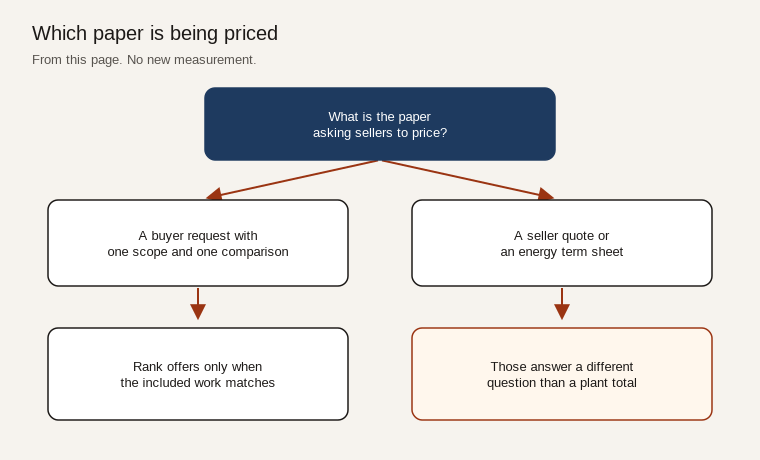
A buyer request, a seller quote, and an energy term sheet price different commercial questions, so printed totals rank together only when the included work and the comparison method are the same.
What the request asks bidders to price
The solicitation is a priced boundary. The U.S. Environmental Protection Agency, on a page updated July 10, 2026, describes a request for proposals as a formal request for a project proposal, and a solar version as the photovoltaic product or service, the contract terms, and the bidding process. A private owner is often outside that public-agency practice. The comparison problem is the same: totals match only when the work matches.
For federal negotiated acquisitions, FAR 15.203, under FAC Number 2026-01 effective March 13, 2026, says a competitive request must describe the requirement, the anticipated terms, the information required in the proposal, and the evaluation factors and significant subfactors, with their relative importance. The Department of Energy’s Federal Energy Management Program, on a procurement-phase page last updated October 13, 2026, adds the cost consequence: if a task is not in the scope, offerors may not include its cost.
Mark each interface included, excluded, or separately allowed: engineering, major equipment, utility work, roof and structure, storage, permits, taxes, monitoring, and early maintenance. List the records bidders may use, such as bills, a roof report, one-line information, and site-access rules.
How an RFP differs from a quote
A quote is a seller’s price, often for a scope the seller chose. An RFP is the buyer’s instrument. It sets the instructions, the technical boundary, and the comparison method before prices arrive.
FAR 13.004, under the same March 13, 2026 FAC, says a federal quotation is not an offer. The government’s order is the offer. That rule is simplified acquisition, not a rule that every private “quote” is nonbinding. State contract law decides whether a seller’s paper is an offer. Counsel reads it.
A short quote often skips evaluation factors, an exceptions list, and a shared capacity definition. One seller prices a plant. Another prices delivery only. A commercial owner can borrow FAR 15.203’s discipline without federal clauses. Soleil Energy’s Maryland commercial cost guide organizes cost discussions. A heading there does not prove a quote included the work.
When a covered Maryland unit uses competitive sealed proposals, State Finance and Procurement section 13-104, as displayed by the General Assembly on November 22, 2026, requires the request to state scope, factors including price, and each factor’s relative importance. Award follows the most advantageous proposal under those factors, not an automatic low total. The preferred-method language names service categories. It does not force that method onto every solar construction contract, and it does not govern private firms, counties, Virginia, or the District. As of November 2026, confirm the enrolled text before relying on this summary.
How an RFP differs from a power-purchase term sheet
A power-purchase term sheet sketches a purchase of electricity, and sometimes the attributes that travel with it. It is not a construction estimate. EPA’s solar power-purchase page, updated April 9, 2026, describes a developer that owns, operates, and maintains the system and a host that buys the output for a predetermined period. The host buys the service, not the plant. EPA’s solicitations page, updated July 10, 2026, notes that the system may be on the property or off site.
EPA says most such agreements run from six years to as long as 25 years, with rates that can be fixed but often include an annual escalator in a range of 1 to 5 percent. That describes common arrangements, not a term or a rate for a building in Maryland, Northern Virginia, or the District. EPA also says a host that wants certain green-power use claims must keep the certificates. Selling them and still claiming the solar use is a different deal. The sheet has to name who keeps them.
A 2013 SunShot webinar, in a National Laboratory of the Rockies transcript, separates the buys. A direct purchase is design, procurement, installation, and commissioning of a system the buyer will own. A power purchase asks for an energy price, how that price changes, purchase options, and end-of-term choices, quoted per unit of energy. A capital total and an energy rate do not rank together until the assumptions are written down.
FEMP’s options page, updated November 16, 2026, keeps federal paths apart too. Appropriated projects are government-owned. An on-site electricity purchase buys energy for a stated term without ownership until the end, often with a separate site agreement. The request still has to say whether bidders are pricing a plant or pricing energy.
Which scopes must be named
Comparison fails between trades. Mark each scope included, excluded, or separately priced. A bare “turnkey” label does not do that work.
Design
FAR 36.102 defines design as defining the construction requirement, including structural, electrical, mechanical, and fire-protection systems, plus specifications, drawings, and the construction cost estimate. Design-bid-build uses two sequential contracts. Design-build uses one. The Design-Build Institute of America treats that single contract as the difference, and it describes both a later design-and-price proposal and a qualifications selection after which price is developed with the owner. Neither path is mandatory for a private roof.
FAR subpart 36.3 is the federal two-phase version, used when the contracting officer finds it appropriate, including when design will be costly before price and at least three offers are expected. Phase One is scope, approach, and qualifications, not price. Phase Two prices a limited set, normally not above five without a documented reason. A private owner need not use it. If the label is used, say who pays for proposal design and what survives if construction is not awarded.
“Design included” should say whether the price contains calculations, electrical drawings, fire coordination, a named energy model, and record drawings. FAR 36.102 defines those as drawings of the work as built. A qualified professional decides what the authority having jurisdiction requires.
Equipment
The 2013 transcript says issuers can require safety standards, code, and warranty conditions without freezing one configuration. Editions from that webinar are not today’s list. As of November 2026, cite an edition only after a qualified professional confirms it. Still say who selects modules, inverters, and racking, whether alternates are allowed, which warranties transfer, and whether monitoring is included. FEMP’s photovoltaic specification tool, updated May 8, 2026, is organized by array type because a generic line does not describe the plant.
Interconnection
EPA says the utility interconnects the system and keeps serving the site when production is below demand, and that payment for excess production varies by state. The transcript suggests assigning permits and the agreement to the contractor while still providing local forms. A private contract can split that, but it must say who files, who pays studies and upgrades, and what happens above any allowance. Building service is not a wholesale path. Soleil Energy’s commercial interconnection guide separates the application from the construction price. It is not an account tariff.
Roof and structure
The transcript treats the roof as a first item: it must carry the added loads, and the installation should not cancel the roof warranty. If it will not last, put replacement or reinforcement in the request, and require confirmation that the warranty survives or a substitute of equal value. That 2013 guidance is not a sign-off. A qualified professional and the warrantor assess the assembly. If roof work is out, name who finishes it first. See Soleil Energy’s notes on replacing a roof before solar and the commercial site checklist.
Storage and the work around the array
FEMP’s lithium-ion battery specification template, dated August 12, 2025, is separate from its photovoltaic tool. Controls, fire coordination, and dispatch are their own scope, and outage supply is a microgrid arrangement, not an automatic result. Say whether the owner wants bill management, backup of selected loads, or no storage. Maintenance, taxes, access, hazardous materials, and a service upgrade move the total too. If a third party owns the plant, say what data the host can see. Soleil Energy’s maintenance guide and Maryland battery guide describe those scopes. They are not bid forms.
Ownership changes which number you can rank
With appropriations, the agency accepts a plant and then owns operations or contracts for them. With an on-site electricity purchase, the developer operates during the term and the agency buys energy. EPA’s private-host version is similar: no upfront plant funding, a more complex contract, a remaining utility bill, and limits on later changes that hurt production or access. Tax results follow the contract. As of November 2026, a seller’s summary is not a credit rate. A tax professional reads the path requested.
For a buyer-owned plant, the file needs capital price, exclusions, the production estimate and its assumptions, operating cost, and the host tariff. For third-party energy, it needs the rate, any escalator, term, purchase and end-of-term options, certificates, site access, and the utility bill that remains. Soleil Energy’s guide to modeling a commercial building’s numbers covers those inputs. It is not a result for an unstudied site.
Exclusions are part of the offer
An exclusion is fair when every bidder drops the same item and the leftover risk is visible. It breaks the rank when the omissions differ. That is the practical point of FEMP’s warning that unlisted work may be unpriced. Require an exceptions list tied to the request.
Mark utility upgrades above an allowance, roof and structural work, a service change, tax, permit fees, later monitoring and maintenance, spare parts, and restoration. The transcript notes that bid security can shrink the field even when it reassures the issuer. State that choice. Send every scope-changing answer to every offeror. Where Maryland’s statute applies, discussions must treat offerors fairly and must not reveal a competitor’s proposal. Private buyers are outside that statute. Selective hints still skew prices.
An illustrative pair of offers
This comparison is illustrative. It is not a Soleil Energy project, not a bid result, and not a preference.
| Scope line | Offer A | Offer B |
|---|---|---|
| Design, equipment, and installation | Included | Included |
| Capacity basis | Direct-current module nameplate | Alternating-current inverter rating |
| Roof repairs | Excluded | Separate allowance, outside the base |
| Utility studies and upgrades | Excluded; owner pays the assessment | Included to a stated cap; owner pays the excess |
| Storage | Not offered | Optional line, outside the base |
| Monitoring and maintenance | Not stated | First year included; later years excluded |
| Energy model | Bidder’s tool and weather file | Buyer-named tool and weather file |
Offer A can look cheaper because roof, utility, and later maintenance sit outside the total, and because its capacity label is not Offer B’s. Adding the excluded exposure, on one capacity basis, can reverse the rank. The owner normalizes the lines or stops comparing the totals.
Energy estimates slip the same way. The 2013 transcript points to PVWatts for a simple case and the System Advisor Model when inputs are richer. Two bidders can name those tools and still change the weather file, losses, and shading. If energy is scored, name those inputs or require one disclosure table.
Score the decision the solicitation was written to make
FAR 15.203 requires federal competitive requests to state factors, subfactors, and relative importance. Maryland’s statute, where it applies, awards on the factors in the request, not on an unstated preference. The SunShot transcript ties weights to the goal, so a cost-focused request and a request that also scores local labor will not weigh the same. Publish the weights.
State the evaluated unit: a capital total, a price per unit of capacity, or a price per unit of energy. Keep optional scopes off the base. Tie experience to similar work. Federal Phase One scores approach and qualifications and keeps price out. Say if you are doing that, or if you want one priced round. Before award, match the scope, the exceptions, and the exhibit. Changing design-bid-build into design-build after opening changes the offer.
Questions to settle before the solicitation goes out
Does federal acquisition law bind a private owner?
No. Those FAR sections govern covered federal acquisitions under FAC 2026-01. A private owner or a local government is not automatically inside them. What travels is the structure: requirement, terms, proposal contents, factors, and a scope that states what is priced.
Does Maryland require this format for every solar project?
No. As of November 22, 2026, section 13-104 requires a request for proposals, with scope and factor weights, when a covered state procurement uses competitive sealed proposals. The preferred-method language addresses named service categories. It does not govern private owners, counties, the District, or Virginia. Counsel should identify the buyer and the code before issuance.
Should a power-purchase offer show the developer’s construction cost?
The transcript treats the evaluated figures as energy price, escalator, term, and end-of-term choices, not a construction total. Some regulated buyers need more cost detail. Ranking two energy prices on one sheet does not. Ask for a purchase option as its own line.
Who files with the utility, and who pays a large upgrade?
Assign the filing and the cost. The transcript suggested giving local-government contractors the permits and the agreement, plus the local forms. A private contract can split that. It should not leave the upgrade unnamed. Include it, cap it, or exclude it on every form, and confirm the utility and customer class. Those differ across Maryland, Northern Virginia, and the District.
What if the roof sits outside the solar number?
Then it is not the project number. Check capacity and the warranty, and put replacement in the request if the roof will not last. An exclusion is fair with a separate plan and a date. It is not fair against a bid that carries a roof allowance. A qualified professional assesses the assembly. The solicitation does not.
Can one request ask for a purchase and an energy sale?
Yes, on separate schedules, with the same site facts. Do not award by comparing the two totals. Ownership, tax posture, operating duty, and the end of the term differ. Say which structures the owner can sign.
Use the draft scope in a commercial conversation
Prices help once inclusions, exclusions, ownership, and the evaluation unit are plain. Bring recent bills, roof and structural information, utility correspondence, and a list of scopes marked in or out.
Soleil Energy discusses commercial solar scope through its renewable energy practice. The service-area page describes Maryland, Northern Virginia, and Washington, DC, names counties it confirms, and says the firm serves the District without an office there. A conversation can test whether a draft request prices one project. It is not legal review, a tax opinion, or a structural or electrical determination. Counsel reviews the request. A qualified professional confirms code, structure, and interconnection for the building.
Project requirements depend on the site, equipment and applicable rules. Confirm design and installation decisions with the appropriate qualified professional.