
Solar rapid shutdown is a function that controls specified photovoltaic conductors on or in a building after an initiation device operates. Where the adopted National Electrical Code requires it, the purpose is to reduce shock hazard for firefighters. It is not an ordinary disconnect, and it is not the inverter’s response to a grid outage. Which conductors it controls, and the limits that apply, depend on the edition the authority having jurisdiction enforces.
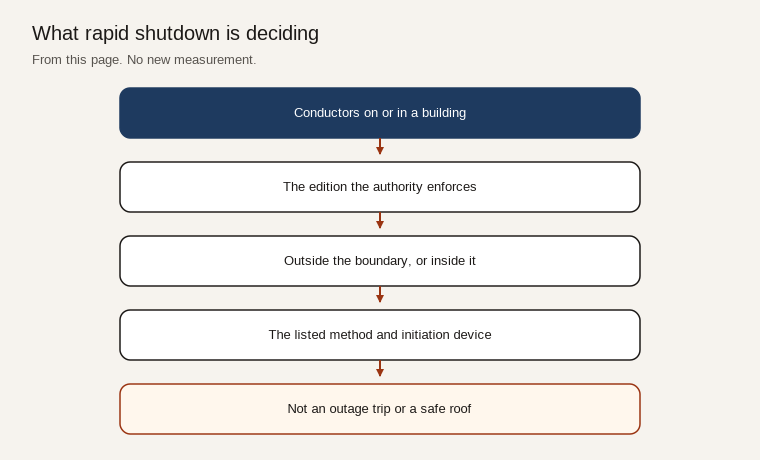
Decide the adopted edition first, then whether conductors sit outside the array boundary or inside it, and whether the listed method and its initiation device are what the edition names, not a grid outage or an ordinary disconnect.
| Distinction | What the page already separates |
|---|---|
| Purpose | Shock hazard for firefighters, where the adopted code requires the function |
| What starts it | An initiation device, not sunset, a blank portal, or a utility failure |
| Where it applies | Conductors outside the array boundary, apart from connections that stay inside it |
| What the listing covers | A system or a combination evaluated together, not a communications logo alone |
| What it leaves energized | The cells can still generate, and a battery or backup path is a separate source |
What solar rapid shutdown is for
A photovoltaic module produces voltage while light reaches the cells. Opening a breaker, or losing the utility, does not turn that source off. Direct-current conductors that stay energized can shock a firefighter who is cutting, ventilating, or moving hose across a roof. The U.S. Department of Energy’s guide to fire safety with solar systems, updated February 21, 2025, and read as of November 2026, names the hazards: shock from live components, including current through water, mechanical and thermal stress on module glass, and slippery roof surfaces.
That guide says shutdown in accordance with the National Electrical Code is intended to protect consumers and first responders, and that labeling should identify photovoltaic lines and component locations. It does not say the array is safe to touch, or that an owner should operate equipment during a fire.
NFPA 70 is the model electrical code. As of November 2026, NFPA’s development page identifies the current edition as 2026 and says the Code is enforced in all 50 states. That sentence is not proof that every state enforces the 2026 edition. The same page does not display the rapid-shutdown clause. The text that matters is the edition the authority having jurisdiction has adopted, including local amendments.
What initiates rapid shutdown
The function starts when its initiation device operates. It does not start because the sun sets, the monitoring portal goes blank, or the utility fails. The device and its location come from the adopted edition and from the equipment instructions.
For the 2026 edition only, NFPA issued Tentative Interim Amendment 26-2 on section 690.12(C). The file, issued August 20, 2025, effective September 9, 2025, and read as of November 2026, says that where circuits identified in 690.12(A) must meet 690.12(B), initiation devices meeting 690.12(C)(1) through 690.12(C)(3) are required. Subsection (C)(1) in that file says the devices are readily accessible and are one or more of the service disconnecting means, the photovoltaic system disconnecting means, or listed switches, as the rapid-shutdown equipment instructions specify. For one- and two-family dwellings, where a device is required, it is at an outdoor location. The file names (C)(2) and (C)(3) but does not print them. This amendment belongs to the 2026 document. It is not, by itself, the rule in Maryland, Virginia, or the District of Columbia.
Older editions also require an initiation device, with different wording. Drawings should show the device that edition allows and how its off position indicates that shutdown was initiated. Operating the device requests the function. It is not a voltage measurement, and this page does not give a test procedure.
Outside the array versus inside the array
The Code treats conductors that leave the array differently from the short connections that stay among the modules. The dividing line is the array boundary. The sources read for this page use that term and do not print its dimension. The distance, and any rule for how far a conductor may run before it must be controlled, has to be read in the adopted edition. This page does not set that distance.
Two UL notes, read as of November 2026, show why one set of numbers cannot be reused across editions.
UL’s 2015 note, Photovoltaic Rapid Shutdown Systems, describes 2014 National Electrical Code section 690.12, Rapid Shutdown of Photovoltaic (PV) Systems on Buildings. As UL stated it, circuits on or in buildings needed a rapid-shutdown function when conductors of more than 5 feet were installed inside a building or extended more than 10 feet from the array. UL stated that controlled conductors had to be limited to not more than 30 volts and 240 volt-amperes within 10 seconds of initiation, measured between any two conductors and between any conductor and ground, and that the equipment had to be listed and identified. That is UL’s description of the 2014 model text. It is not a finding that a current Maryland, Virginia, or District of Columbia permit still uses those distances or that 10-second limit.
UL’s September/October 2019 note, PV rapid shutdown inside the array, says the inside-boundary requirements in 2017 section 690.12(B)(2) took effect on January 1, 2019. For conductors outside the boundary, the note describes a limit of 30 volts within 30 seconds under section 690.12(B)(1), and says series-string optimizers and DC-to-DC converters were often used to discharge inverter capacitors toward that limit. Inside the boundary, it describes one 2017 option: the array is certified or field labeled as a rapid-shutdown photovoltaic array and installed according to those instructions. The note states no inside-boundary voltage. The free NFPA page did not display the clause, so this article does not invent an inside-boundary voltage, time, or boundary distance for later editions. Confirm those figures in the adopted book. A single voltage quoted for the whole roof mixes the two regions.
Listings are part of the method
That 2019 note separates the hardware. A December 22, 2017 revision of UL 1741 addresses rapid-shutdown equipment and systems. Equipment in one category has to be combined with other equipment. A rapid-shutdown system is evaluated as a whole. An AC module investigated for the function can be identified at the UL mark. A module-mounted optimizer can carry its own certification and still need a further evaluation with the rest of the array before the combination is a system.
The same note says a SunSpec mark covers a communications protocol so different makers can share a language. UL stated that the protocol mark does not, by itself, meet the listing requirement in section 690.12 and is not a substitute for a UL 1741 rapid-shutdown certification.
On December 10, 2020, Underwriters Laboratories announced ANSI/CAN/UL 3741, the Standard for Safety for Photovoltaic Hazard Control. Read as of November 2026, the announcement says the standard evaluates functions that provide a reduced level of shock hazard from energized photovoltaic equipment, aimed at keeping firefighters out of hazardous current paths. The work followed firefighter research and a Department of Energy project with Sandia. UL 3741 evaluates a system. It is not permission to omit module-level devices, and not permission to rearrange racking, wire management, or the inverter outside the listed instructions. OSHA 29 CFR 1926.403(b)(2), read as of November 2026, states the employer-side version of that limit: listed, labeled, or certified equipment shall be installed and used in accordance with its instructions. The adopted edition and the authority having jurisdiction decide which path is acceptable on a given roof.
What rapid shutdown does not do
It does not set the cells to zero in sunlight. The cells can still generate. The function controls specified conductors, or it controls shock hazard in the way a listed system was evaluated. Damaged modules and wet equipment can remain hazardous. The Department of Energy guide still treats shock through water, glass, and footing as operational problems. This page is not a firefighting procedure and not a finding that a roof is safe to enter.
It does not replace arc-fault protection, grounding and bonding, overcurrent protection, or roof-access rules. Pathway widths and setbacks were not in the rapid-shutdown sources read here.
It does not erase workplace rules. OSHA 29 CFR 1926.403(i)(2)(i), read as of November 2026, says that except as that subpart requires or permits otherwise, live parts of electric equipment operating at 50 volts or more shall be guarded against accidental contact. That is an employer duty under the federal construction standard, not the rapid-shutdown acceptance test, not an array design voltage, and not permission for an unqualified person to handle a conductor below that level.
It does not open a battery or a backup inverter. A hybrid system can keep selected circuits energized after the photovoltaic conductors are controlled. Soleil’s guide to adding a battery to an existing solar system treats storage as another source, with its own disconnect and backed-up circuits.
How rapid shutdown differs from a normal disconnect
A disconnect opens the circuit at the switch. A DC disconnect at a string inverter opens that input. An AC disconnect opens the path toward the service. Either can be required and still not be rapid shutdown, which controls the conductors the adopted section identifies, including conductors that stay at module voltage in the sun unless equipment at the array changes their state.
The same hardware initiates the function only when the edition and the instructions say so. The 2026 amendment allows the service disconnect, the photovoltaic system disconnect, or listed switches, as those instructions specify. An older permit may name different devices. Calling the AC disconnect a rapid-shutdown switch is wrong until the listing and the adopted text agree.
Anti-islanding is separate. IEEE 1547-2018, read as of November 2026, covers interconnection with the utility system, including response to abnormal conditions and islanding. No clearing time appears there. An illustrative case: the utility drops, the inverter stops exporting, and the portal goes dark. That is a loss of production or communication. It does not show that the initiation device operated or that outside-boundary conductors met the adopted limit. Soleil’s guide on whether solar panels work in a power outage covers the outage. It is not the shutdown section of the electrical code.
Maryland, Virginia, and DC are not one edition
As of November 2026, the documents below do not put this region on one National Electrical Code edition. The permit official still has to confirm amendments and whether the work is new or an alteration.
Virginia is the most uniform of the three on these pages. The Department of Housing and Community Development’s codes page says that, effective January 18, 2024, Virginia adopted the 2021 I-Codes and the 2020 National Electrical Code. The same date is in the historical notes to 13VAC5-63-10, which incorporates the 2021 International Building Code and lists 2020 NFPA 70 among the major referenced codes. This article did not find a Virginia amendment that rewrites rapid shutdown. Ask the local building official whether that 2020 text applies to the permit without a state change.
The District of Columbia Department of Buildings construction-codes page says the 2017 DC Construction Codes consist of the 2015 International Code Council family, the 2014 National Electrical Code, and ASHRAE 90.1-2013, as amended by Title 12 of the DC Municipal Regulations, effective May 29, 2020. Integrated copies can omit later amendments, and Title 12 is the official text. This article did not re-read Title 12. If the 2014 edition is still the one on the permit, use that edition’s rapid-shutdown language. UL’s 2015 description is background, not a substitute for the District’s official section.
Maryland is split. The Department of Labor Building Codes Administration matrix, dated March 18, 2026, has three electrical rows. The State Fire Marshal row lists the 2017 National Electrical Code, through the State Fire Prevention Code, for buildings other than modular and state-owned buildings, and marks that row not applicable to modular and state-owned buildings. The Department of Labor row lists the 2020 National Electrical Code for modular and state-owned buildings. A third row says ordinary-building electrical requirements are locally adopted. A separate fire-prevention row adopts the 2024 editions of NFPA 1 and NFPA 101, with stated exceptions for one- and two-family dwellings and for buildings in Baltimore City, citing COMAR 29.06.01.03. That exception does not state which electrical edition a house uses. The local official can.
What the AHJ checks
The plan should show the edition and any local amendment, whether the circuits are on or in a building under that edition, the initiation device and its labeling, the method outside the array boundary, and the method inside it. A listed hazard-control system needs the listing identity and the instructions for layout, inverter location, and wire management. Module-level equipment needs the evaluated combination of modules, electronics, and inverter, not three unrelated model numbers.
Moving an inverter, or splitting one array into several after the listing was chosen, can leave the paperwork describing a system that was not built. A qualified designer and the authority having jurisdiction decide that for the address.
What changes before equipment is ordered
The module, the electronics, the inverter, the racking, and the initiator are one package. An illustrative replacement: a different inverter is ordered while the optimizers were evaluated only with the original model. The new inverter may produce power and still sit outside the listed shutdown combination. That story is illustrative, not a Soleil project. Soleil’s guide to solar inverter replacement covers the hardware change.
This page does not price either path. Module-level hardware and a hazard-control listing constrain the job in different ways, and only the listing instructions show which way. In Maryland, permit steps are discussed in Soleil’s guide to the solar installation process in Maryland. Virginia and the District use their own paths.
Questions that change the scope
When is a ground mount or carport outside the rule?
Only when the adopted edition’s exception fits that structure. Some cycles treat circuits that are not on or in a building differently, and some address detached structures used to support photovoltaic equipment. The exception has to be read. A clearance slogan is not an exception.
Why can a communications logo fail an inspection?
UL’s 2019 note says a SunSpec mark documents a shared communications language. It does not, by itself, satisfy the section 690.12 listing requirement. The official is looking for the safety evaluation of the system that was actually installed, including the combination of parts.
Does a battery change what stays energized?
It can. Photovoltaic rapid shutdown does not describe the battery disconnect, the backed-up panel, or whether a hybrid inverter may keep forming a local supply. Those belong on a separate part of the drawing, next to the photovoltaic method rather than inside it.
What changes if only the inverter is replaced?
The shutdown listing may cover a combination, not the inverter alone. A new inverter can run the array and still fall outside the combination that was evaluated. Confirm that before purchase, and confirm whether the repair is judged under a newer edition than the original permit.
Match the method to the edition before ordering
For a home in Maryland, Virginia, or Washington, DC, Soleil Energy can carry that constraint into residential solar design: the roof assessment, equipment selection, permit documents, and electrical installation. The edition sets the duty, and the listing sets which combination of modules, electronics, inverter, and mounting hardware performs it. Bring the address and any existing inverter or optimizer model numbers. The conversation can sort compatibility against the local edition. It cannot declare the building compliant, and it cannot supply a voltage limit that was not read in the adopted code.
Project requirements depend on the site, equipment and applicable rules. Confirm design and installation decisions with the appropriate qualified professional.