Solar shading analysis is a site-specific study of how objects block sunlight from a photovoltaic array, and of how that blockage changes the electricity the array can be expected to produce. It separates distant horizon blockage from nearby shadows, and it separates lost sunlight from the electrical effect inside the modules and strings. The result is an input to an energy estimate. It is not a roof approval, a permit, or a single loss percentage that applies to every house.
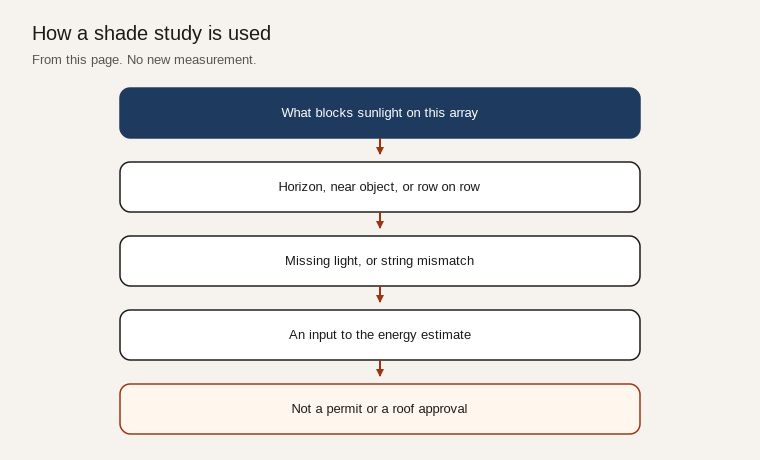
Separate a far horizon, a nearby shadow, and row-to-row shade, then separate missing sunlight from the electrical effect in the string, before treating the result as an energy input rather than a roof approval.
What the study is measuring
Sunlight at a module is not one quantity. Models usually split it into beam irradiance from the solar disk, diffuse irradiance from the rest of the sky, and a smaller ground-reflected part, often called albedo. An object can hide the sun while the module still receives light from open sky.
Zenith and azimuth depend on the date, the time, and the location. The National Laboratory of the Rockies publishes a solar position algorithm for those angles. In the northern hemisphere, a Department of Energy design overview, last updated July 8, 2022, describes the highest annual energy for modules pointed due south and inclined at local latitude, and says the mounting angle also depends on the structure and the electrical load. A house roof usually fixes tilt and direction. The study asks what still reaches that plane.
Solar access is the share of sunlight still available after obstructions, for the year or by month. A Pacific Northwest National Laboratory site guide, last updated May 9, 2014, describes instruments that report annual sunlight available and monthly solar access. That share leaves tilt, azimuth, temperature, soiling, snow, equipment limits, and the weather file outside the number. A clear north-facing plane can post a high access figure and still receive less sun than a south-facing plane with a modest tree.
Horizon blockage and a nearby shadow are different
A distant skyline
PVsyst’s shading documentation calls far shading a horizon line, elevation against azimuth over the sun path, for objects far enough that the sun is either visible to the whole array or hidden from it. The rule of thumb is a distance greater than about ten times the PV field.
The horizon documentation treats the beam as a switch. It finds when the sun crosses the line and weights that hour’s beam. Diffuse light is reduced by the sky the plane can no longer see, and that reduction stays constant through the year. The model reduces ground-reflected light as the horizon rises, and a nearer obstacle may justify treating albedo as absent. The pages say the real scene is more complicated than those assumptions. PVsyst drops a profile whose heights are all under 2 degrees. That cutoff is in the software, and the profile describes only the place it was taken. A nearby oak belongs in the near-shade scene.
A shadow that covers only part of the array
Near shading is the chimney, parapet, dormer, neighboring house, or tree over the roof. PVsyst defines the shading factor as shaded area divided by the sensitive area of the field. One sun position can cover a few modules and leave the rest in full sun, so the work needs a three-dimensional scene. Diffuse and albedo reductions from that scene stay constant through the year, while beam shade changes with the sun. Reporting only one of those leaves the other part of the hour out.
Rows that shade one another
Self-shading is one tilted row on the row behind it. The ground coverage ratio is array area divided by the ground or roof area the array occupies. On the PVWatts calculator page, website version 8.7.4, one-axis trackers take that self-shading from the ratio, and the page says not to enter it again as the shading-loss percentage. For fixed arrays the page points to a graph of shading loss against the ratio at about 35 degrees north. That curve is not a survey of a local tree.
On the System Advisor Model forum on January 26, 2022, Paul Gilman limited the ratio to rows that can shade one another. Modules in one plane, as on a typical sloped house roof, do not shade one another. On a flat commercial roof, row spacing is the question, and a parapet tree can still be a second source. The PVWatts Version 5 manual reduces both beam and diffuse light on the shaded fraction of each one-axis row. Its backtracking option is aimed at avoiding that shade, and its two-axis algorithm assumes no shading.
Lost sunlight and lost power are not the same quantity
Power does not have to fall in proportion to the shaded area. In a string, current is limited by the weakest cell. PVsyst splits the beam effect of near shading into an irradiance loss, also called the linear loss, and an electrical loss from mismatch. In the near-shading procedure, the linear result is a lower limit because it ignores the electrical effect, and a string-based factor is described as a higher limit. A setting between those limits, or a calculation that uses the module layout, is a statement about that wiring.
In NREL/CP-5J00-64570, a 2015 paper by MacAlpine and Deline, a detailed tool predicted an annual shade loss of 21.1% for a representative 3 kW array with two large trees in Denver, against 13.8% for the linear estimate, while a representative 18 kW array with regular row-to-row shade was closer, at 15.8% and 14.5%. That comparison used one polycrystalline module treated as representative of conventional crystalline-silicon residential modules, with up to eight parallel strings on a central inverter, so it is not a result for every cell technology. A tree across part of one string can remove more energy than the shaded patch suggests, because those modules set the current for the modules wired with them. The Department of Energy overview notes that a microinverter lets each module operate more independently when some modules may be shaded. The shade is still on the cell.
What should change in the layout and the energy estimate
The PNNL guide asks for a year-round prediction of shade from chimneys, dormers, trees, antennas, and similar objects, taken where the modules will sit, including the corners and the top and bottom, because one part of the array can be shaded when another is not. A driveway photo is the wrong sky. Modules can leave the worst corner or move off a chimney’s afternoon path. On a flat roof, spacing and tilt trade winter self-shading against capacity, and this page cannot assign that spacing. One untouched shade entry for the whole roof means the layout never entered the estimate.
Two PVWatts descriptions, both online as of November 2026, disagree on that untouched entry. The Version 5 manual says the default shading loss is 3%, that it represents horizon blocking on systems described as unshaded, that nearby trees or structures need a higher value from shading software or an on-site survey, and that these losses are a percentage of direct-current energy. The calculator’s category text says the shading default is 1% and that it stands for little or no shading, while that same page displays an estimated total system loss of 14%. A separate system-losses help page still lists shading at 3% inside a stack that multiplies, rather than adds, to that 14% total. Inverter efficiency and temperature sit outside that shade percentage. Read the shading input on the run in front of you. None of those defaults is this roof. The calculator warns that predictions reflect the site only as far as the inputs do, and its roof polygon ignores tilt, azimuth, and shading.
Illustrative arithmetic, not a site estimate and not a Soleil project. An unshaded model of one roof plane, using one weather file, produces 9,400 kilowatt-hours in a year. A study returns one annual solar-access fraction of 0.86. Multiplying gives 9,400 times 0.86, or 8,084 kilowatt-hours. The step assumes every hour lost the same share of sun. A chimney on summer afternoons, or a tree on winter mornings, does not work that way.
In that 2015 paper, small differences in tree size or placement changed predicted annual output by several percent, sometimes by more than the gap between models, and, after small moves of trees that were hard to place from pictures, monthly errors of up to about 10% in a month still cancelled into a closer annual figure.
How the study is made, and what it leaves out
The 2014 PNNL guide illustrates a reflective dome over a sun-path chart and a fisheye photo with the sun path overlaid. Both must be leveled, aligned to true south, and used at the height of the proposed array. They are 2014 method examples, not a required brand. Ask where the sky was recorded, which months the path covers, and which modules that point stands for. The same trees in both a horizon profile and a near-shade scene are counted twice.
A January photograph misses a July canopy, and a July photograph misses bare branches, so the file should name the canopy it used. The 2015 paper notes that trees grow or are removed later, and the PNNL guide says future landscaping and construction should be planned so they do not spoil the resource. When the solar disk is behind a tree, beam on the shaded modules drops, and the open sky does not go dark. Zeroing the whole hour overstates the loss. Ignoring diffuse light the crown also blocks understates it.
When a study is worth doing
Match the effort to the decision. Obvious trees, a crowded roof, a clash between an aerial image and the yard, or several tilted rows on a flat roof can change the module count, the stringing, and the energy estimate. A broad, clear south plane may need a horizon check and a note on future growth, not a dense model of empty sky.
Dividing annual use by a default yield has not mapped the roof. Soleil’s guide to how many panels a house needs says its worked examples are not a shading study, and it treats shade, direction, roof area, and any utility size cap as later limits. Those caps vary by utility and year. Soleil’s commercial site checklist asks for a shade assessment and a layout apart from structure, electrical gear, and utility capacity.
Low output on an operating system can be weather, dirt, an inverter, the grid, or new shade. Soleil’s guide to a system that is not producing separates those causes. A design-time file does not diagnose a live array.
What the study does not approve
Permit and utility lists in Maryland, Northern Virginia, and the District of Columbia are set for the address. As of November 2026 they are not one regional rule, and this page does not cite a statute that requires or exempts a shade exhibit for every address there. A production model is not an electrical permit, a structural approval, or permission to operate.
What to ask for before you rely on the number
These questions expose assumptions. They are not a form every contract must use.
| Question | What a useful answer includes |
|---|---|
| Where and when was shade recorded? | Roof location, date, and whether trees were in leaf. |
| Which problem was modeled? | Horizon, near objects, row-to-row shade, or a stated mix, without double counting. |
| Was the loss only missing light? | Whether string mismatch was included, or the figure is an area fraction only. |
| Which surfaces have their own result? | Separate planes or rows, or the spread behind one average. |
| What did the energy model start from? | Weather file, tilt, azimuth, and the shade input that replaced any default. |
| What is outside the study? | Soiling, snow, faults, later growth, and a new building. Structure and electrical gear are separate. |
Nothing on this page is a tilt, a row pitch, a string length, or a loss percentage for a specific address. A qualified professional has to judge the roof in front of them.
Common questions
If solar access is high, is production settled?
No. Ask for the unshaded and shaded estimates on the same weather file, and keep soiling, snow, and equipment losses in their own lines. A high access figure on a weak orientation is still a weak starting point.
Does a winter visit miss a deciduous tree?
It misses the leaves, and it can still record shade from branches and from a low sun. In the 2015 paper, a south-facing Denver array with a chimney and a large deciduous tree to the southwest took most of its shade in winter, and a southeast-facing Boulder array was shaded on some mornings and, at times, in the afternoon by a deciduous tree to the south. Ask for the monthly pattern and for the canopy the file used.
Will module-level electronics erase the shade?
They can shrink the mismatch portion. They do not move the shadow. A 2012 NREL test on its OSTI record compared a microinverter with a string inverter on identical 8 kW arrays under a procedure meant to resemble residential rooftop shade, and production was 3.7% higher under light shading, 7.8% under moderate shading, and 12.3% under heavy shading, relative to the string inverter. A 2016 update’s abstract says the module-level products tested generally recovered 25% to 35% of the shading losses, and that the larger difference among trials was the number of parallel strings, not which product was tested. Neither figure is a credit for a new roof.
Output is already low. Is this the same study?
New growth can add shade the original design did not include. Weather, dirt, a dead monitoring link, and an equipment fault can look alike on a phone screen. Record which hours and which strings fell. A new shade model explains the sun path and does not, by itself, find a failed inverter.
Must Maryland, Northern Virginia, or DC projects use one shade tool?
As of November 2026 this page does not treat city, county, and utility lists as one regional rule. Ask the authority for that address whether a shade exhibit is required, and ask the utility whether the energy model must use a named method.
Start with the roof and the bill
Note which planes matter, where the trees and chimneys sit, and whether a commercial roof is one plane or several tilted rows. A recent bill shows the use an array would be compared with. It does not measure shade.
For a house, Soleil Energy’s residential solar work includes an assessment of roof layout, age, condition, and shading, together with the electrical panel and the bill, for homes in the Maryland, Virginia, and Washington, DC area described on that page. The site-survey guide explains what that visit is for, and that a production estimate is not a structural or electrical assessment. Bring the bill and a note of the obstructions already visible. A qualified designer still has to confirm the roof, the structure, and the electrical equipment in person.
Project requirements depend on the site, equipment and applicable rules. Confirm design and installation decisions with the appropriate qualified professional.