
Usable battery capacity is the energy a battery system can actually deliver under the limits stated for that measurement. Those limits include the permitted state-of-charge window, the power and temperature used for the rating, and the electrical point where energy is counted. It is not the nameplate energy, which identifies the battery on a different stated basis. Treating the two numbers as interchangeable misstates both backup duration and daily cycling.
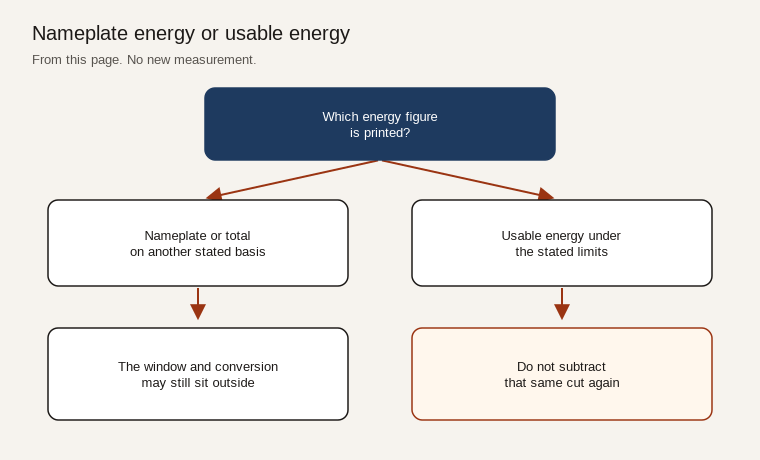
Nameplate energy and usable energy are different measurements, and a state-of-charge window or conversion loss already inside a usable figure should not be subtracted again.
Nameplate energy is a rating, not delivered energy
The Department of Energy solar-and-storage overview, updated March 31, 2025, describes energy capacity as the total that can be stored, usually in kilowatt-hours or megawatt-hours, and power capacity as the amount released at one time, usually in kilowatts or megawatts. The page states that storage is never completely efficient.
Nameplate, nominal, rated, total, and usable are labels, not one rule every sheet follows. The April 2016 federal performance protocol, PNNL-22010 Revision 2, calls accessible energy at the AC terminals, at the beginning of life and at the end of life, rated discharge energy. Stored energy there is rated power times the discharge time at that power.
Ampere-hours are a third quantity. In the December 2023 Federal Energy Management Program method, Walker and Desai say rated capacity, in kilowatt-hours or megawatt-hours, is often estimated as ampere-hours times nominal voltage. The method lists that voltage as DC, so the product is not energy measured at the AC terminals.
One product family does not keep one label. An Australian Powerwall 3 installation-manual page for a 230-volt, 50-hertz system lists total battery energy of 14 kilowatt-hours and usable battery energy of 13.5 kilowatt-hours, both at 25 degrees Celsius, beginning of life, and 3.3 kilowatts of charge and discharge. A 2026 Ireland datasheet does not print the higher total. It lists usable AC battery energy of 13.5 kilowatt-hours as a minimum at the beginning of life, 25 degrees Celsius, and 5 kilowatts. The US limited warranty effective May 6, 2026 uses 13.5 kilowatt-hours as energy capacity on the initial installation date and publishes no higher total. The three pages are not interchangeable across grids.
Equal total and usable labels can still hide a reserve. Enphase datasheet DSH-00931-1.0, dated April 21, 2026, for model IQBATTERY-5P-1P-NA, lists total capacity and usable capacity as 5.0 kilowatt-hours each. Its supported-country line does not name the United States. A domestic-content ordering code on that sheet is not a country listing, and the installation-country edition still has to be confirmed.
Where the energy is counted
Cell energy, DC-bus energy, and energy at the AC terminals are different measurements. The April 2016 protocol places rated discharge energy at the AC terminals. When the system powers its own auxiliaries, the stored-energy test includes controls, cooling, fans, pumps, and heaters. Heating or cooling fed from a separate source enters a different round-trip equation.
Round-trip efficiency is not the usable-capacity line. The protocol defines it as useful output divided by input, including parasitic heating or cooling, reported against charge and discharge power. That April 2016 protocol repeats the routine at 75, 50, and 25 percent of rated power. The December 2023 method defines meter efficiency as discharged energy divided by charged energy over a long period. Because efficiency varies with temperature and rate, one average only approximates deployed operation.
One product can publish more than one efficiency. The April 2026 Enphase sheet reports 96 percent DC and 90 percent AC, the AC figure taken from AC to the battery to AC at half of rated power. The Australian manual reports 89 percent solar-to-battery-to-grid efficiency for a typical solar-shifting case, at the same 25-degree, beginning-of-life, 3.3-kilowatt conditions as its energy lines. The Ireland sheet reports 89 percent for a typical path from photovoltaic production through the battery to the home or grid, using the 5-kilowatt condition in its energy footnote.
The state-of-charge window is a product limit
State of charge estimates how full the battery is. Depth of discharge is the share of a stated capacity a cycle uses. Controls can stop short of full and short of empty.
The April 2016 protocol does not force a swing from 100 percent state of charge to zero. A discharge the manufacturer does not allow could compromise the system, so the test uses the manufacturer’s limits. Duration is discharge time at rated power between those limits. If power in that April 2016 test falls by 2 percent or more before the lower limit, counted energy stops at 98 percent of starting power.
The December 2023 method treats minimum state of charge as a controller setpoint that leaves charge in place to extend life. In the authors’ illustration, a withheld share of 20 percent covers a cycle from 20 percent to 100 percent state of charge and a cycle from 10 percent to 90 percent of rated capacity. Demonstrated capacity at 80 percent of rated capacity would then confirm the rating. That illustration reads meter data. It is not a reserve to copy onto a project.
Enphase note TEN-00031-2.0, November 2024, puts two reserves inside usable capacity: 2 percent state of charge as an extremely low safety limit, and 3 percent as a very-low shutdown level for the electronics and for starting a photovoltaic charge. On that November 2024 note, the ordinary cycle runs from 100 percent to 5 percent and a full cycle includes those reserves. With non-grid-forming Enphase microinverters from the IQ7 generation or earlier, or a third-party photovoltaic inverter, the note sets the shutdown level at 8 percent and the cycle from 100 percent to 10 percent.
An owner’s outage holdback is a further cut. This page does not assign one. Energy reserved for a grid failure is unavailable for ordinary cycling, and adding a cut the usable line already contains understates the sheet.
Do not fold the same loss in twice
When a line already says usable or accessible AC energy, ask whether conversion loss is inside it before applying another efficiency. Nominal or total cell energy usually still excludes both the window and that loss. The December 2023 method keeps efficiency and demonstrated capacity apart, then adjusts rated capacity for minimum state of charge.
An illustrative calculation separates the factors. Suppose stated battery energy, before any window, is 10 kilowatt-hours. A window of nine-tenths leaves 9 kilowatt-hours. A round-trip efficiency of nine-tenths also returns about 9 kilowatt-hours from 10 kilowatt-hours put in. The equal result belongs only to this example. Applying both to a usable line that already includes the window counts a cut the sheet did not make. The nine-tenths figures are teaching arithmetic, not a depth of discharge and not a reserve for a site.
Temperature now is not the warranty floor later
The Australian Powerwall 3 manual and the 2026 Ireland datasheet both list operation from minus 20 degrees Celsius to 50 degrees Celsius and say performance may be de-rated above 40 degrees Celsius. Both tie the energy line to 25 degrees Celsius at the beginning of life. Both describe a 230-volt system. Neither page is a US installation manual.
The April 2026 Enphase sheet lists charging from minus 20 degrees Celsius to 50 degrees Celsius and discharging to 55 degrees Celsius, with an optimum from 0 to 30 degrees Celsius. The Enphase footnote places full performance from 15 to 45 degrees Celsius while charging and from 0 to 50 degrees Celsius while discharging, and current can be reduced outside that band.
The April 2016 protocol also asks how performance changes with time and use. The US Tesla limited warranty, revision 2.6, effective May 6, 2026, covers listed Powerwall 2, Powerwall+, Powerwall 3, and Expansion part numbers bought from Tesla or a Tesla certified installer and installed in the United States, with energy capacity of 13.5 kilowatt-hours on the initial installation date and retention of 70 percent of that rated capacity at 10 years. Unlimited cycles apply to the row that warranty names as solar self-consumption or time-based control, and backup. Any application not listed there, or any combination that includes one not listed, keeps 70 percent at 10 years and adds a cap of 37.8 megawatt-hours of aggregate throughput measured at the battery AC output. A shortfall from operation outside the owner’s manual sits outside that warranty, and rights vary by state.
The same April 2026 Enphase sheet summarizes capacity above 60 percent for up to 15 years or 6,000 cycles, whichever is first, with restrictions. The installed contract controls. Neither the Tesla 70 percent row nor the Enphase summary above 60 percent is a universal end of life. The quotation should say whether its kilowatt-hours are beginning-of-life energy or a later warranty floor.
Power still limits that energy
Continuous charge and discharge power, in the April 2016 protocol, apply across the stated state-of-charge range without exceeding maximum operating temperature. Motor-start power lasting a few seconds does not set the runtime.
The Department of Energy page says solar and storage can provide backup power during an electrical disruption. Islanding and transfer equipment still have to be present. A grid-following battery does not keep circuits alive on its own. Soleil Energy’s guide on whether solar panels work in an outage separates ordinary grid-tied operation from backup equipment.
An illustrative runtime divides accessible energy by average power. It is not a load study. Ten kilowatt-hours at a steady 2-kilowatt load inside the continuous rating lasts 5 hours, and the same energy at 1 kilowatt lasts 10 hours. An 8-kilowatt load is not served by continuous power of 5 kilowatts, whatever energy remains in the battery. Holding back part of the 10 kilowatt-hours for an outage shortens the other uses by that amount. Auxiliaries and a temperature derate sit outside the example. Which circuits remain on is the subject of Soleil Energy’s whole-home battery backup guide. A facility peak needs enough usable energy for the length of the peak, apart from the bill mechanics in Soleil Energy’s demand-charge guide.
Compare quotations on one basis
| Question for the quotation | What a mismatch hides |
|---|---|
| Nameplate, nominal, total, rated, or usable? | The larger label may be cell energy. |
| DC energy or AC terminal energy? | Inverter loss and some auxiliaries sit between them. |
| Beginning of life, a later year, or a warranty floor? | A later floor is not energy available next month. |
| Which temperature and power? | The printed energy often belongs to one stated test. |
| Are state-of-charge limits already inside the number? | A second depth of discharge counts the window twice. |
| Are heating, cooling, and controls inside the test? | Battery-fed auxiliaries do not reach the building load. |
| What continuous power accompanies the energy? | Energy the inverter cannot move does not serve the load. |
| Which warranty, part number, and duty? | A throughput cap or exclusion can remove the retention row. |
On a retrofit, the existing inverter decides which rows exist. Some batteries include their own AC conversion. Others rely on a hybrid inverter, so AC energy belongs to the pair. Soleil Energy’s guide to adding a battery to existing solar covers that pairing. Soleil Energy’s commercial battery storage guide for Maryland is Maryland context, not a Northern Virginia or District of Columbia utility ruling.
What the number changes
Usable capacity is the energy a project can assign after those limits are named. A larger figure does not raise continuous power, a bus rating, or an export limit.
Fire approval is a separate document. UL 9540A tests thermal-runaway fire propagation and does not define usable kilowatt-hours. UL Solutions’ article, read on November 22, 2026, describes large-scale fire testing in the 2026 edition of NFPA 855, says an effective date of January 1, 2027, will be set for UL 9540A Edition 6, and says adoption of that 2026 NFPA edition will take time. It gives no nationwide energy threshold. The April 2026 Enphase sheet says the product was evaluated to UL 9540A, including reduced separation, under provisions it names in the 2021 International Residential Code, the 2021 International Fire Code, and the 2023 edition of NFPA 855. That is one manufacturer’s statement, not a finding that Maryland, Northern Virginia, or Washington, DC, has adopted those editions. As of November 22, 2026, the authority having jurisdiction and a qualified electrical professional determine the edition at the address.
Price per nameplate kilowatt-hour can buy less accessible energy, or a warranty duty that does not match the building. Compare price only after the rows match. This page does not estimate a bill, a price, or a time to recover cost.
Homes and businesses in Maryland, Northern Virginia, and Washington, DC, can request a battery sizing and compatibility assessment through Soleil Energy’s battery storage service. Useful inputs are the existing inverter and service equipment, the circuits that must stay on, the operating goal, and the datasheets under comparison. The assessment does not replace the warranty or the authority’s reading of the code.
Questions before a sizing decision
If the sheet prints only one energy number, is it usable capacity?
Not from the word alone. Ask whether it is cell or AC energy, which year it describes, and whether a state-of-charge reserve is already inside it. The Australian manual separates total from usable. The April 2026 Enphase sheet prints 5.0 kilowatt-hours for both and still describes reserves.
Should depth of discharge be applied again when the sheet says usable?
Only if the line excludes the window. The April 2016 test uses the manufacturer’s limits. The Enphase ordinary cycle already runs from 100 percent to 5 percent state of charge. A second percentage on that cycle double-counts the reserve.
Does round-trip efficiency shrink usable capacity?
It reduces energy delivered compared with energy stored. It does not automatically reduce a figure already defined as accessible AC energy. The Enphase 90 percent AC result, at half of rated power, and the 96 percent DC result use different boundaries. Match the meter, and apply the loss once.
Why can weather cut runtime while the warranty still has years left?
A present derate and a warranty floor are different dates. The May 6, 2026 Tesla warranty is a 10-year retention term under a named duty, with a throughput cap on the unlisted-use row. The Australian, Ireland, and Enphase documents allow output to fall outside stated temperature bands. The manual shipped with the unit controls that hardware.
Does more usable capacity change the permit?
It can, after the adopted code, the listing, and the site are known. The UL Solutions article checked on November 22, 2026, treats UL 9540A as fire and thermal-runaway testing, not as a definition of usable capacity, and it sets no universal energy threshold. Maryland, Virginia, and the District of Columbia do not share one adoption date.
What should two quotes show before prices are compared?
Each quote should name the energy figure, the AC or DC boundary, test temperature, test power, state-of-charge limits already included, auxiliary loads, continuous power, part number, and warranty duty. DC nameplate energy and AC energy inside a reserve are not the same delivered energy.
Project requirements depend on the site, equipment and applicable rules. Confirm design and installation decisions with the appropriate qualified professional.