
Demand response is a reduction in a customer’s electric energy use below the consumption that was expected, made because the price of energy rose or because an incentive payment was offered for using less. Federal tariff rules use that definition for wholesale markets. A facility still has to read the separate contract that calls the event, because a utility retail program and a PJM registration do not measure, pay, or penalize the same way.
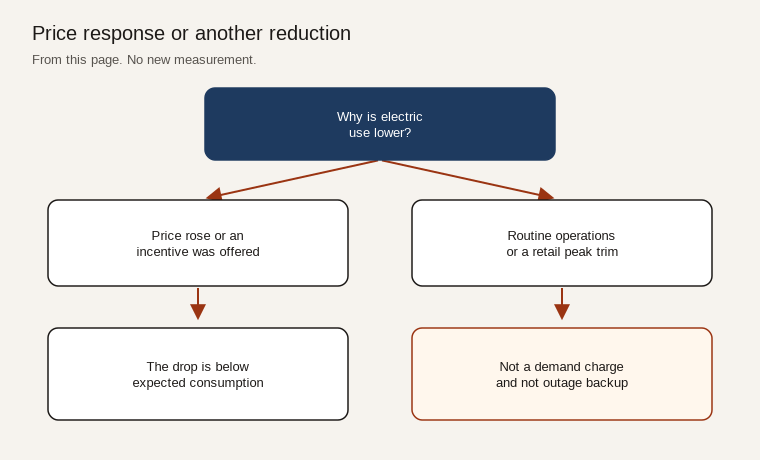
Use falls under this definition only when the drop is below expected consumption because price rose or an incentive was offered, and a routine peak trim or an outage plan is a separate decision.
Expected use is the reference point
The Federal Energy Regulatory Commission’s wholesale tariff rule, 18 CFR 35.28(b), defines demand response as a reduction from expected consumption in response to a higher energy price or to an incentive payment meant to induce lower use. A demand response resource is a resource capable of providing that reduction. This is the eCFR text read on November 22, 2026, with Title 18 shown as current through November 19, 2026. The eCFR is not the annual printed Code of Federal Regulations.
A closed building has used less electricity. It has not necessarily provided demand response. PJM’s fact sheet dated June 2, 2026 excludes normal operating patterns from demand response, and it limits energy-market pay to reductions that are not part of normal operations. Routine retail-bill management is not eligible.
PJM’s end-use overview applies the same line to a holiday closure and to a behind-the-meter generator run as normal practice to cut the retail bill. Peak shaving and other cost avoidance that would have happened anyway are normal operations, not a compensable energy-market benefit. The overview says the tariff and manuals control and may change, and the copy read on November 22, 2026, prints no revision date.
A daily afternoon peak trim can still be the wrong offer as economic demand response.
A demand charge, a price, and an event are different tools
Lawrence Berkeley National Laboratory describes demand flexibility as changing when power is used, or how much, to follow a price or a signal. Shedding drops load, shifting moves it, and modulating changes the level. Operators use demand response to shed load for economics or emergencies. That grid service is not automatically a line on a bill.
The Department of Energy’s demand flexibility page, updated October 26, 2026, separates a time-variable rate, a demand charge on the highest kilowatt demand in the billing cycle, and a demand response program that asks for a short-term decrease when reliability is strained or wholesale prices are high. Pay may be a discount, a bill credit, or other remuneration, sometimes for the commitment. The capability may be lower consumption, a behind-the-meter resource such as diesel backup or solar with storage, or both. Calling that decrease voluntary does not erase a penalty after a capacity commitment is accepted. How demand charges interact with solar and batteries is a billing question, not enrollment. One controller can cut a billed peak and never be registered.
What PJM buys, and who is paid
The end-use overview describes PJM as the wholesale operator for all or parts of 13 states and the District of Columbia, a footprint that includes Maryland, Virginia, and the District. PJM does not deal directly with the retail customer, and a PJM rule is not a utility retail schedule.
The June 2, 2026 fact sheet describes two paths, and a site may use both. Load management, Pre-Emergency and Emergency demand response, is a capacity commitment to reduce when required or take a financial penalty. Economic demand response joins energy and ancillary services when that is economic, and is dispatched much like a generator if its offer is below the marginal price. Entry is voluntary. Payment still requires qualification.
Most activity is in the Reliability Pricing Model. The fact sheet says a resource may be paid for a commitment as far as three years ahead and must perform or face a significant financial penalty. The end-use overview, which defers to the tariff, describes Capacity Performance as available any day from June through the following May, with a request that may have no stated duration limit, and with pay largely for availability in a delivery year from June 1 through May 31. A summer device credit is not that product, and the penalty formula is not in the summaries read here.
On the economic path, a curtailment service provider offers the reduction into the day-ahead or real-time market and may offer ancillary services over short intervals. The June 2026 sheet names Synchronized Reserve, Regulation, and Secondary Reserves. Where the tariff allows price-responsive demand response, 18 CFR 35.28(g)(1)(v) requires payment of the energy market price when the resource can balance supply and demand and when a Commission-accepted net benefits test finds the payment cost-effective. The overview says PJM uses a monthly net benefits price and assesses deviation charges when realized reductions differ significantly from dispatch.
PJM pays the curtailment service provider, which registers the capability and submits the load data. The customer’s share is a private agreement. As displayed on November 22, 2026, 18 CFR 35.28(g)(1)(iii) lets an aggregator bid customers of utilities above 4 million megawatt-hours in the prior fiscal year unless the retail regulator prohibits it, and allows smaller utilities only where the regulator permits it. Section 35.28(g)(12) separately requires distributed energy resource aggregations, at a minimum size no higher than 100 kilowatts, with metering and coordination rules of their own. A one-site registration is not that aggregation, and later orders may change how the products combine.
How capacity prices reach a retail bill is a charge on load, not a payment for being a demand resource.
Retail programs in this region are separate contracts
The pages below were read on November 22, 2026. They are not every tariff. Cooperatives, municipal utilities, and other investor-owned utilities can differ. Northern Virginia is not one utility, and a District account is not covered by the Maryland Pepco text.
Baltimore Gas and Electric’s demand response page describes residential programs under Rider 15 and Rider 26, Peak Time Rebate, used at high load or high wholesale prices. BGE pays the credit even when another supplier sells the energy, and it monetizes the reduction in PJM. Rider 15, filed November 18, 2025 and effective January 1, 2026, is device control rather than a large-customer curtailment contract: for residential direct-install air conditioning, closed to new entrants since April 1, 2020, it sets, as of October 1, 2025, 50 percent cycling, overrides twice a year but not during a PJM emergency, and a credit of $10 per device on the May through September bills that, with any enrollment incentive, cannot exceed the bill otherwise due, and for bring-your-own-device on residential schedules and Small General Service Schedules G and GS it states a credit of $10 per device on the cooling-season bills, year-round only where electric heat is confirmed. A customer in a supplier or curtailment-provider program monetized in PJM is not eligible for BGE demand response or peak-time rebate.
Pepco’s Energy Wise Rewards for Business cycles central air conditioners and heat pumps for Maryland commercial customers, nonprofits, and similar accounts. The overview places the season typically in June through October, usually three to six hours on weekday afternoons, with an expectation of five or fewer events in most years and no fixed cap, and it states an annual credit of $80, paid as $16 on each of the five monthly bills in that season, subject to change. Any metered Maryland business with a qualified unit may join, regardless of rate class, if it controls the thermostat, and a tenant needs certified landlord approval. A switch or programmable thermostat may override two events a year but not a PJM emergency, while an eligible smart thermostat may opt out even of a PJM emergency. Pepco says it cannot state how long a reliability event lasts. This is cooling control, not a District rule.
Dominion Energy Virginia’s targeted sector page lists two programs that exclude each other. Non-Residential Curtailment uses a load reduction plan, carried out by staff or by controls and checked with metering or an approved calculation, and the targeted sector page states that participants receive $36 per kilowatt per year, paid monthly from nominated kilowatts in quiet months and measured performance in events or tests, for medium and large customers, typically with at least 100 kilowatts of curtailable load, called 10 to 20 times a year. The account must be on standard general service and the rider the page calls C1A, and participants cannot also take other curtailment rates, such as Schedule 10, or peak-shaving programs such as PJM or the generator program.
On that same page, Non-Residential Distributed Generation commits owned or lease-financed backup generation of 200 kilowatts or greater for up to 120 hours a year, with at least 30 minutes of notice to the program vendor and events that typically last four to six hours, and it states a capability payment of $8.25 per kilowatt-month plus fuel and a variable operating payment, adjusted to what was delivered. That enrolled load cannot also sit in PJM demand response or in another curtailment program from Dominion, PJM, or any other party. Funding follows Virginia State Corporation Commission approval for a five-year period whose dates are not in the text read. The Department of Energy notes that some emergency generators are hour-limited and must meet federal, state, and local rules before they run.
Load reduction is not the same as export
PJM Manual 14H, revision 07, effective August 19, 2026, section 9.13, defines a demand resource as a resource that can reduce demand. An on-site generator that participates in wholesale markets as demand response should be read against Manuals 11 and 18. Any portion that may inject past the point of interconnection must use the interconnection process to participate in those markets.
18 CFR 35.28(b)(9) defines an electric storage resource as equipment that can take grid energy and later inject it back. A battery that only serves the building is changing import. Whether that counts depends on the program meter, the baseline in the effective manual, and the normal-operations rule. This page does not restate a baseline formula. Energy kept for an outage cannot also be offered. Ordinary grid-tied solar stops when the grid stops unless the inverter and storage are configured to island, as the Department of Energy’s solar and resilience basics, updated May 18, 2026, explain. Why panels usually stop in an outage is that design. A demand response call assumes the grid is still up.
The December 2023 battery evaluation method compares measured charge and discharge with stated performance. It treats peak shaving and load shifting as bill strategies. It also notes that charging 1 kilowatt-hour and discharging 1 kilowatt-hour inside one hour can net to zero on an hourly meter. If the settlement interval does not match the meter, the credited reduction will be wrong.
Controls that move setpoints, start a generator, or dispatch a battery are operational technology under NIST Special Publication 800-82, Revision 3, September 2023. A Revision 4 draft was in comment through November 30, 2026. The guide is not a finding about a site or about Soleil Energy. A qualified person has to assess the control path. This page sets no equipment settings.
What to lock down before sizing equipment
| Decision | Controlling document | Common miss |
|---|---|---|
| Who calls, and on what notice | Rider, plan, or curtailment agreement | Treating a price offer and a reliability call as one operation |
| Meter | Premises interval data, a device, or a calculation | Crediting discharge the baseline ignores |
| Overlap | Exclusivity clause | Stacking a device credit and a PJM registration |
| Duration | The product rules | Sizing for one hour when the call can run longer |
| Export | Manual 14H if power can cross the point of interconnection | Treating export as only lower import |
| Reserve | Loads that must stay served | Offering the whole battery to the event |
Commercial interconnection approves export. It does not enroll demand response, and a demand response registration does not replace it.
An illustrative hour, not a bill
This example is illustrative. It is not a Soleil Energy project, not an accepted baseline, and not a payment.
Expected import in the event hour is 800 kilowatts. After setpoint changes and battery discharge, the meter averages 550 kilowatts. If the program credited the full gap, the reduction would be 250 kilowatts, or 250 kilowatt-hours if it held for the hour, before losses and any reserve that could not move. A recharge of 200 kilowatts in the next hour can set the demand-charge interval even though the event hour met the target. If that battery already discharges every afternoon to manage the retail peak, the June 2026 fact sheet leaves the routine reduction outside energy-market compensation.
Start from the load record and the contract already signed
Soleil Energy’s battery storage work includes commercial systems and retrofits to existing solar, designed around the loads and the electrical connection. Where demand response is also in view, the useful step is a review of interval data and operating priorities: movable loads, circuits that must stay up, any agreement already signed, and whether the battery might export. Commercial storage in Maryland covers the related project discussion. The published service area is Maryland, Northern Virginia, and Washington, DC.
Questions facility managers ask
Is demand response the same as cutting a demand charge?
No. One prices a measured retail peak. The other, if it pays, pays for a reduction from expected use. Daily peak shaving can fit the tariff and still miss PJM energy-market compensation.
Can one reduction be sold to the utility and to PJM?
Only if that account’s contract allows it. As of November 2026, the BGE rider and both Dominion business programs read here forbid the overlap, and Pepco Maryland’s override right during a PJM emergency depends on the device. Do not assume a second enrollment is open.
Will a battery or generator count on its own?
No. Manual 14H separates a load reduction from injection past the point of interconnection, and the program still has to accept the meter and baseline. A generator also faces runtime, fuel, and permit limits. Outage reserve left in a battery is not spare capacity for the call.
Does participation carry the site through a grid outage?
No. The call reduces use while the grid is serving the site. Keeping selected loads up during an outage is a separate inverter, storage, and circuit design. A cycling credit does not create it.
What should be settled before equipment is purchased?
Settle the caller, the notice, the longest event, the meter, the exclusivity clause, the reserve that will not be released, and who may change a setpoint. If the battery might export, a qualified professional has to assess that site. This page is not a setting or an approval.
Who receives the money?
PJM pays the curtailment service provider, and the customer’s share is private. BGE and Pepco Maryland describe credits on the utility bill. Dominion’s generator program pays through its vendor. Compare those cash paths before comparing the posted rates.
Project requirements depend on the site, equipment and applicable rules. Confirm design and installation decisions with the appropriate qualified professional.